

📽️ Roswell Encina sat on a DC Metro train as masked Patriot Front members filled the car around him on July 4.
Roswell Encina was riding the DC Metro when the train car filled with masked members of Patriot Front.
He was alone. They were organized. The moment was photographed, circulated, and quickly became viral because the threat was visible before anyone needed to explain it.
Encina, a gay Filipino man and DC resident, later said he was terrified. He told reporters he tried to stay safe, avoid eye contact, and text friends so someone would know where he was and what was happening if the situation escalated.
In the NBC4 Washington video, Encina described the moment Patriot Front members boarded the train and said nothing really prepares a person for being surrounded that way.
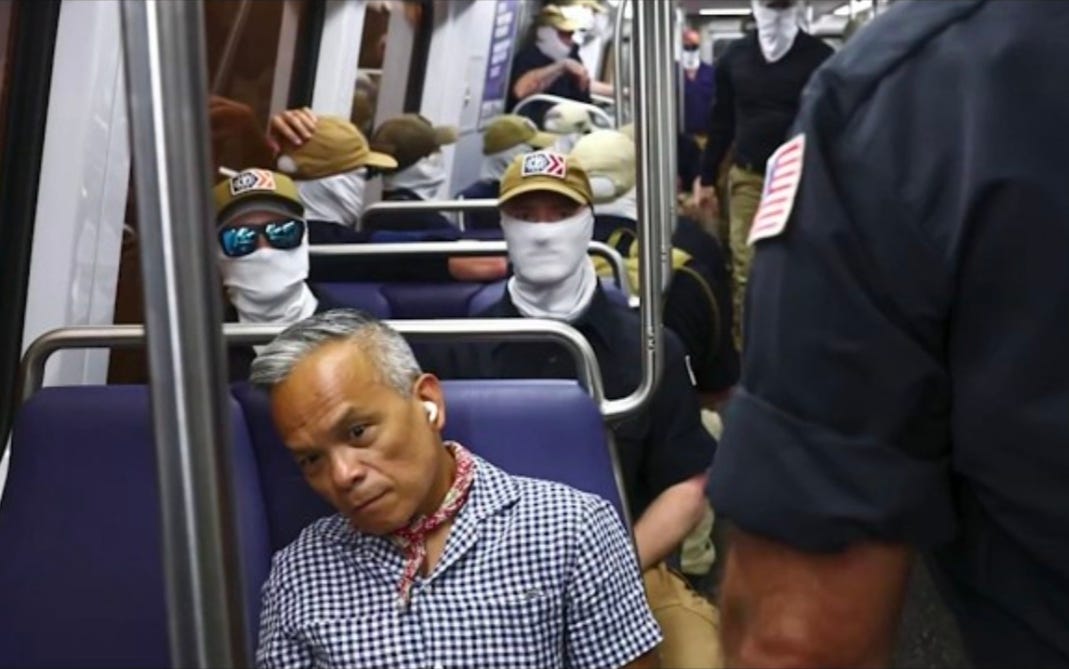
The center of this story is not the photo alone. It is what the photo showed: white supremacist intimidation making a targeted person feel surrounded, watched, and unsafe in ordinary public space.
Public transit is supposed to be ordinary infrastructure. People ride it to work, to celebrations, to errands, to home. Encina was on his way to an Independence Day celebration in Maryland when the car around him became something else: a contained public space filled by masked men from an organized white supremacist group.
The violence in that moment did not require a punch, a weapon, or a shouted threat to become real. The intimidation was already built into the formation. A gay Filipino man sat in a train car while masked white supremacists stood around him on the Fourth of July, moving through the nation’s capital under the language of patriotism.
The photo landed because it captured the contradiction without staging it. A man of color, an immigrant, a gay man, and an American citizen sat inside public transit while men whose politics are built around exclusion crowded the space around him.
Encina’s fear was not irrational. It came from reading the room correctly.
Patriot Front is not a neutral civic group. It is an organized white supremacist formation whose public actions are built around visibility, discipline, masks, banners, and spectacle. The point is not only to march. The point is to be seen marching. The point is to make targeted people understand that the threat has entered the street, the station, the train car, the public square, and the national holiday.
Organized intimidation does not always need direct contact to work. It changes the atmosphere around everyone the group marks as outside its vision of America.
Encina described the men as surprisingly civil among themselves. That detail makes the moment more disturbing, not less. White supremacist intimidation does not become harmless because the men are calm while they do it. A group can speak quietly, stand in formation, avoid direct confrontation, and still turn a public space into a warning.
The image went viral because it showed the quiet part clearly. White supremacy does not only operate through open violence. It also operates through presence, numbers, masks, and the message that certain people can be made to feel alone in a crowd.
For Encina, the fear was immediate. He was inside the train car, texting friends so someone would know where he was if the situation escalated.
The target does not have to be named by the group in that moment for the threat to be understood. A gay Filipino man does not need a white supremacist to point at him for the message to land. The politics of the group already tell him what he represents to them.
The Fourth of July setting matters. Patriotism is often treated as a costume, a chant, a flag, or a performance of ownership over the country. But Encina’s reflection after the incident cut in the opposite direction. He wrote about the promise of America, the work still required to protect it, and the need to keep widening the circle of liberty, dignity, and opportunity.
White supremacist spectacle tries to break that wider promise. It narrows belonging, turns shared space into claimed territory, and makes targeted people calculate their safety in places that should belong to everyone.
Encina’s story exposes that mechanism. The train did not stop being public transit because Patriot Front members entered it. But for the people their politics target, the space changed. Safety became calculation. Movement became risk assessment. A ride became a moment of survival thinking.
The harm is not small.
A society does not have to wait for physical injury before it recognizes intimidation. When organized white supremacists move through public space in masks, when they flood a train car, when a gay Filipino man feels compelled to text friends in case something happens, the danger is already present.
The question is not whether every person in that train car was physically attacked. The question is what kind of America is being performed when masked white supremacists can turn public transit into a stage for exclusion.
Encina’s image became viral because it showed the answer in one frame. It showed the country’s conflict over belonging inside a train car: one man trying to get through the day, surrounded by men whose movement is built around telling people like him that America is not theirs.
This cannot be reduced to a strange Metro encounter or a dramatic photo. It is a record of public intimidation. It shows how white supremacist spectacle uses ordinary spaces to send an extraordinary message: you can be surrounded here, too.
Roswell Encina should not be remembered only as the frightened man in the photograph. His own words named what the image captured: the situation was terrifying because the threat was designed to be understood.
A public train car became the scene of a national argument about who gets to move freely, who gets to feel safe, and who gets to claim America without being surrounded by organized hate.
Roswell Encina was not wrong to be terrified. The threat was the point.
White supremacist intimidation does not become harmless because it hides behind order, silence, or patriotic language.
This work documents anti-LGBTQIA+ harm, racist public intimidation, and the systems that let organized hate turn public space into a warning about who belongs.
Subscribe to support the work.