

Aurora Rush and Shae Sanders went to Cypress Black Bayou Park on May 31, 2026, expecting an ordinary summer day together. They met friends beside the water, shared food and tried to escape the Louisiana heat. They say they left the park with serious injuries, criminal charges and a fear that has followed them home.

According to their account, the danger began after Sanders used the women’s restroom. Rush says a man followed and harassed her, challenged her presence near the restroom and tried to provoke a confrontation. By the time Sanders returned, a crowd had gathered around Rush.
Rush and Sanders say people blocked their path, shouted anti-trans slurs, threatened them and prevented them from leaving. They describe an ordinary attempt to use a public restroom turning into group violence driven by strangers who acted as though they had the authority to inspect their identities, control their movement and punish them for existing in public.
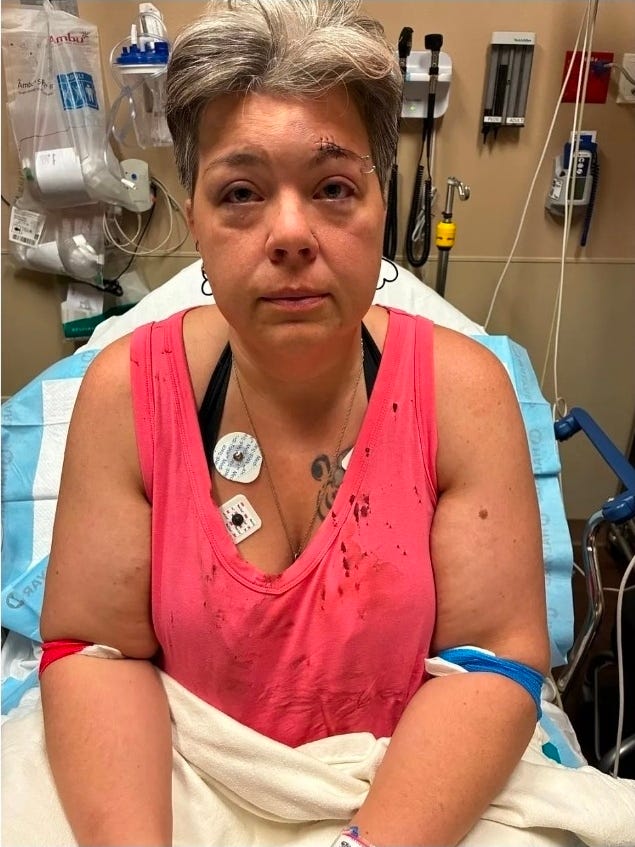
Sanders says they pushed through the crowd to reach Rush and tried to guide her away, but people continued blocking them. Sanders says they were knocked unconscious during the violence and later transported by ambulance. They required four stitches above one eye and reported a scratched cornea that left them unable to see from that eye for several days.
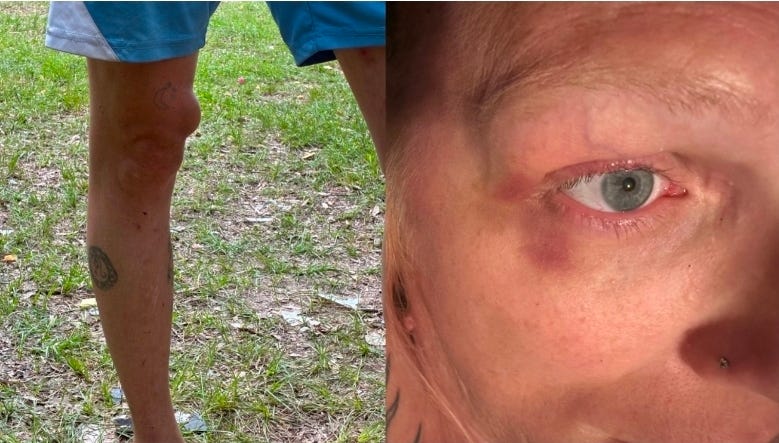
Rush reported a concussion and documented bruising around her eyes, scratches, contusions and severe swelling on her leg. Photographs published with Erin Reed’s reporting show visible injuries across her face and body.
The physical harm did not end when they left the park. Rush and Sanders have described chronic pain, migraines, mounting medical expenses and severe psychological trauma. Sanders said the experience changed them and left them frightened in a way they had never been before.
Instead of being permitted to recover from the violence they say they survived, both partners were charged with disturbing the peace. A publicly indexed booking record lists Rush under two provisions of Louisiana law: disturbing the peace by fighting and disturbing the peace through offensive or derisive language likely to provoke a disturbance. Reed reported that Sanders was also charged with disturbing the peace.
An ordinary violation of the cited Louisiana statute carries a maximum penalty of a $100 fine, up to 90 days in jail or both. The available public record does not establish how a court could treat multiple counts, and it does not explain what evidence deputies relied upon when they decided to charge Rush and Sanders.
That gap sits at the center of the police response. Rush and Sanders say they were surrounded, threatened and attacked by a crowd. Their injuries were visible, and Sanders required emergency treatment. Yet the public record available now places criminal charges beside the names of the injured partners without providing a comparable account of action against the people they identify as their attackers.
No public record located confirms an arrest, citation or charge against anyone Rush and Sanders accuse of attacking them. The visible record documents the couple’s criminalization while offering no comparable public evidence that the people they say harmed them faced consequences.
The Bossier Parish Sheriff’s Office owes the public a complete account of how deputies reached those decisions. Body-camera footage, dispatch records, witness statements and incident reports could show what officers encountered, whom they interviewed and what evidence they used. Those records could also reveal whether the alleged attackers were identified or investigated.
Rush says the state’s treatment of her became more degrading after her arrest. Despite the female marker on her driver’s license, she says deputies placed her in a men’s jail, subjected her to a search by a male guard and initially labeled her belongings with an unfamiliar male name before writing her legal name beneath it.
The publicly available record does not include the jail-classification, search or property documents that would confirm those details. Rush’s account describes government custody reproducing the same denial of her identity that accompanied the violence she described at the park: the jail placed her in a men’s facility and subjected her to a search by a male guard after she had already survived an alleged anti-trans attack.
According to Rush, the jail did not restore the safety she had lost. It deepened her vulnerability and added another institutional harm to the injuries she carried away from the park.
Rush has said she is angrier at the Sheriff’s Office response than at the people who attacked her because deputies added another layer of victimization. She and Sanders must now defend themselves in court while managing the medical and psychological consequences they say the original violence caused.
The state’s response converted survival into criminal exposure. The people who say they were trapped and beaten must secure legal representation, appear before a judge and face possible punishment within the same system that has not publicly explained whether the people accused of attacking them faced any action.
While Rush and Sanders contend with those charges, Bossier Parish officials are moving toward expanded restroom enforcement. The Bossier Parish Police Jury advanced a proposed ordinance governing restrooms, changing rooms and similar facilities in parish-operated buildings. Official materials show the proposal remained pending for a public hearing scheduled for September 2, 2026.
Local reporting says the measure would expand the authority of parish employees and law enforcement to confront people suspected of using a facility officials consider inconsistent with their sex. Refusing an order to leave could escalate the encounter into criminal enforcement.
The Bossier Parish Sheriff’s Office supports the proposed measure. Multiple police jurors reportedly attributed the request for the ordinance to Sheriff Julian Whittington after the incident involving Rush and Sanders. The available public record contains no direct statement or written request from Whittington confirming that he personally requested the ordinance, but juror Glenn Benton said the sheriff sought another enforcement tool because nothing was already “on the books” for him to use.
That reported explanation places the park incident and the proposed ordinance within the same public-record sequence. Rush and Sanders say strangers treated restroom access as permission to inspect them, confront them and enforce a gender boundary through violence. The proposed ordinance would not reproduce the alleged attack, but it would carry the underlying machinery of gender policing into parish government: identify someone as suspicious, challenge that person’s presence, demand removal and escalate resistance into police action.
Enforcing that policy would require public employees to decide who appears out of place. Someone would judge another person’s body, clothing, voice or presentation and decide that the person did not satisfy expectations about sex or gender. The accusation would create a government confrontation before any violation had been established.
The danger would extend beyond trans people. Any woman judged too masculine, any man judged too feminine or anyone whose appearance unsettles another person’s assumptions could be questioned, humiliated and ordered out of a public facility. For trans people, the threat is sharper because they are the intended targets of the political campaign surrounding restroom access.
The proposal would turn public suspicion into an official duty. Rush and Sanders already know what can happen when strangers decide they have the right to police another person’s gender. Their account begins with harassment near a restroom and ends with emergency medical care, criminal charges and Rush’s reported placement in a men’s jail.
Their local government’s response should have produced a transparent account of who harmed them, why deputies charged the injured couple and how Rush was classified in custody. It should have publicly accounted for what body-camera footage, dispatch records and investigative decisions show. Instead, parish officials are preparing to consider a policy that would create more government-backed confrontations around restroom access.
The proposed ordinance cannot be separated from the human consequences already surrounding this case. Rush and Sanders continue to live with physical injuries, trauma and court uncertainty. They entered a public park expecting an ordinary day together and left with their safety broken and their names entered into the criminal system.
Government had the power to protect them, investigate the people they say attacked them and account for every decision deputies made afterward. The public record instead shows Rush and Sanders facing charges while parish officials consider expanding the machinery that places trans people under suspicion.
Rush and Sanders’s case shows how anti-trans harm can deepen after the first act of violence—through arrest records, jail placement and policies that convert gender suspicion into government power.
Trans United follows those systems beyond the first headline, documents the decisions that expanded the harm and keeps the people targeted at the center of the record.
Upgrade to a paid subscription to support independent reporting that traces how public institutions turn prejudice into procedure and forces those decisions into view.
This is lunacy. There is very little humanity in the U.S. right niw.
This story is disgusting ! What the FUCK is wrong with people ?!?