

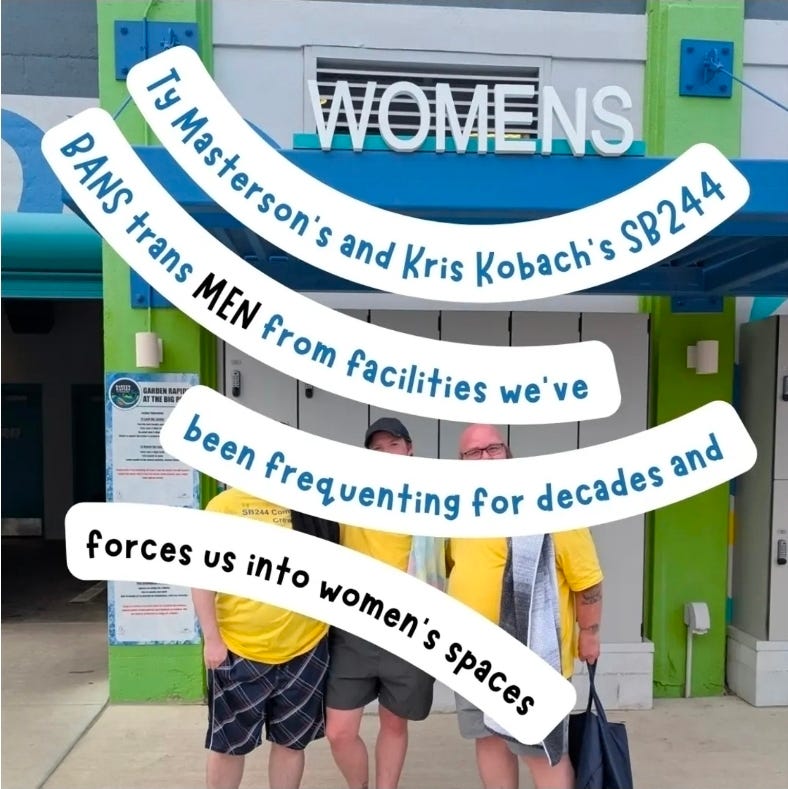
On August 8, transgender men wearing bright yellow “SB 244 Compliance Crew” shirts entered women’s restrooms and changing areas across Kansas to demonstrate how SB 244 classifies them in covered public facilities. Their action made the law’s rule visible: in covered public facilities, people who live and are perceived as men can be directed into women’s spaces because SB 244 classifies them as female there.
The men traveled through Emporia, Great Bend, Dodge City and Garden City, using women’s facilities in what organizers described as deliberate compliance with SB 244’s birth-sex rules. Some had used men’s restrooms for years without attracting attention, allowing the action to show what the law’s classification can require when legal sex and everyday public perception point in different directions.
Kansas requires multi-user restrooms, locker rooms, changing rooms and showers in covered government facilities to be designated by sex while defining sex according to biological sex at birth. For transgender men whose sex at birth was recorded female, those rules can place them in women’s facilities regardless of how they live, present or are perceived by people around them.
The Compliance Crew built its action around following that classification rather than defying it. By doing so, the participants shifted SB 244 from statutory language into the public spaces where transgender Kansans have to navigate its requirements.
Charles Osman described how uncomfortable that was. According to the organizers, he had used men’s facilities for years and felt nervous returning to women’s restrooms for the demonstration. Participants wanted Kansas residents to see what happens when transgender people subject to the law must choose between the spaces they ordinarily use and those assigned by the state’s birth-sex rules.
In Emporia, organizers say three demonstrators entered women’s restrooms at the Emporia Public Library, the Lyon County Historical Society museum and the David Traylor Zoo. They used the restroom, washed their hands and left. One library patron reportedly reacted with alarm and complained to staff, but the encounters ended without a larger confrontation.
Another group traveled through public aquatic facilities in Great Bend, Dodge City and Garden City. Organizers say the men changed in locked stalls, used women’s restrooms, washed their hands and left. In Great Bend and Garden City, the response was largely limited to confused looks and hurried exits.
The situation escalated in Dodge City. At Long Branch Lagoon, organizers say the presence of three visibly male transgender people in the women’s changing and restroom area prompted a manager to intervene, move children out of the area and call police. Organizers say the men explained that they were using the women’s facility because SB 244 classified them as female for that space.
According to the Compliance Crew, that conversation became intimate as the demonstrators described aspects of their bodies while explaining why state law classified them as female despite their appearance. The group also says the manager and responding officers told participants they had not heard of SB 244 or been notified of its passage.
SB 244 bases access on birth-sex classification without creating a general mechanism for strangers or public employees to inspect someone’s body. In Dodge City, organizers say that gap left participants explaining intimate details themselves when their appearance and the state’s legal classification pointed in opposite directions.
The Dodge City account shows how appearance can become the trigger for scrutiny. When someone is perceived as inconsistent with a sex-designated space, that judgment can escalate to management or police, leaving transgender people to explain why the state classifies them differently from how they are perceived.
Ray Vieux described another side of that enforcement problem. He said he could continue using men’s restrooms “under the radar” because people perceive him as a man and that he had already used men’s facilities after SB 244 took effect without being reported, even though the law assigns him elsewhere.
Vieux’s experience shows how legal compliance and practical enforcement can pull in opposite directions. Using the men’s room may attract no attention because strangers already perceive him as male, while following SB 244’s classification can make him more conspicuous by placing him in a women’s facility.
That choice carries legal consequences. SB 244 establishes an escalating structure beginning with a written warning, followed by a $1,000 civil penalty for a second violation and exposure to a Class B misdemeanor for a third or subsequent violation. Kansas law permits up to six months in county jail for a Class B misdemeanor.
The statute separately creates private civil liability, allowing an allegedly aggrieved person to pursue actual damages or $1,000 in liquidated damages, along with possible attorney fees and injunctive relief.
For transgender Kansans subject to SB 244 in covered public facilities, using the restroom that matches how they live and are perceived can create legal exposure, while following the state’s birth-sex classification can expose them to confrontation from people who perceive them as men in a women’s space.
SB 244 extends the same birth-sex framework into Kansas identification records, including driver’s licenses and birth certificates, restricting gender markers that conflict with that classification. Vieux has described fearing what it means to carry an “F” on identification while moving through the world as a man, even as SB 244 uses that same classification to determine where he belongs in covered public facilities.
Those identification provisions are already being challenged in court. In Doe v. State of Kansas, transgender plaintiffs are contesting SB 244 after licenses reflecting their gender were invalidated. The case began with two transgender men and later expanded to include additional plaintiffs. A request for a temporary restraining order was denied in March, and an evidentiary hearing on a temporary injunction is scheduled for September 29. As of August 11, the challenged provisions remain in effect.
Attorney General Kris Kobach has defended the law and argued that state identification documents should reflect what he characterizes as objective government facts rather than gender identity. Kobach has said compliance with the law is “perfectly possible,” and the Compliance Crew’s action demonstrated what that compliance can require when transgender men follow the statute’s classification into women’s facilities.
Senate President Ty Masterson has framed SB 244 around protecting women and girls and described the measure as restoring what he called sanity in Kansas. In covered public facilities, the law’s birth-sex rules can exclude transgender women from women’s spaces while directing transgender men into them.
The organizers emphasized that trans women bear the brunt of rhetoric portraying transgender people as male intruders in women’s spaces and of the scrutiny surrounding bathroom access. They said the Compliance Crew used trans men’s different position within that system to expose what SB 244’s birth-sex classifications produce in practice.
Theodore, a transgender man and case manager who participated in the action, said much of the hostility appeared after news of the demonstration spread online. He described seeing rape and violence threats, accusations that participants were pedophiles and anti-trans conspiracy rhetoric aimed at the group, while describing himself as a father trying to keep his children safe.
Ray Vieux, Charles Osman, Theodore and the other participants carried SB 244’s birth-sex classification into facilities across Kansas in what organizers described as compliance with the law. In Dodge City, organizers say that compliance escalated into a confrontation with management and police that required the men to explain why the state classified them differently from how people perceived them. Their August 8 action made the law’s consequences visible by forcing them to live through the conflict its classifications create.
The August 8 action exposed one part of SB 244’s machinery. The same law also reaches identification documents, civil penalties and criminal exposure, while an ongoing court fight challenges its identification rules.
Trans United follows those laws after passage, documents how enforcement reaches real people and keeps the consequences visible long after the legislative vote is over.
Upgrade to a paid subscription to support reporting that traces anti-trans policy from statutory language into the lives of the people required to live under it.
How brave and noble!!!
Makes the point very clearly. Tough to arrest anyone for following the law.