

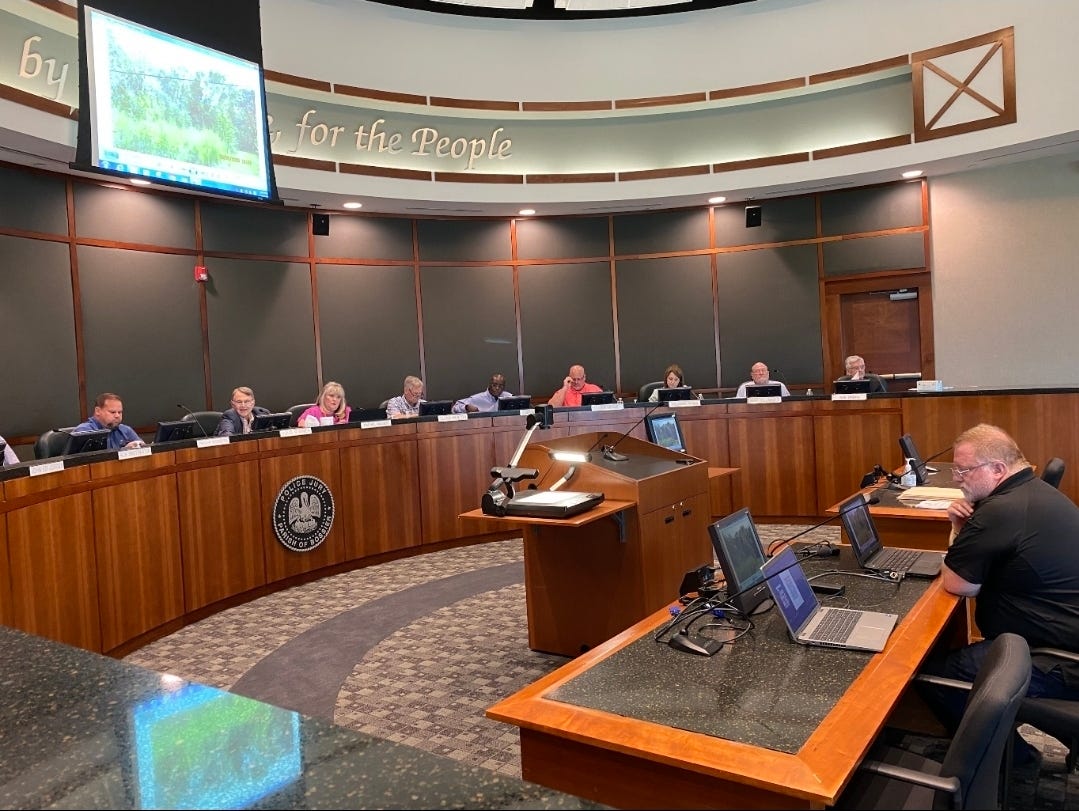
Bossier Parish officials are moving to criminalize transgender people for using restrooms, locker rooms, and changing rooms on parish-owned property. The proposed ordinance would turn public employees into frontline gender enforcers and expose people accused of repeated violations to fines and as much as six months in jail.
The Bossier Parish Police Jury advanced the measure on July 15, according to local reporting. It would apply to parish-controlled facilities such as libraries, parks, courthouses, government offices, restrooms, locker rooms, and changing areas. The proposal does not cover schools, private businesses, or property controlled by state or federal agencies because those facilities fall under different authorities.
The reported penalty structure escalates with each violation. A first offense could bring a fine of up to $250. A second could bring a fine of up to $500 and as many as 30 days in jail. A third or subsequent offense could bring a fine of up to $500 and imprisonment for as long as six months.
Those penalties would transform an ordinary trip to a library, courthouse, park, or public office into a potential criminal encounter for transgender residents. A person could enter a restroom, be challenged by an employee who believes they do not belong there, be ordered to leave, and face escalating criminal penalties if found in violation again.
The ordinance reportedly directs any parish employee who observes what the policy defines as a violation to ask the person to leave the facility designated for the “opposite biological sex.” That instruction makes municipal workers responsible for enforcing a sex classification they cannot reliably determine by looking at another person.
A librarian, maintenance worker, courthouse employee, or parks worker cannot see someone’s chromosomes, reproductive anatomy, medical history, or reproductive cells. They cannot know what appears on a stranger’s birth certificate. Under this system, enforcement would begin with appearance, suspicion, and another person’s assumptions about whose body belongs in a public space.
The proposal reportedly imports its definition of sex from Louisiana’s 2024 Women’s Safety and Protection Act. That state law defines sex through reproductive biology and refers to the reproductive gametes a person has, had, will have, or would have absent a developmental or genetic anomaly or what the statute calls a “historical accident.”
That statutory language does not create a practical method for enforcement inside a restroom. It instead gives legal authority to a category that employees and police cannot verify through ordinary observation. The result is a system in which gender presentation becomes evidence and anyone who does not match another person’s expectations can be challenged.
Police Juror Jimmy Cochran reportedly told Erin in the Morning that a birth certificate could establish a person’s “biological sex.” People do not ordinarily carry birth certificates while visiting a park, borrowing a library book, attending court, or using a public restroom. When asked what would happen if someone were wrongly arrested because another person misjudged their sex assigned at birth, Cochran reportedly answered that the court system exists to resolve such disputes.
That response places the burden of government error on the person targeted. Confrontation, removal, police contact, arrest, legal expenses, public humiliation, and possible detention could occur before the accused person ever receives an opportunity to challenge the government’s judgment in court.
The proposal was also reportedly developed with the involvement of Bossier Parish Sheriff Julian Whittington. Police Juror Glenn Benton said the sheriff wanted an ordinance because there was no existing law authorizing his office to act against people using these facilities.
“There was nothing on the books for him to do as law enforcement, so that’s why he asked us to do it,” Benton said, according to the supplied reporting.
That statement exposes the ordinance’s purpose. Bossier Parish is not creating a measure focused on assault, voyeurism, harassment, or other harmful conduct. It is creating a separate offense centered on who may enter a public restroom, giving law enforcement authority to intervene even when no such misconduct has occurred.
Benton reportedly defended the proposal by invoking men who might dress as women to enter women’s facilities and prey on others. That narrative treats transgender women as cover for hypothetical predators while offering no evidence that transgender people using restrooms consistent with their gender are creating the danger the ordinance claims to address.
The policy would punish identity and access rather than misconduct. A person would not need to assault, threaten, harass, expose themselves to, or record anyone to become subject to enforcement; their presence in the space, combined with an employee’s judgment about their sex, would be enough to trigger confrontation.
Transgender people would carry the immediate burden, but appearance-based policing does not stop with them. Trans men can be challenged in women’s restrooms when laws force them to use facilities associated with their sex assigned at birth. Cisgender women with short hair, masculine clothing, facial differences, or other traits that strangers read as insufficiently feminine can also be accused of being trans.
That is not a flaw outside the system. It is the foreseeable result of asking workers and police to determine sex through visual inspection.
For trans residents, the proposal would make access to basic public services conditional. A person appearing in court, visiting a government office, attending a parish meeting, taking a child to a park, or spending time at a library would have to calculate whether using the restroom could result in confrontation or police contact.
The ordinance would also conscript municipal employees into that harm. Workers whose jobs have nothing to do with policing bodies would be expected to observe patrons, decide who appears out of place, and initiate removal. The parish would turn public employment into an enforcement network for a policy built on personal judgment rather than verifiable conduct.
Bossier Parish’s proposal would create a parish-level criminal restriction for government property where Louisiana does not currently impose a comparable statewide bathroom ban. The state’s 2024 law supplies the biological definitions, while the parish ordinance would attach those definitions to direct confrontation and escalating punishment.
A final vote has been reported for August 5, 2026. The parish had not yet posted the complete ordinance record or final language.
Before that vote, parish officials owe the public direct answers. They should identify the conduct that supposedly requires a new criminal law, explain how employees are expected to determine another person’s sex, disclose how wrongful accusations will be prevented, and account for the harm imposed before an accused person ever reaches court.
They should also explain Sheriff Whittington’s role in developing the measure and why law enforcement requested new authority over restroom access rather than relying on existing laws against actual misconduct.
Bossier Parish is building a system in which government employees judge strangers’ bodies, police can escalate those judgments, and transgender people face fines or jail for entering ordinary public spaces. Telling someone to seek justice later does not erase the removal, arrest, expense, fear, or humiliation already inflicted.
The Police Jury’s August vote will determine whether that machinery becomes parish law. The officials casting those votes will own the enforcement system they create—and the foreseeable wrongful targeting that follows from it.
Bossier Parish is not acting alone. Across the country, local officials are turning anti-trans fear into policy, enforcement, and criminal punishment—often before the public understands what is being built.
Upgrade to a paid subscription to help Trans United follow these measures from proposal to enforcement, name the officials responsible, and document what happens to transgender people when political targeting becomes law.
This makes me think of the W. Bush administration saying we can sue after a corporation gives us cancer.