

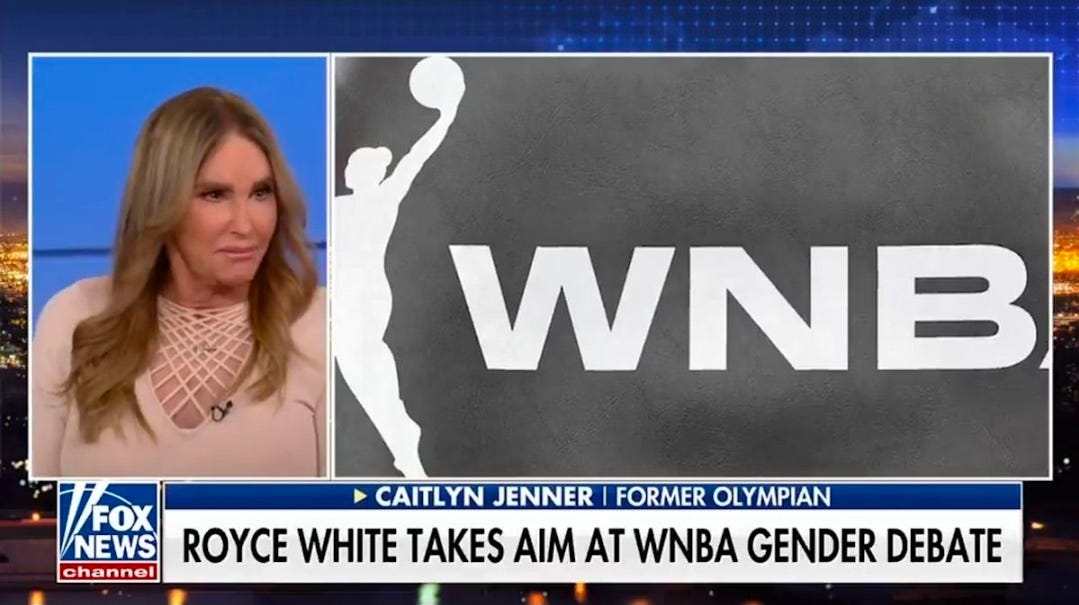
Trans women are being made the subject of a national fight inside professional basketball without a trans woman actually creating the WNBA eligibility crisis being invoked. No transgender woman has played in the league to date, and the WNBA said this week that there are “no immediate eligibility matters affecting the WNBA.” Yet trans women have again been positioned as a threat requiring exclusion, ridicule and increasingly aggressive public scrutiny.
Caitlyn Jenner joined that fight this week, backing former NBA players Enes Kanter Freedom and Royce White after both announced plans to enter the 2027 WNBA Draft while invoking female or transgender identity as part of the stunt. Appearing on Fox News, Jenner praised their actions as exposing what she called “hypocrisy” and argued for a chromosome-based eligibility standard, declaring, “XX, you’re in; XY, you’re out.” Their declarations made gender identity central to the argument, while trans women became the target of the controversy surrounding it.
Kanter Freedom and White are not current WNBA players facing an unresolved eligibility decision, and the league has not established that either would become eligible simply by making those declarations. The WNBA’s collective bargaining agreement limits participation to women, but the public record does not support treating either man’s interpretation of eligibility as settled league policy. Their stunt creates a hypothetical challenge and presents that challenge as evidence of a problem.
The people targeted by that hypothetical are real. Trans women are being discussed as a threat to women’s basketball while their identities are used to argue for harder exclusionary rules. The controversy is being amplified by public figures using trans identity to argue for exclusion and to mock the league rather than by trans women competing in it. The WNBA responded by stating that there were no immediate eligibility matters affecting the league and condemning “bad-faith efforts” to use these subjects to demean or marginalize others.
The controversy had already been developing before Jenner’s appearance. Indiana Fever guard Sophie Cunningham publicly supported restricting transgender girls and women from girls’ and women’s sports, bringing the issue further into the league’s public discussion. Other WNBA figures responded with support for trans people, but Cunningham’s comments added another prominent voice to calls for exclusion.
Kanter Freedom and White then escalated the spectacle by announcing their draft plans and tying them to gender identity. Jenner’s endorsement gave those declarations another national platform and treated them as proof of a contradiction inside the league. The record supports a narrower conclusion: the stunt generated attention around a hypothetical eligibility scenario by making gender identity central to it.
That distinction is central to the harm documented here. The spectacle presents trans women as a category requiring exclusion and turns their legitimacy into the subject of public scrutiny. Their identities are being invoked by others, their place in women’s sports is being publicly challenged, and a hypothetical scenario is being used to demand harder boundaries against them even though no trans woman is currently driving the eligibility dispute being invoked.
WNBA Players Association president Nneka Ogwumike has warned against political agendas being attached to women’s basketball in ways that marginalize communities that have long supported the league, including transgender people. Her warning adds an internal league voice to the record of concern over how political fights surrounding women’s basketball can turn marginalized communities into targets.
Jenner’s endorsement adds another prominent voice to that pressure. Kanter Freedom and White’s declarations use gender identity to challenge the league, while Jenner’s response treats the stunt as evidence that harder exclusion is necessary. The result is a public controversy in which ridicule and exclusion are directed at trans women even though they did not create the dispute being used against them.
Trans women should not have to appear on a WNBA roster for the harm directed at them to count. The current record is enough to show what is happening: a hypothetical eligibility dispute has become a vehicle for ridicule and exclusion directed at trans women, while the league itself says no immediate transgender eligibility matter exists.
Trans United documents the rhetoric, policies and systems shaping trans survival — and keeps that record visible when the headlines move on.
Upgrade to a paid subscription to support independent reporting and accountability work.
I used to have respect for her when she was an athlete and several years after that because she didn't announce that she was a Republican and didn't really seem like a Republican but now since she's become trans she seems to be all over the map.