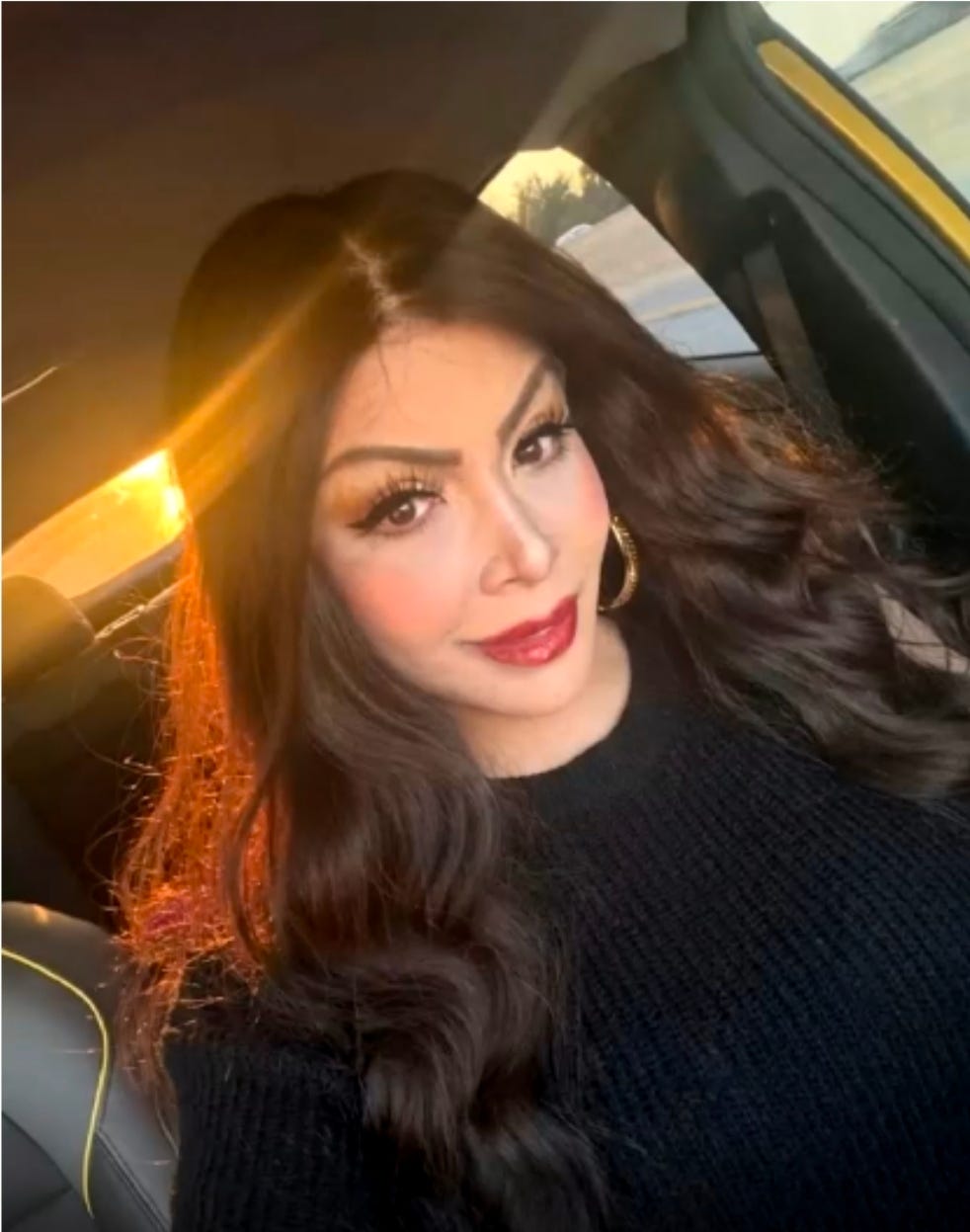
Daniella Analee Escobedo, a Latina Trans Woman Killed in Las Vegas, Was Erased After Death
Why Daniella’s death was left to obituary fragments, TikTok reports, and unanswered questions while anti-trans erasure swallowed the public record
Her name was Daniella Analee Escobedo. She was 34 years old, a Latina trans woman, and most recently living in Las Vegas. What should have followed her death was a clear public record: reporting, identification, context, and the basic dignity of being named and remembered without confusion. Instead, what remains in public is thin, scattered, and unstable. Social media traces. Reports circulating on TikTok. An obituary. A tribute video. A wake notice. Questions without answers.
That is not enough.
Daniella’s death matters because her life mattered. It also matters because the public record around her death is so weak that it exposes something larger and darker happening in real time. A trans woman can die, and what follows is not a stable account of what happened, but fragments. Not a coherent record, but residue. Not recognition, but a slow slide toward disappearance.
The details that can be confirmed are limited. Daniella’s date of death is listed as April 12, 2026. Her obituary places her wake at Rose Hills Memorial Park in Whittier, California, on May 11 from 5:00 p.m. to 9:00 p.m. She appears to have had ties to the greater Los Angeles area even while living in Las Vegas. Beyond that, the record becomes disturbingly thin. Reports of her death circulated online, but there are few public details. Searches for homicides or suspicious deaths in Las Vegas from that period appear to be tied to other victims. Searching in Los Angeles is difficult in a different way: too many possibilities, too little certainty, and too much noise around too little truth.
Even her first name appears in more than one form. I have seen both Daniela and Daniella. I am using Daniella because that spelling is attached to a social media account she controlled, but the fact that even this remains unsettled says something about the state of the record. The problem is not only that information is missing. It is that the public account of her life and death is so weak that basic facts must be reconstructed from scraps.
And yet the scraps still tell us something important.
Someone loved Daniella very much.
That is visible in the tribute video attached to her obituary. It is visible in the care of the images. It is visible in the fact that people made something beautiful in the aftermath of her death when so much else remained unspoken. Public systems may have failed to produce a meaningful account of what happened to Daniella, but love left a trace. So did her own presence.
On Trans Day of Visibility, Daniella shared a line that now reads with painful force: “Let us be grateful to the people who make us happy.” I did not know her, but that sentence alone carries warmth, relationality, and an instinct toward gratitude rather than spectacle. It is enough to make the silence around her death feel even colder.
That coldness is not neutral.
It would be one thing if the details around Daniella’s death were thin because the event had just happened and reporting was still developing. But that is not what this feels like. What is unsettling here is the scale of the absence. A woman is gone. Community reports suggest violence. Researchers begin searching. Social media circulates her name. An obituary appears. Yet there is still no clear, stable mainstream account that fully names what happened, where it happened, or why the public knows so little.
For a trans woman, especially one who may have been a sex worker, that kind of silence does not read as random. It reads as patterned neglect.
That possibility matters.
Media bias against sex workers is longstanding in practice, even when it is not honestly named. Violence against sex workers is routinely underreported, flattened, or framed as inevitable. When anti-trans bias overlaps with that existing contempt, the result is often a profound collapse of public concern. The victim is treated as less legible, less urgent, and less worthy of sustained attention. The story is less likely to be pursued. The life is less likely to be honored. The death is more likely to blur into rumor.
If that is what happened here, then Daniella was failed twice: first by the violence that took her from the world, and then by the public systems that should have made sure her death did not disappear into fragments.
This is where Daniella’s case connects to a broader crisis I have already been documenting. Earlier this year, I wrote about the Trump administration’s erasure of harm against trans people from the internet and from federal data systems. That piece was about more than policy language. It was about consequences. When governments strip gender identity from surveys, records, and reporting structures, they make trans people harder to count, harder to trace, and easier to erase. They make it easier for violence to fall through the cracks. They make it easier for public institutions to pretend there is less harm than there is. They make it easier for media failure to deepen without consequence.
Daniella’s death feels like the lived result of those conditions.
Not because one federal data decision alone explains every missing detail, but because the larger climate of anti-trans erasure creates the exact conditions in which a death like this can become publicly unstable. That instability is now part of the harm. Daniella’s life should not depend on whether researchers, mutual networks, community archivists, and trans writers can piece together enough fragments to keep her visible. A woman should not have to rely on TikTok circulation, obituary fragments, and digital traces to remain legible after death.
And yet that is exactly where we are.

So the community does what institutions refuse to do. People search. People compare names. People check memorial pages. People try to confirm social accounts. People ask questions no one else seems willing to ask. People gather the pieces. This is not a failure of community response. It is evidence of community responsibility expanding because mainstream systems have withdrawn from the work.
That work matters. It matters for Trans Day of Remembrance. It matters for public awareness. It matters because visibility is not symbolic when the issue is whether the dead will be accurately recognized at all. It matters because a life cannot be mourned properly through vagueness, rumor, and digital debris. It matters because when the mainstream record is weak, the burden shifts onto those already closest to the violence.
That burden should not exist.
Daniella deserved more than this thin public afterlife. She deserved more than an obituary without a full public account. She deserved more than community uncertainty. She deserved more than researchers having to ask whether a woman who appears to have died violently has been omitted from the news altogether. She deserved more than a media environment so degraded by anti-trans bias that even the basic facts around her death are difficult to confirm.
She also deserved more than being reduced to the mystery of her death.
The available photos matter for that reason. They show style, softness, beauty, playfulness, affection, and self-fashioning. They restore personhood where the public record has failed. They remind us that Daniella was not simply an unresolved case waiting to be solved. She was a woman with presence, social life, aesthetics, relationships, and selfhood. Whatever public institutions failed to preserve, the images still insist that she was here.

That insistence matters because erasure rarely begins with an announcement. It begins with thinning. Fewer details. Less coverage. More confusion. More dependence on rumor. Less follow-up. More gaps. A trans woman disappears not only when no one says her name, but when the systems that should hold her life and death in view prove too weak, too biased, or too indifferent to do the work.
That is why Daniella’s story belongs in public even in its incompleteness. Not because uncertainty is satisfying. It is not. But because the uncertainty itself is part of the evidence. It shows what happens when a trans woman’s death does not generate the kind of public record a human life deserves. It shows the violence of neglect. It shows what anti-trans erasure looks like before the archive is even built.
More information may still emerge. I hope it does. I hope someone who knew Daniella, loved her, or understands more about what happened comes forward with clarity. I hope the record becomes stronger, fuller, and more exact. I hope her name is not left suspended between fragments. But even before that happens, one truth is already clear: Daniella Analee Escobedo deserved more than this.
She deserved more than uncertainty as a public legacy. More than scattered clips and memorial traces. More than a digital trail trying to do the work that institutions refused to do.
She deserved a record equal to her humanity.
For now, what remains is the obligation to keep her visible, to say her name carefully, to honor what can be confirmed, and to refuse the easy disappearance that anti-trans systems make possible. Daniella should not have to be reconstructed from scraps in order to be mourned. But if that is what this moment demands, then the work must continue until the silence around her life and death is broken.
Because being loved should not be easier to prove than being lost.
This work exists because trans people are still being pushed out of the record even in death. Support Trans United. Help fund the reporting, memorial writing, documentation, and public-record work needed to make sure trans women like Daniella are not left behind in fragments, rumor, and institutional silence.
Trans United helps hold open a space that mainstream systems keep trying to close. It keeps names visible. It keeps lives legible. It helps build the public memory that anti-trans erasure is trying to thin out, distort, and bury.
Support Trans United:
Sources:
Public obituary and wake information for Daniella Analee Escobedo at Rose Hills Memorial Park in Whittier, California.
Social media traces and tribute materials connected to Daniella Analee Escobedo.
Community researcher findings and concerns about the lack of mainstream coverage.
Earlier Trans United reporting:


Thank you. RIP dear Daniella.