


A federal judge has blocked Florida from moving forward with a lawsuit against the American Academy of Pediatrics, ruling that the state likely pursued the case in bad faith and may have used litigation to target protected speech about gender-affirming healthcare.
The ruling is a significant setback for Florida Attorney General James Uthmeier and a major development in the growing conflict between state governments and medical organizations over transgender healthcare. It also raises a broader constitutional issue: whether government officials can use state power to punish professional organizations for public positions they oppose.
U.S. District Judge Matthew Kennelly granted a preliminary injunction preventing Florida from pursuing its lawsuit while the American Academy of Pediatrics’ federal challenge moves forward. The AAP, which is based in Illinois, argued that Florida’s case was not a legitimate consumer-protection action but an attempt to retaliate against the organization for its speech supporting access to gender-affirming healthcare.
Kennelly agreed that the AAP had presented enough evidence to support that concern. In his ruling, he found that Florida’s complaint appeared weak and that evidence of the attorney general’s motives supported an inference that the lawsuit was filed in bad faith.
“The objective weakness of the state complaint and the more direct evidence of Uthmeier’s subjective motives put together a mosaic of specific facts that support an inference of bad faith,” Kennelly wrote.
That finding moved the case beyond a standard legal dispute between a state and a professional organization. Governments often disagree with medical associations, advocacy groups, universities, and other institutions. Public officials can criticize their views, challenge their research, and argue for different policy choices.
What the First Amendment does not allow is government retaliation against protected speech. If a state uses lawsuits to punish an organization because of the views it expresses, that raises a constitutional problem separate from any underlying policy disagreement.
Florida filed its lawsuit in December, accusing the AAP and other medical organizations of misleading the public about gender-affirming treatments for minors. The state alleged violations of consumer protection law and anti-racketeering law, claiming the organizations made misleading representations about the safety, effectiveness, and reversibility of gender-affirming care.
Florida argued that the organizations promoted information supporting access to care while benefiting from memberships and related professional services. The AAP denied wrongdoing and responded by filing its own federal lawsuit in Chicago, arguing that Florida’s case was retaliatory and unconstitutional.
The AAP said the lawsuit was designed to intimidate organizations that support access to gender-affirming healthcare and discourage them from speaking publicly. That argument became central to Kennelly’s ruling.
The judge did not simply question Florida’s legal theory. He found that the state’s allegations appeared objectively weak and suggested the lawsuit may have been filed without a reasonable expectation of success. That mattered because weak claims, when combined with evidence of improper motive, can support an argument that litigation is being used as punishment rather than lawful enforcement.
Kennelly also criticized what he described as provocative misrepresentations of the AAP’s actual positions on gender-affirming care. In one of the ruling’s most important findings, he wrote that there was “no dispute” that the AAP’s support for gender-affirming care was the “but-for cause” of Florida’s lawsuit.
That finding goes directly to motive. If the lawsuit exists because the organization supports a particular viewpoint, the case becomes less about neutral enforcement and more about whether the state targeted constitutionally protected expression.
The ruling does not decide whether every AAP policy statement is correct. It does not settle the broader national debate over gender-affirming care. It does not end the legal fight between Florida and the organization.
What it does is block Florida from continuing its case while the federal court considers whether the state crossed a constitutional line.
The lawsuit comes during a wider national campaign to restrict gender-affirming care. Florida and more than twenty other states have enacted laws restricting or banning puberty blockers, hormone therapy, and other forms of care for transgender minors. Several states have also pursued restrictions affecting transgender adults.
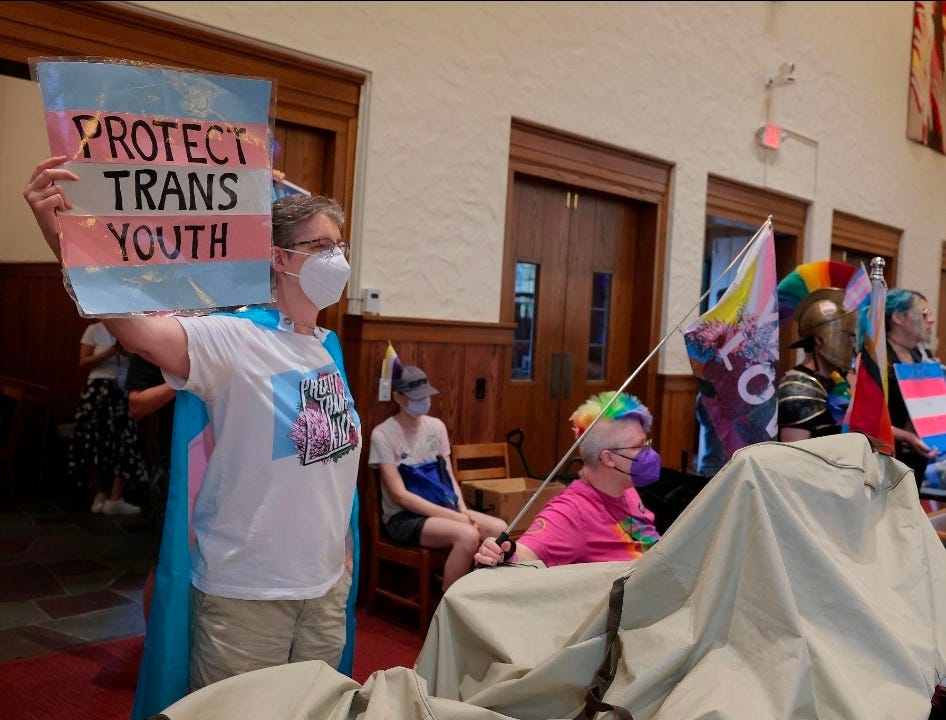
Supporters of those measures argue that gender-affirming treatments carry risks and should be limited or prohibited for young people. Medical organizations including the AAP have taken a different position, arguing that evidence-based gender-affirming care can be medically necessary and that decisions should be made by patients, families, and healthcare providers.
Those disagreements have produced years of legislation, lawsuits, and political conflict. Florida’s case stands out because it did not only regulate care. It targeted one of the country’s largest professional pediatric organizations over statements and policy positions related to that care.
That distinction is important because professional medical associations play a major role in public health. They publish guidance, review research, train providers, issue policy statements, and help shape medical standards. Their recommendations can influence doctors, hospitals, lawmakers, insurance providers, and courts.
If states can sue professional associations because they dislike their policy positions, the effect could reach far beyond transgender healthcare. Medical organizations may become more cautious about speaking on politically contested issues if they believe state officials can respond with litigation.
That concern could apply to reproductive healthcare, vaccination guidance, addiction treatment, infectious disease policy, mental health care, and other areas where medicine and politics collide. The issue is not whether professional organizations should be immune from criticism; they should not be. The issue is whether state power can be used to punish them for taking positions elected officials oppose.
Supporters of Florida’s approach may argue that medical organizations should be held accountable if they make inaccurate or misleading claims. That argument will likely continue as the case moves forward.
But Kennelly’s ruling focused on a different question. He examined whether the evidence suggested Florida’s lawsuit was driven by disagreement with the AAP’s speech rather than a good-faith effort to enforce consumer protection law. At this stage, the court found enough evidence of bad faith to stop the state from proceeding.
The injunction is preliminary, so the case is not over. Florida may continue defending its position, and the AAP’s constitutional claims still have to move through federal court. But preliminary injunctions are not granted lightly. Courts generally require a strong showing before blocking government action while a case is still pending.
That makes the ruling significant for medical organizations, free speech advocates, and trans rights groups watching similar fights unfold across the country.
For transgender youth and their families, the legal battle adds another layer of uncertainty to an already unstable healthcare landscape. Access to care now depends heavily on geography, state politics, litigation, and court orders. Families seeking care may face different rules depending on where they live, while providers must navigate shifting legal risks and political pressure.
This case will not determine the entire future of gender-affirming care in the United States. But it could help decide whether medical organizations remain free to advocate for that care without facing retaliation from state officials.
The central question is larger than one lawsuit and larger than one state. It is whether government officials can use the machinery of the state to punish organizations for expressing protected views.
A federal court has now found enough evidence of that possibility to intervene.
This report is part of the public record on transgender healthcare, government retaliation, free speech, medical organizations, and the growing effort to restrict access to gender-affirming care across the United States.
Upgrade to a paid subscription to support Trans United and the work that keeps these records public, tracks attacks on trans rights, and documents policies affecting trans people, families, and healthcare providers.
This is exactly the kind of thing we need to keep noticing.
Not only the headline. The mechanism.
Because the danger is not just that care gets restricted. It’s that the people and organisations willing to speak for that care get punished until everyone else learns to stay quiet.
As a queer person, that lands in my body.
We know what it means when power starts treating our existence, our care, and our advocates as problems to be managed.
Thank you for keeping the record.