

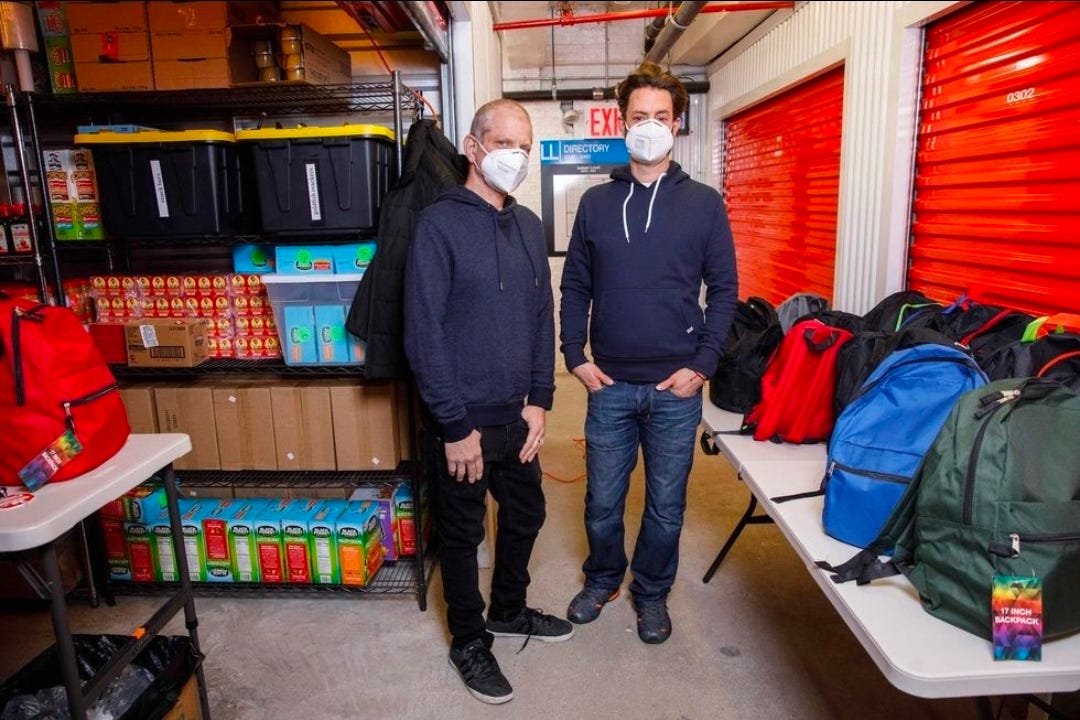
Jayson Conner and Jeffrey Newman spent years walking through New York City carrying backpacks filled with the supplies that can determine whether a person living outside gets through another day with food, clean socks, basic medical care, or a safe place to keep what little they own.
Conner, 48, died from a heart attack at the couple’s Queens home on June 28. Newman, 58, died four days later, on July 2. His family did not publicly disclose where or how he died. The couple would have marked 22 years together on July 7.
Their deaths ended a partnership that had become the operating center of Backpacks For The Street, the program they launched in 2018 through their nonprofit, Together Helping Others. By 2026, the couple and almost 40 volunteers had distributed more than 180,000 packs to unhoused New Yorkers.
Every backpack represented an answer to an immediate need that New York’s public systems had failed to meet. The bags carried toiletries, food, socks, underwear, notebooks, first-aid supplies, clothing, water, flashlights, hygiene products, and other essentials selected for people who might have no private room, permanent address, secure storage, or reliable access to healthcare.
Conner understood that instability from inside it. He had experienced homelessness himself from 2002 to 2004, first in San Francisco and later in New York City. The organization described him as its unofficial first client because Newman’s compassion and practical support helped him regain stability after they met.
That lived experience became operational knowledge. Conner knew that a sturdy bag was not a symbolic gift when someone had to carry every possession through the city. Clean clothing could protect dignity and health. Food had to be usable without a kitchen. Hygiene products had to account for the absence of a shower. First-aid supplies mattered when medical attention was inaccessible, while notebooks, pens, phone chargers, and business cards could help someone pursue work, services, or continued contact with the organization.
The backpacks provided immediate survival support while Conner and Newman worked to connect people with longer-term help. Their outreach met urgent needs in the present without confusing emergency supplies with the permanent housing, healthcare, income support, and safe shelter New York still owed the people living outside.
Their first organized distribution took place on March 27, 2018. Nineteen volunteers handed out 75 backpacks containing more than 5,000 individual items during four hours of outreach. That first effort grew into a continuing operation in which volunteers gathered in Queens, assembled more than 100 packs at a time, loaded them into a van, and distributed them across the city.
The operation delivered supplies, but the couple refused to reduce outreach to a handoff.
Conner and Newman trained volunteers to approach people with care, especially those experiencing physical pain, emotional distress, isolation, or deep distrust. Volunteers were expected to speak with people rather than simply place a bag beside them and walk away. The couple treated conversation, eye contact, patience, and recognition as part of the work because homelessness often makes people socially invisible before it deprives them of material necessities.
That method challenged the bureaucratic distance that defines many institutional responses to homelessness. People did not have to enter an office, complete a form, prove eligibility, survive a waiting list, or demonstrate worthiness before receiving basic help. They were approached as human beings with individual needs.
The couple’s relationship was inseparable from that work. They packed supplies together, recruited volunteers, raised donations, managed outreach, and built the organization around a shared conviction that people living outside should not be treated as disposable.
Their nearly 22-year partnership mattered because it created the trust, persistence, and shared labor required to sustain the program. Conner later said that helping people had strengthened their relationship because they operated as a team.
They also brought their own experiences of stigma and survival into the work. Newman was open about living with HIV and had advocated around HIV and AIDS, LGBT rights, and suicide prevention. Conner spoke publicly about homelessness, addiction, and recovery. Their service was shaped by an understanding that hardship becomes more dangerous when institutions treat illness, poverty, addiction, homelessness, or queer identity as evidence that a person matters less.
During the COVID-19 pandemic, that understanding became especially urgent. People living outside were exposed to a public-health crisis while many ordinary sources of food, sanitation, shelter, and contact disappeared. Backpacks For The Street expanded its distributions to include masks, sanitizer, hygiene products, food, solar-powered chargers, supplies for pets, and other items selected for life without reliable access to buildings or electricity.
The organization’s work exposed a contradiction at the center of one of the wealthiest cities in the world.
New York could sustain luxury towers, corporate headquarters, private clubs, and extraordinary concentrations of personal wealth while volunteers still had to pack socks, toothpaste, water, food, first-aid materials, and underwear for people sleeping outside.
The existence of Backpacks For The Street demonstrated the power of community care while revealing the public abandonment that made such care necessary. A city should not require two private citizens and a small volunteer network to become a distribution system for necessities that should be available through durable housing, healthcare, shelter, and social-service infrastructure.
The backpacks relieved immediate suffering while exposing the institutional gap around it. Permanent housing, safe shelter, accessible healthcare, income support, addiction care, mental-health services, legal assistance, and protection from displacement remained public obligations that volunteer outreach could not carry alone.
Conner and Newman expanded their work beyond distributing supplies by helping connect people with housing, employment, healthcare, substance-use treatment, immigration assistance, vocational training, résumé support, and case management.
That broader work matters because homelessness is produced and prolonged by unaffordable housing, inadequate income, inaccessible healthcare, family instability, discrimination, untreated illness, violence, and systems that often require a person in crisis to navigate layers of bureaucracy before receiving help.
The couple responded by treating unhoused people as neighbors whose needs, stories, and decisions deserved attention. Their outreach centered the person receiving help rather than the generosity of the people providing it.
A business card placed inside each backpack allowed recipients to contact the organization again for assistance, moving the encounter beyond a one-time handoff. Volunteers sometimes met people carrying damaged bags or struggling to protect their belongings, and the replacement backpack became both practical equipment and an opening for continued support.
That model gave the work a continuity frequently absent from emergency charity. The supplies addressed the present while the conversation could reveal what longer-term help might be possible.
The deaths of both founders now create a serious question for the volunteers, donors, community partners, and unhoused New Yorkers who relied on the organization.
Conner and Newman were not only its public faces. They carried its institutional memory, leadership, training, fundraising, and connection to the people it served. Losing them within four days creates the kind of rupture that can destabilize a grassroots service even when volunteers remain committed to continuing its mission.
Their deaths expose another structural weakness in how community care is sustained. Essential work is often built around a few people carrying enormous responsibility without the permanent staffing, funding, succession planning, or institutional support available to larger organizations, leaving the communities they serve vulnerable when those leaders are lost.
Conner and Newman died four days apart, while Newman’s cause of death remains undisclosed.
What deserves attention is the life they built before those four days.
They spent nearly 22 years together and eight years turning their partnership outward toward people whom New York routinely ignored. Their work created thousands of direct encounters in which someone living outside was offered practical help without first being treated as a threat, nuisance, failure, or administrative problem.
The 180,000 backpacks represented immediate responses inside a city that still had not provided enough permanent housing, healthcare, shelter, and sustained support.
Their legacy carries two obligations: protecting the organization and community work they built so that the people depending on it are not abandoned, and forcing public officials and institutions to stop treating volunteer compassion as a substitute for housing, healthcare, safe shelter, income, and sustained outreach.
Jayson Conner and Jeffrey Newman proved what direct care can accomplish when it begins with dignity and listens to the person receiving it. Their deaths should not allow the public to convert that work into a comforting story about private generosity while leaving the conditions that made it necessary unchanged.
They carried backpacks into the streets because people needed help immediately. The city’s unresolved obligation is to build a system in which survival no longer depends on whether two compassionate strangers arrive with a van.
Jayson Conner and Jeffrey Newman built practical care around people New York too often leaves unseen, but private compassion cannot replace permanent housing, healthcare, safe shelter, and public responsibility.
Share this report to honor their legacy, support the continuation of their work, and demand durable systems that treat unhoused people with dignity and provide care before emergencies become irreversible.
Worthy effort... I hope someone picks it up
😢😢