

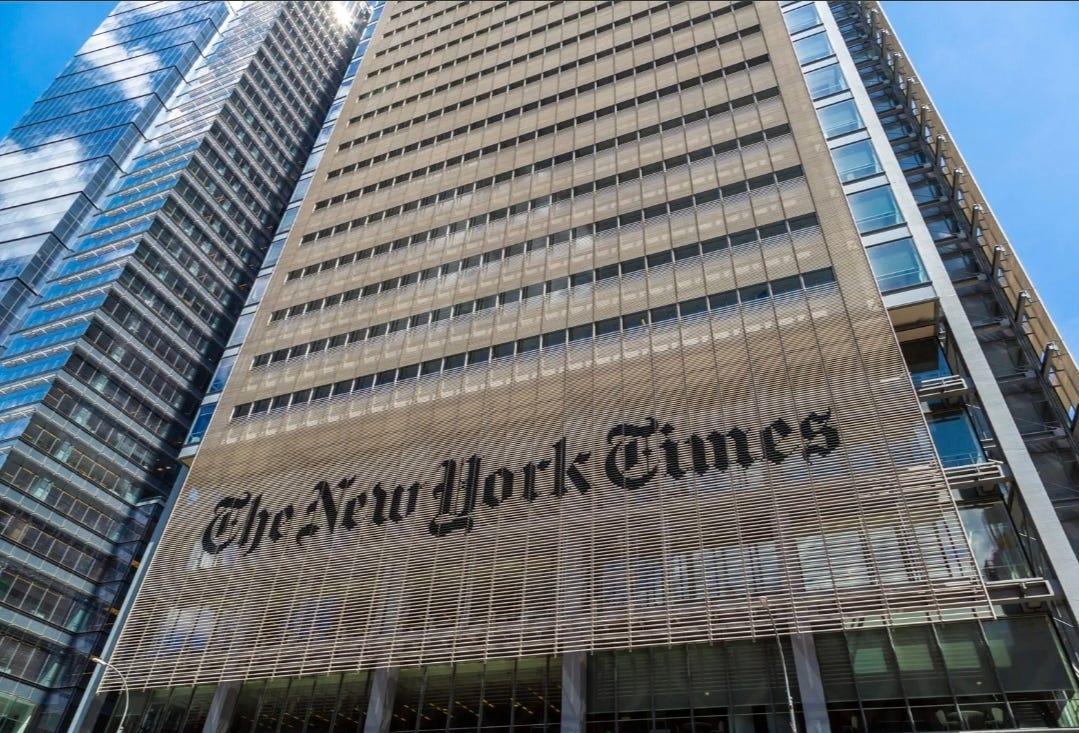
A new analysis of New York Times coverage argues that one of the most powerful newspapers in the country helped turn trans rights into a political controversy by changing how it framed trans people, trans healthcare, and trans public life.
The analysis, written by civil rights attorney Alejandra Caraballo and published in The Dissident, examined 3,242 New York Times articles on trans issues from 2014 through early 2026. Caraballo’s findings do not describe a single article, headline, or editorial mistake. They describe a pattern: a shift away from rights-based coverage and toward a frame that increasingly treated trans people as a subject of conflict, skepticism, and public debate.
That distinction matters because harm does not require an openly hostile sentence. It can come through repetition, sourcing, emphasis, placement, and priority. Caraballo’s analysis argues that The New York Times helped move trans people from the category of people under attack into the category of people whose rights, healthcare, and public existence could be repeatedly questioned.
Her research found that the Times’ coverage changed in several connected ways. Stories became less protective of trans communities, trans voices appeared less prominently, opponents of trans rights gained greater visibility, and controversy language became more common. Coverage also shifted toward medicalized reporting, particularly around gender-affirming care for young people. By her account, the paper did not simply cover a political backlash. It provided a mainstream language through which that backlash could travel.
The reported turning point came between 2018 and 2022. Earlier coverage more often treated trans people as communities facing discrimination, violence, exclusion, and civil-rights harm. Later coverage increasingly moved trans issues into a debate frame. That shift matters because debate framing does not land evenly when one side is a targeted minority and the other side is trying to restrict that minority’s healthcare, school access, public recognition, employment, and legal status.
The problem Caraballo identifies is not a dispute over newsroom style. It is a pattern of editorial choices: whose voices were treated as authoritative, which fears were elevated, and which harms were given less prominence. In her analysis, those choices made it easier to recast trans existence as a public controversy rather than a question of rights and protection.
That is how a civil-rights issue can become a threat narrative. The subject stops being whether trans people are facing discrimination and political attacks. Instead, the focus shifts toward whether trans people are moving too quickly, asking for too much, or creating discomfort for others. Once coverage adopts that framework, anti-trans politics can operate inside it without needing every institution to repeat the same rhetoric.
The harm is clearest in the gap between what was happening to trans people and what received the greatest attention. Across the country, anti-trans legislation expanded through schools, healthcare systems, sports policy, public accommodations, identity documents, and child welfare fights. Trans people were being targeted by coordinated political campaigns. Yet Caraballo argues that the paper’s most prominent coverage often focused less on the scale of those attacks and more on questions surrounding gender-affirming care, youth transition, parental anxiety, and institutional doubt.
Media framing does not remain confined to a newspaper’s pages. It shapes what readers, lawmakers, judges, school boards, and voters understand to be urgent, controversial, dangerous, or legitimate. Repeatedly treating trans rights as a matter for public dispute, Caraballo argues, helped build a permission structure around anti-trans politics and encouraged readers to view trans existence as something requiring adjudication.
Her analysis concludes that institutional coverage repeatedly treated trans people’s healthcare, rights, safety, and public existence as open questions, helping turn their lives into a public controversy.
Caraballo’s findings point to the editorial machinery behind that shift, including sourcing decisions, story placement, and judgments about which harms deserved prominence and which remained in the background.
The analysis concludes that editorial choices gradually repositioned trans rights as an unsettled question, gave greater legitimacy to opposition voices, and reduced the authority of trans people to define their own lives and harms. Over time, Caraballo argues, that controversy framing helped make anti-trans politics appear more mainstream and more legitimate in public debate.
The danger identified in this research is not simply that coverage changed. The analysis argues that a powerful media institution helped create a public environment in which anti-trans politics could be presented as legitimate concern rather than discrimination.
For trans people and trans communities, the consequences are not abstract. The harm identified in the analysis lies in turning rights into controversy, healthcare into suspicion, and trans existence into a question for public debate.
Trans people should not have to fight both policy attacks and the media frames that make those attacks easier to sell.
Trans United documents anti-trans harm because these patterns do not stay abstract. They become bills, bans, school policies, healthcare restrictions, employment threats, family fear, and public permission to treat trans people as problems.
Upgrade to a paid subscription to support Trans United and help keep this documentation going.
They have helped make the issue a both sides controversy. I canceled my subscription due to their coverage of trans rights. It was a policy decision.
I must admit that I have never understood the obsession with the transgender community. I'm 80, female and couldn't tell you if I have ever been in the bathroom with a transgender person. Maybe it's because I am just going to the f*cking bathroom! Indigenous people call them two spirits, sounds kinda cool to me. I guess I'm just curious why so many people are afraid of different people. Weird