

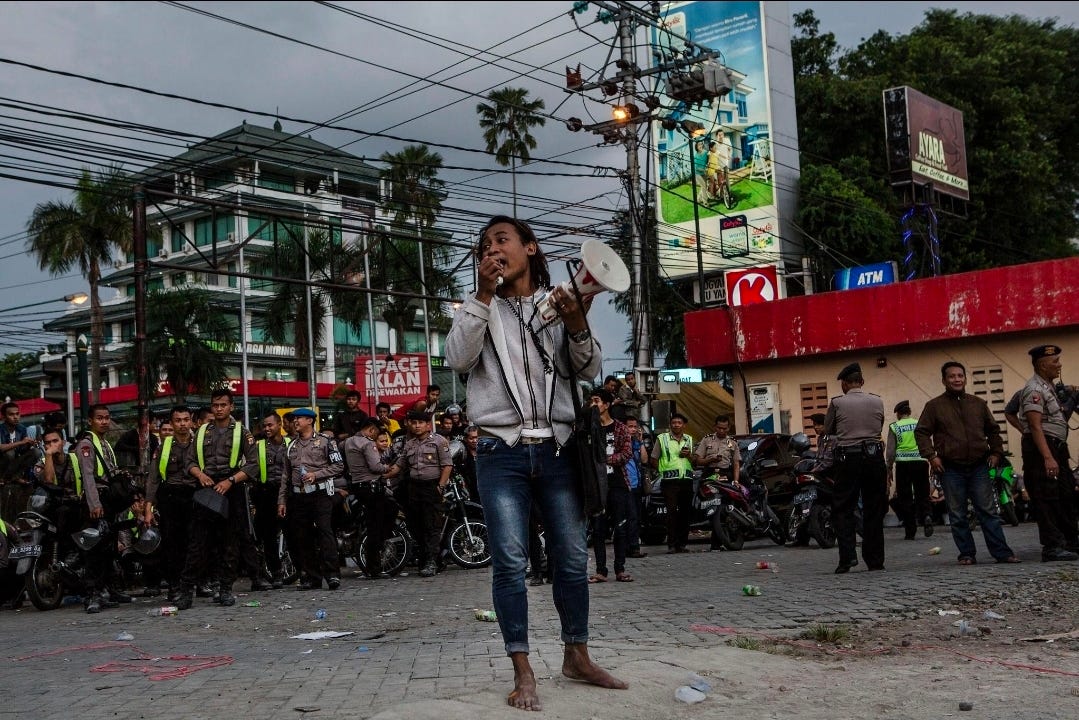
LGBTQ+ advocates report that groups of men targeted and chased trans women through the streets of Bogor, Indonesia. According to advocates documenting the attacks, the men punched and kicked victims, stripped some of them, and doused at least one with urine. At least 15 trans women were reportedly targeted, many of them poor women whose survival depended on street-based work that kept them visible to the people determined to punish them.
The reported stripping and urine attacks inflicted more than physical injury by turning assault into public degradation and communicating that trans women could be humiliated without protection. The victims were left carrying trauma, serious injuries, fear of returning to the streets, and the economic consequences of being driven away from the places where they earned enough to survive.
Months before those attacks entered the public record, President Prabowo Subianto signed a regulation establishing Indonesia’s national-defense policy for 2025 through 2029. Presidential Regulation No. 111 of 2025 included the “spread of LGBTQ culture” among the nonmilitary threats the government said could endanger the country. The same framework included terrorism, radicalism, illegal trafficking, drug abuse, online gambling, resource theft, and other activities presented as dangers to sovereignty, security, and public safety.
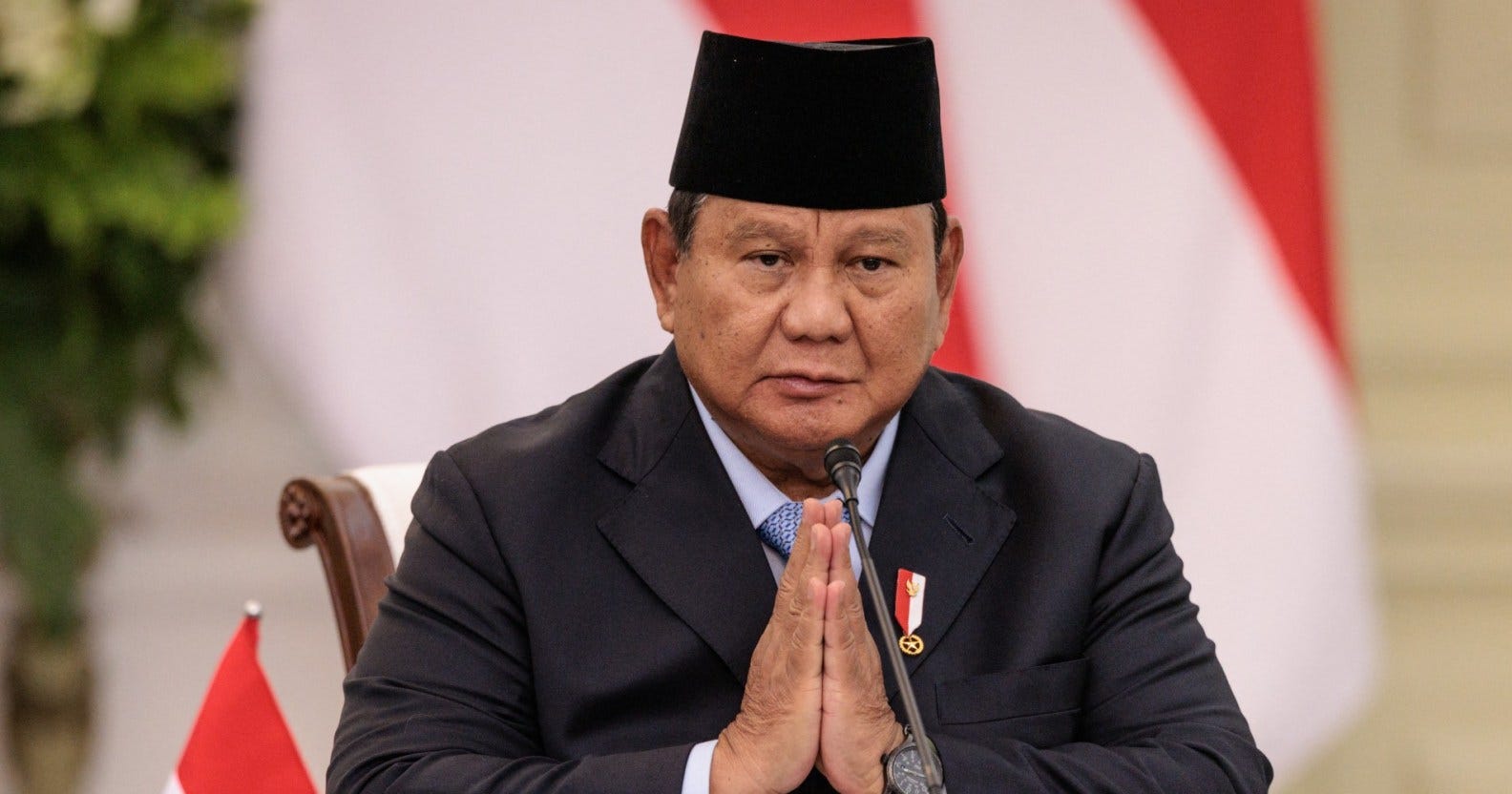
The government did not place LGBTQ+ people inside a framework of rights or public protection. It placed the supposed spread of LGBTQ+ culture inside a defense doctrine built around threats the state must confront.
The regulation did not directly create a nationwide criminal offense for being LGBTQ+. Its reach is broader than a single statute. By defining the spread of LGBTQ+ culture as a nonmilitary threat and directing ministries, state institutions, and regional governments to respond, the policy gave anti-LGBTQ+ discrimination a national-security vocabulary and an administrative route into daily life.
President Prabowo did more than express personal prejudice. He signed a policy that allows officials to describe discrimination as national defense. Ministries can turn the classification into public messaging and programs. Regional governments can use it to justify exclusionary directives. Universities can treat LGBTQ+ students, organizations, publications, and discussions as institutional risks. Religious leaders can cite the state’s language while demanding criminal punishment. Attackers can present humiliation and violence as protection of their communities rather than assaults on people the government has already marked as dangerous.
The men who reportedly attacked trans women in Bogor remain responsible for every punch, kick, chase, forced stripping, and act of degradation they carried out. State responsibility does not erase individual responsibility. It explains the political environment in which attackers are encouraged to see vulnerable people as threats and themselves as defenders.
A presidential regulation does not need to instruct a particular group of men to attack a particular trans woman before it contributes to the danger surrounding her. Government language shapes what institutions permit, whose speech they restrict, which bodies authorities treat as suspicious, and whose reports of violence authorities may fail to treat with urgency. When a president places the supposed spread of LGBTQ+ culture beside terrorism and other national dangers, the human targets of that classification are queer and trans people.
Amnesty International Indonesia warned that the classification would deepen discrimination and expose LGBTQI+ people to further violations. Human Rights Watch later reported that harassment and attacks against LGBTQ+ university students escalated during Pride Month in June 2026 and that at least 10 public universities had adopted discriminatory regulations or restricted student media and social-media discussions involving gender and sexual diversity.
Campus restrictions are not separate from the national-defense policy. Universities are where the government’s threat classification becomes daily control over speech, association, education, and personal safety. Administrators do not need police at every classroom door when codes of conduct, disciplinary panels, event restrictions, and control over student publications can perform the same political work.
An LGBTQ+ student organization can be treated as a disruption to institutional order. A discussion about gender identity can be restricted as ideological promotion. Student journalists can be pressured not to cover discrimination. Faculty members may decide that defending targeted students creates too much professional risk. Support networks can be dismantled while harassment is described as a controversy between competing views rather than a threat to students’ safety.
Under the state’s framing, LGBTQ+ students can be cast as carriers of a cultural threat, making students who report harassment vulnerable to investigation themselves. Trans students may hide their identities to avoid discipline, family exposure, loss of housing, or removal from campus, while student groups and publications silence themselves before administrators issue a formal order.
Religious leadership has added another layer of escalation. The Indonesian Ulema Council, a powerful body of conservative Islamic scholars, reportedly argued that what it described as sexual deviation should receive criminal punishment harsher than the penalty for adultery. A council leader complained that Indonesia lacked a fixed national prison sentence for LGBTQ+ conduct and suggested that local officials had been left to rely on informal measures.
The council leadership is responsible for that demand; Indonesia’s Muslim population is not collectively accountable for it.
The council’s intervention matters because it pushes the presidential framework toward explicit criminalization. The state calls the supposed spread of LGBTQ+ culture a national threat, and religious leaders then argue that the people associated with that supposed threat should face prison. Regional officials and universities receive further permission to treat exclusion as prevention, while anti-LGBTQ+ groups hear that the law has not yet become punitive enough.
Government ministries and regional authorities have also begun translating the threat classification into administrative action. The Ministry of Religious Affairs has reportedly prepared educational content intended to prevent LGBTQ+ behavior, while officials in Bogor have discussed local directives aimed at prevention. The presidential label is therefore moving beyond a document signed in Jakarta and into public education, local government, campus discipline, and community enforcement.
These institutions reinforce one another. The president supplies the national-security label, ministries and regional officials turn it into programs and directives, universities enforce it through censorship and discipline, religious leaders demand criminal punishment, and attackers carry the message into public spaces where poor trans women are easier to identify and less likely to be protected.
The poverty of the reported Bogor victims is central to understanding the violence. These women were not attacked because they held unusual public power. They were targeted because economic exclusion had already made them vulnerable.
Many poor trans women survive through work in streets and other public spaces because discrimination blocks access to formal employment, stable housing, education, and healthcare. Visibility becomes a condition of survival, and that same visibility gives attackers a map. A woman working in public can be watched, followed, isolated, filmed, and assaulted. If injuries keep her from working, she can lose the income required for food and shelter. Reporting the violence may expose her to ridicule, detention, family rejection, or further attack.
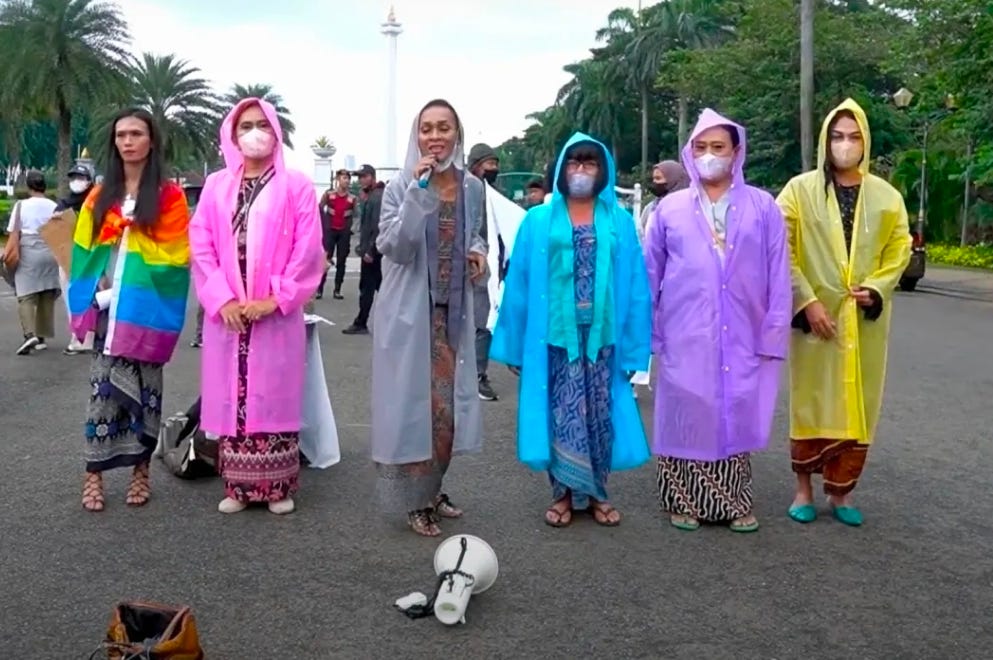
The attacks targeted the women’s gender and dignity by exposing their bodies for public judgment and making humiliation part of the violence directed at them for being visibly trans. Recording or circulating the assaults would extend that harm by allowing strangers to replay the degradation long after the attackers had left.
The women targeted in Bogor must not be reduced to evidence in an argument about government policy. They are the people carrying the injuries produced inside that policy environment. Their names should not be published without permission, and identifiable or graphic footage should not be circulated merely to make audiences believe the violence occurred. Survivor safety matters more than spectacle.
Indonesia’s anti-LGBTQ+ escalation did not begin with Prabowo’s regulation. Human Rights Watch documented a government-driven campaign in 2016 involving hostile official statements, exclusionary policies, repression of peaceful gatherings, and intensifying attacks against LGBTQ+ people. The new regulation matters because it elevates that long-running hostility into national-defense doctrine, connecting existing prejudice to a presidential framework for state action.
Official prejudice becomes public policy, policy makes institutional discrimination easier to defend, and discrimination isolates people from support. That isolation makes violence easier to carry out and easier for authorities to ignore.
Indonesia’s legal landscape already gives officials multiple ways to target LGBTQ+ people without a nationwide law explicitly outlawing LGBTQ+ identity. Same-sex relations are criminalized under Sharia-based law in Aceh, while national morality, pornography, electronic-information, marriage, adoption, health, and criminal provisions have been criticized for exposing LGBTQ+ people to discrimination, raids, prosecution, and censorship.
The presidential regulation adds a security justification to that vulnerability. Universities can disguise censorship as institutional order, ministries can package stigma as education, regional governments can present exclusion as prevention, and religious authorities can frame criminalization as social protection. Attackers can describe violence as moral enforcement, while authorities deny responsibility because no single policy sentence ordered the final assault.
Government policy does not exist outside its human consequences. When officials classify LGBTQ+ life as a danger, institutions gain permission to restrict it, attackers gain language to justify cruelty, and vulnerable people absorb the harm.
The state’s duty was to protect trans women in Bogor from assault and LGBTQ+ students from harassment and censorship. Instead, President Prabowo’s government supplied an escalating anti-LGBTQ+ campaign with the language of national defense.
Universities restricting LGBTQ+ discussion are responsible for choosing discrimination over student safety. Indonesian Ulema Council leaders demanding prison sentences are responsible for pushing prejudice toward criminal punishment. Ministries and regional officials translating the policy into local programs are responsible for expanding its reach. Police and local authorities must answer for whether the Bogor victims were protected, whether attackers were identified, whether evidence was preserved, and whether the assaults were investigated as violence rather than dismissed as community discipline.
No actor should be hidden behind phrases such as traditional values, social conservatism, public morality, or cultural tension. Those terms blur decisions made by identifiable people and institutions. LGBTQ+ people are not using state power to remove heterosexual people from universities, criminalize their relationships, or hunt them through the streets. A president, government agencies, public institutions, religious authorities, and organized attackers are directing power downward at people with fewer resources and less protection.
Once the state marks LGBTQ+ people as threats, ordinary acts of speech, organizing, visibility, and survival can be recast as evidence of danger. Authorities can insist they never ordered the violence, but they cannot separate it from a policy that taught institutions and the public to see the victims as dangers.
Indonesia must remove LGBTQ+ life from its national-defense doctrine, end discriminatory university rules, reject demands for criminalization, investigate the attacks in Bogor, protect the survivors, and hold the men responsible for the violence they reportedly inflicted. Ministries and regional governments must dismantle programs that treat LGBTQ+ existence as something to prevent, while universities must restore the speech, organizing rights, and safety of targeted students.
The trans women attacked in Bogor were not threats to Indonesia. They were poor women trying to survive in public while men reportedly chased, beat, stripped, and humiliated them. LGBTQ+ students are not dangers to their universities. They are students whose institutions chose to police their identities instead of protecting their education.
President Prabowo placed the supposed spread of LGBTQ+ culture inside a defense framework designed to identify threats to the state. Universities, ministries, regional authorities, religious leaders, and attackers then gave that classification material force. The conditions surrounding the Bogor violence were built when powerful institutions decided that queer and trans existence could be treated as a national danger and that the people carrying the consequences deserved less protection than the prejudice directed against them.
Trans United documents the policies, institutions, and public campaigns that place trans people in danger while demanding silence from those forced to survive them. This work preserves the record, names the actors behind individual acts of punishment, and refuses to let government language erase the human beings carrying the consequences.
Subscribe to Trans United and help keep trans lives, trans resistance, and state violence in the public record.