

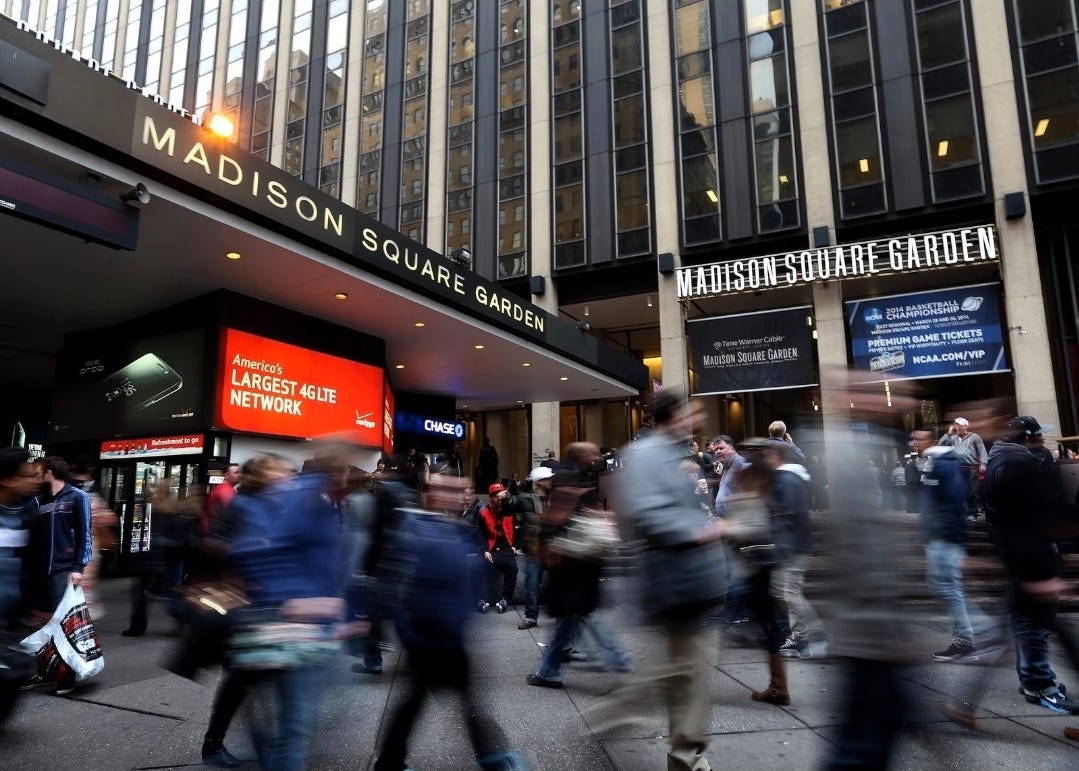
Madison Square Garden was already facing scrutiny over allegations that its security operation tracked a trans Knicks fan through the venue in extreme detail.
Now new reporting points to something broader.
According to reports from 404 Media and Wired, an internal MSG database allegedly included 93 celebrity entries marked with the label “LGBTQIA.” The same reporting describes a wider venue database containing tens of thousands of entries, risk labels, and internal categories used to identify and assess people connected to the venue’s security system.
MSG has denied the reporting, calling it inaccurate and false. That denial can be part of the record. It cannot erase the public accountability question raised by the reporting: why would queer and trans identity appear as a label inside a venue security database at all?
The accountability question starts there.
This is not celebrity gossip. The celebrities reportedly named in the database are not the point. They are evidence of scale. The deeper issue is that LGBTQIA+ identity itself was allegedly turned into a category inside a corporate security system connected to one of the most visible public venues in the country.
A concert venue or sports arena is not a place where private identity should become security metadata. A person buying a ticket, entering a building, attending a game, performing onstage, or appearing as a guest should not have their queer or trans identity treated as part of venue security infrastructure.
But that is what the reporting suggests may have happened.
The alleged “LGBTQIA” label matters because labels inside security systems are not neutral. They are built to be used. They can shape who gets flagged, who gets watched, who gets separated, who gets escalated, who gets treated as a risk, and who becomes visible to security staff before they have done anything at all.
That is why the earlier trans fan story matters here.
MSG security was previously reported to have tracked a trans Knicks fan’s movements through the venue down to specific actions and timestamps. Reporting described an 18-page dossier that allegedly included when she scanned her ticket, used an elevator, hugged an usher, ordered drinks, entered the women’s bathroom, and left minutes later. The employee account said she posed no threat, yet the surveillance allegedly followed her through ordinary movement inside the venue.
That case already showed how far a venue security apparatus could reach into the life of one trans person.
The new reporting makes the concern larger. If MSG’s internal system allegedly included a broader LGBTQIA category, then the issue was not only whether one trans fan was tracked. The issue becomes whether queer and trans identity was built into the venue’s wider surveillance logic.
That is a different level of harm.
Corporate surveillance does not have to look dramatic to be dangerous. It can appear as a database field, a risk label, a note, a flag, a file, a category, a profile, or a quiet internal marker that follows a person through spaces they thought they were simply entering as guests.
For queer and trans people, that kind of labeling has a history. Institutions have long turned identity into a file, a suspicion, a risk factor, a moral panic, a police note, a medical marker, a school record, or an employment liability. The language changes. The technology changes. The mechanism remains familiar: someone in power decides that who we are belongs in a system built to monitor and control access.
MSG is not just any room. It is a major public venue where people go to watch sports, attend concerts, work, perform, gather, celebrate, and be seen. When a venue like that allegedly categorizes LGBTQIA+ identity inside security infrastructure, the harm is not limited to the names in the database. It reaches everyone who has to wonder whether entering public space also means being quietly sorted by identity.
The company’s denial does not answer that fear by itself.
The public needs to know what data was collected, who created the labels, how those labels were used, whether the labels affected access or treatment, who could see them, whether they were shared, how long they were retained, and whether queer and trans identity was treated as relevant to risk.
Those are not abstract privacy questions. They are safety questions.
If a security system can mark people as LGBTQIA+, queer and trans people have a right to know how that information is used: whether it changes how security sees them, whether it places them in a separate category, and whether it increases the chance of being watched, followed, blocked, separated, or documented.
A venue cannot answer those questions with public-relations language alone.
This is why the story should not be reduced to the celebrity names reportedly found in the database. Celebrity gives the story visibility, but the mechanism is bigger than celebrity. The danger is a security culture that allegedly treats queer and trans identity as something worth labeling.
That is the part that should alarm the public.
A database does not need to say “dangerous” for a label to become dangerous. A system only needs to make identity searchable, visible, and actionable inside an institution with power over entry, movement, and removal.
That is how surveillance can become a tool of control.
MSG’s alleged database also raises a larger question about public venues in a surveillance era. Arenas and stadiums increasingly rely on cameras, facial recognition, ticket scans, internal watchlists, private security teams, vendor systems, and data tools most guests never see. People may think they are entering a venue. In reality, they may be entering a network of systems that decide how they are identified before they ever reach their seat.
For LGBTQIA+ people, that is not a minor concern. Public space has never been equally safe. Queer and trans people already navigate harassment, outing, profiling, bathroom policing, employment risk, family risk, and political campaigns built around treating their existence as a threat. Adding corporate identity labels to security systems only deepens that vulnerability.
This is especially dangerous when the earlier reporting already described a trans woman being tracked through ordinary venue behavior.
A person hugging an usher, ordering a drink, entering a bathroom, or moving through a building should not become the basis of a surveillance file when there is no threat. A queer or trans person’s identity should not become a category in a security database because a corporation wants to know who is entering its building.
The public needs transparency, not denial alone.
MSG should have to explain whether the alleged LGBTQIA labels existed, why they existed, who applied them, how they were used, whether people were notified, whether anyone was treated differently because of them, and whether the company still maintains any identity-based categories inside its security systems.
Anything less leaves the core concern untouched.
Madison Square Garden allegedly turned LGBTQIA+ identity into a label inside its security infrastructure. That matters because queer and trans people are not risk categories. They are not surveillance tags. They are not metadata for corporate control.
They are people entering public space.
And public space becomes less public when identity can be quietly turned into a security label before a person even knows they are being watched.
Queer and trans identity should never become security metadata inside corporate surveillance systems.
Trans United documents anti-trans laws, public safety failures, surveillance harms, and the systems that strip trans people of privacy, housing, dignity, and protection.
Support the work.
Related report:
Madison Square Garden Built a Surveillance Machine to Track a Trans Woman

Madison Square Garden is not a government agency, but the reporting now circulating describes a private surveillance operation with state-level consequences. A WIRED inves…