

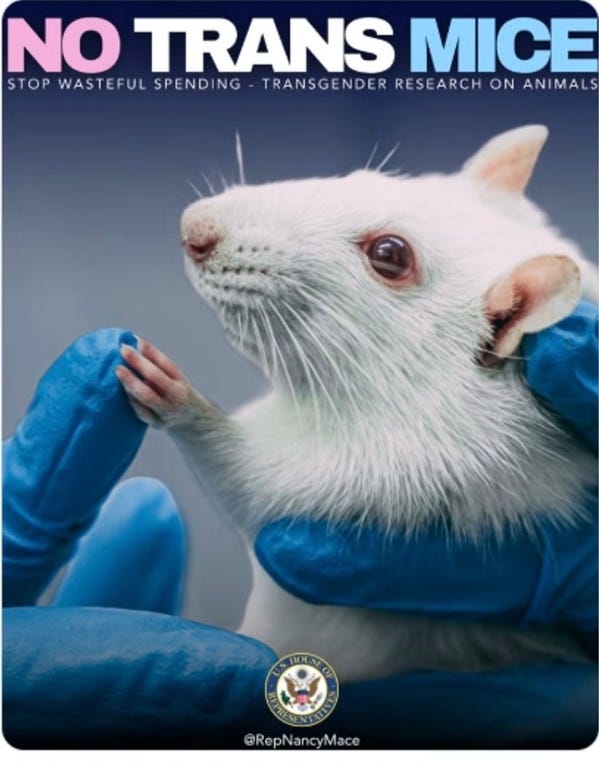
Nancy Mace tried to make “trans mice” sound like proof of a political scandal. Instead, the phrase ran straight into the meaning of a basic science term.
The South Carolina congresswoman promoted the TRANS MICE Act while describing federally funded animal research as “radical transgender experiments” and “ideological cruelty.” Her office framed the bill as a way to stop taxpayer funding for animal experiments connected to gender-transition-related research.
But the public correction that followed exposed the problem with the panic. A Community Note on X explained that “trans mice” can refer to transgenic mice — laboratory mice that have foreign DNA incorporated into their genome so scientists can study gene function and disease mechanisms, including cancer research.
That distinction matters. Mace’s language did not just confuse people online. It fed the larger anti-trans pattern of turning medical terms, research language, healthcare systems, and basic science into political weapons.
After the correction, Mace doubled down and said her post was not about transgenic mice. She claimed it was about federally funded transgender-related animal experiments. But the damage of the framing was already clear: “trans” had been used as a trigger word to move public attention away from science and toward panic.
This is how anti-trans politics works now. It does not only attack trans people directly. It turns hospitals into targets, doctors into suspects, research into propaganda, and scientific language into culture-war bait.
The result is not just mockery of one post. It is another public record of an elected official using anti-trans panic to justify legislation while science is forced to clean up the mess.
Trans people are not the subject of a lab-animal scare campaign. Trans healthcare is not “ideology.” Biomedical research should not become political bait because a lawmaker found another way to make the word “trans” sound dangerous.
Anti-trans panic does not stay online.
It becomes legislation, hearings, lawsuits, investigations, and public pressure against the systems trans people rely on to survive.
This reporting stays open to read, share, and comment on. Paid subscriptions help fund the public-record work behind it — documenting anti-trans policy, trans healthcare attacks, institutional pressure, and the people fighting to survive them.
Why is this coming up again? The explanation came out long ago, and I thought it was a nonissue. Leave it to Mace.