

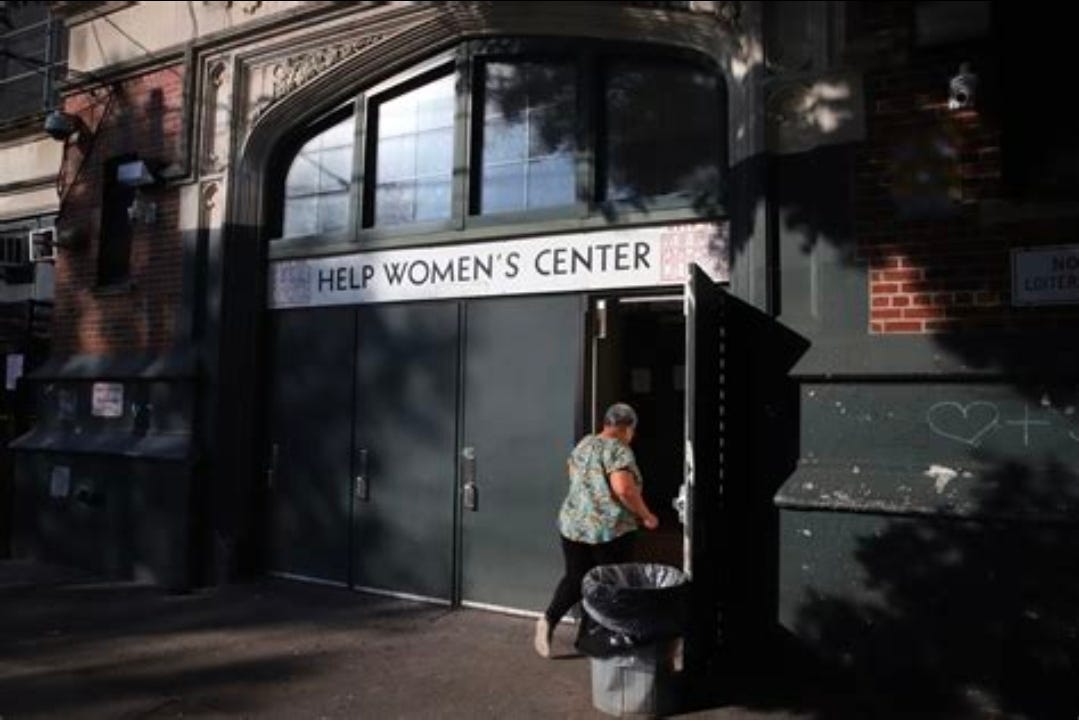
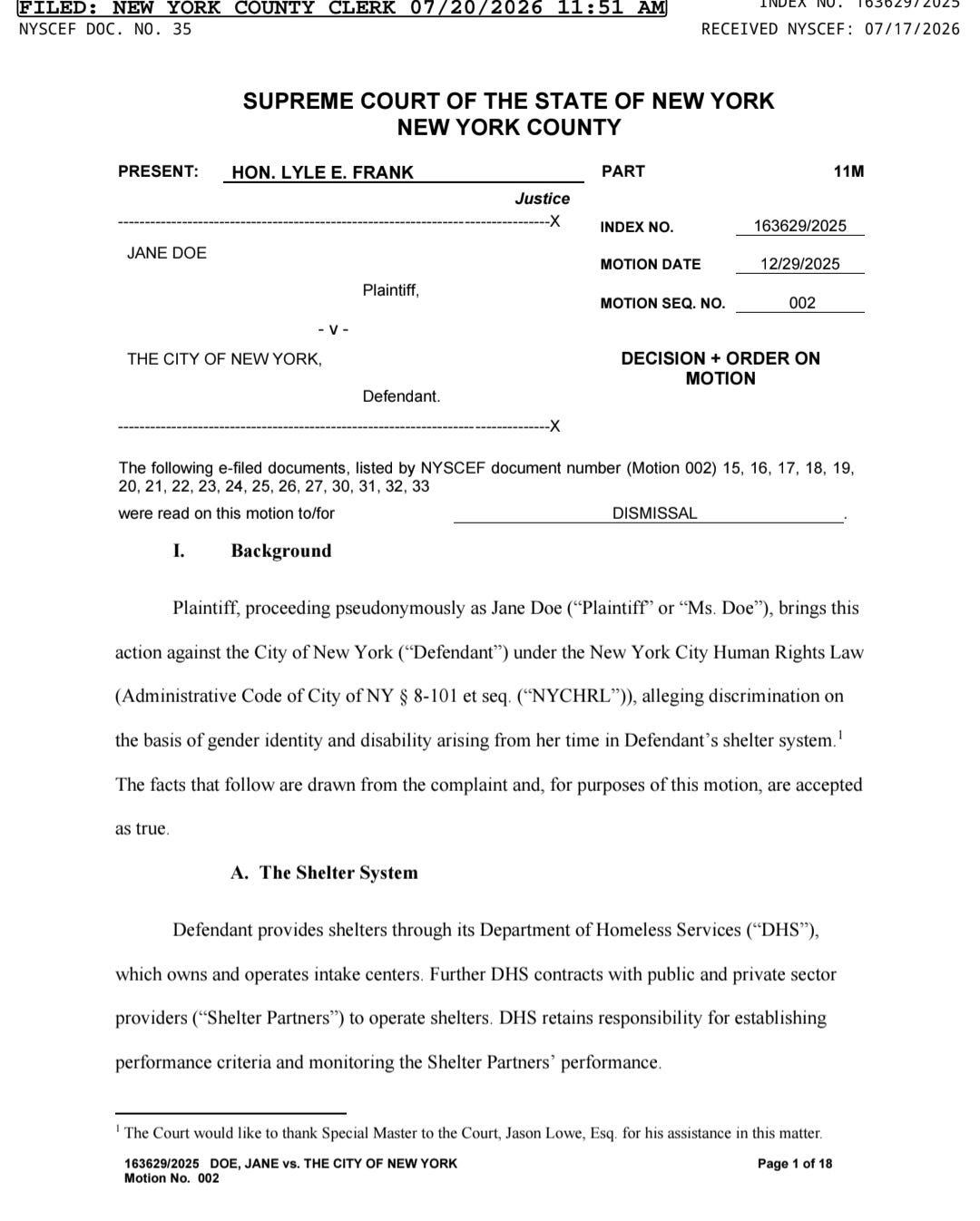
New York City allegedly placed a houseless trans woman in men’s shelters, denied her repeated requests for safer placement, and left her exposed to sexual harassment and assault. When Jane Doe sued, the city pointed to its written nondiscrimination policy and the absence of any official hormone requirement as reasons her claims should be dismissed. New York Supreme Court Justice Lyle E. Frank rejected that argument and allowed her case to proceed, ruling that policy on paper does not erase conduct that allegedly contradicts it in practice.
For purposes of deciding the dismissal motion, the court accepted Doe’s factual allegations as true and considered whether they stated legally viable claims. Justice Frank concluded that they did, opening the way for Doe to test whether New York City’s shelter system violated the protections its own rules promised her. The ruling does not establish that every allegation has been proven or that the city is liable.
The contradiction at the center of the case began when Doe became houseless in 2022 and called 311 for help. According to her complaint, a dispatcher told her that a trans woman could not enter a women’s shelter unless she had been receiving hormone replacement therapy for at least one year. She alleges that staff within the Department of Homeless Services system repeated the same requirement and directed her instead into shelters designated for men.
That alleged demand directly conflicted with DHS policy, which states that shelter clients should be placed according to the gender they report during intake. It also transformed an alleged medical requirement absent from DHS policy into a decision about where Doe would be required to sleep. Hormone therapy does not determine whether a trans woman is a woman, and access to safety cannot legitimately depend on whether someone has taken hormones, wants them, can obtain them, or is medically able to receive them.
Because the disputed rule controlled her placement, its consequences extended far beyond disrespectful language. Doe alleges that she was sent through three men’s shelters over roughly two and a half years, even as she repeatedly requested placement in a women’s shelter or access to a bed designated for trans and gender-nonconforming residents. Her complaint says those requests were denied or ignored while she was sexually harassed and assaulted by other residents.
The city shelter system was not simply the location where those alleged harms occurred. It controlled the intake process that routed Doe into men’s facilities, the transfer process she relied on to escape them, the room assignments that determined who had access to her, and the complaint mechanisms through which she sought protection. Each denied request allegedly kept her inside conditions she had already identified as dangerous.
Doe was eventually assigned to a trans and gender-nonconforming bed in a women’s shelter, but the change in classification did not end the danger she described. According to the complaint, staff repeatedly misgendered her, mocked her clothing, called her degrading names, and told her that she looked like a sex worker. She further alleges that cisgender men were placed in her room and that she again experienced sexual harassment and assault.
That part of the complaint is especially important because it shows why a designated bed cannot substitute for a safe shelter environment. A placement can carry an inclusive label while staff conduct, room assignments, and complaint responses continue to expose a trans woman to hostility. The failure alleged by Doe was therefore not limited to placement in shelters inconsistent with her gender. She describes a system in which the culture and operation surrounding her bed remained unsafe even after the city formally placed her in a space intended for trans residents.
The written policy became central only after Doe sued New York City under the New York City Human Rights Law, alleging discrimination based on gender identity and disability. City lawyers moved to dismiss the case, arguing in part that she lacked standing and that DHS’s nondiscrimination policies undermined her claim that she had been barred from women’s shelter placement.
Justice Frank rejected that reasoning. He explained that the city human rights law governs practice and conduct, not merely the rules an institution publishes. A nondiscrimination policy cannot defeat a claim at the dismissal stage when the plaintiff alleges that the people administering the system behaved in ways that contradicted it.
The ruling prevents the city from treating the existence of a protective policy as conclusive evidence that discriminatory conduct did not occur. The policy identifies what the shelter system was supposed to do; the complaint describes the decisions allegedly made by the workers controlling Doe’s access to safety.
That distinction gives the case significance beyond one procedural motion. A policy cannot answer a 311 call, correct an intake worker, approve an emergency transfer, remove an unsafe roommate, discipline abusive staff, or protect someone overnight. Those responsibilities belong to the city agencies, supervisors, employees, and contractors who operate the shelter system. When their conduct allegedly contradicts the written rule, the rule becomes evidence of the protection that failed rather than proof that no failure occurred.
The question of responsibility becomes more complicated because New York City relies heavily on nonprofit contractors to operate shelters. DHS sets shelter policy, administers placement and transfer processes, establishes provider requirements, and oversees a network of contracted shelter operators, while many workers inside individual facilities are employed by outside organizations. In seeking dismissal, the city argued that it should not be liable for at least some conduct attributed to workers employed by those providers.
Justice Frank ruled that Doe’s claim seeking to hold the city responsible for conduct attributed to employees of contracted shelter providers could proceed.
That part of the ruling addresses a familiar gap in public systems built around contracting. Outsourcing may divide the work among different organizations, but it does not eliminate the government’s control over who receives contracts, which standards apply, where residents are placed, how providers are monitored, or what happens when complaints reveal danger. A city cannot retain authority over the shelter system while treating responsibility for harm as something that disappears once a contractor enters the chain.
For a houseless trans woman, that fragmented structure can make protection difficult to reach. A dispatcher can refer her to intake. Intake staff can invoke placement rules. Shelter workers can refer complaints to management. Management can point to DHS. A contractor can say that the city controls transfers, while the city says that the contractor employs the staff. The institution responsible for the next decision can keep changing even though the woman remains in the bed the system assigned her.
Doe’s complaint describes that kind of cumulative failure. She alleges that more than one worker repeated or enforced the same unofficial hormone requirement, that requests for safer placement were denied across multiple facilities, and that hostility continued even after she reached a bed formally designated for trans and gender-nonconforming residents. The repetition across intake, placement, transfer requests, staff conduct, and room assignments is what turns the case from an allegation about one employee into a challenge to the operation of the shelter system itself.
One incorrect statement from a dispatcher might be dismissed as an isolated mistake. The same barrier appearing across multiple points of contact raises a more serious question about whether the policy announced by the city had any meaningful control over what workers and contractors actually did. Doe’s lawsuit gives her the opportunity to examine that gap through records, testimony, training materials, supervision practices, contractor standards, and complaint histories.
The city made that gap more visible by presenting its nondiscrimination policy as evidence of compliance, while Justice Frank recognized that publishing a rule and enforcing it are separate questions.
The Department of Social Services, which oversees DHS, has said that it is committed to strengthening protections for transgender New Yorkers and ensuring trauma-informed support throughout the shelter system. The value of that commitment will depend on whether trans women can enter shelters without being subjected to invented medical tests, whether requests involving threats and sexual harm receive immediate action, whether abusive staff face consequences, and whether contracted providers are monitored through the experiences of the residents placed in their care.
Trauma-informed support must be visible at the moment a woman seeks shelter, when a worker records her gender, when a placement decision is made, and when she reports danger. A system that responds only after harm has accumulated is not preventing trauma; it is documenting the consequences of its own delay.
That delay carries particular weight inside emergency housing because shelter residents do not enter the system with equal bargaining power. A houseless person cannot simply reject an unsafe placement and return to a secure home while an agency reviews the decision. She may depend on the same workers for her bed, belongings, transportation, services, and future transfer. Reporting mistreatment can therefore require her to challenge people who still control the conditions of her survival.
For trans women, placement decisions can create immediate exposure to gender-based harassment and violence. That danger is neither speculative nor difficult to foresee, which is precisely why policies based on self-reported gender exist. When workers allegedly replace those protections with a hormone requirement, the result is not a minor administrative mistake. It is a decision that directs a trans woman into conditions the policy was designed to prevent.
Doe is seeking compensation and legal fees, but her lawsuit also asks for policy and training changes. Those demands recognize that accountability cannot end with payment for past harm if the same intake failures, transfer delays, contractor gaps, and unsafe room assignments remain in place.
Meaningful reform would require workers controlling shelter access to understand that trans women do not need to prove their gender through hormones, surgery, identification documents, appearance, or time spent transitioning. Supervisors must stop invented requirements before they determine placement; reports of sexual harassment or assault must produce an immediate safety response; and complaint systems must not force a trans woman to repeatedly seek help from the same people controlling her housing. Contractors must be evaluated according to residents’ experiences rather than what policy manuals promise.
The ruling preserves a question that extends beyond this lawsuit: whether an institution can use an inclusive policy as proof of compliance when the person seeking protection alleges that the system operated differently at every point where it controlled her safety. Government commitments matter only when workers and contractors enforce them in practice.
The court has not yet decided whether New York City violated Jane Doe’s rights. It has decided that the city must answer the allegations instead of defeating them by displaying the policy it was accused of failing to enforce.
Jane Doe entered New York City’s shelter system because she needed a safe place to sleep. According to her complaint, workers turned her gender into a barrier to safe placement, directed her into men’s facilities, denied repeated requests for protection, and left her exposed to the violence she had warned the system about. Even after she reached a bed intended for trans residents, she alleges that the surrounding staff conduct and room assignments reproduced the same danger.
The city’s policy said she should have been housed according to her gender. Her lawsuit will now examine why the shelter system she encountered allegedly operated as though that promise did not apply.
A written nondiscrimination policy cannot protect trans women when shelter workers and contractors allegedly enforce another system in practice. Jane Doe’s case may now expose how intake barriers, unsafe placements, denied transfers, and outsourced responsibility put houseless trans women in danger.
Support independent reporting that keeps trans women at the center and holds institutions accountable for the harm hidden behind their policies.
EMERGENCY HOUSING SUPPORT

Trans United provides direct emergency support for Black trans women facing homelessness, unsafe shelter conditions, and immediate housing instability.
Not fucking ok anymore