

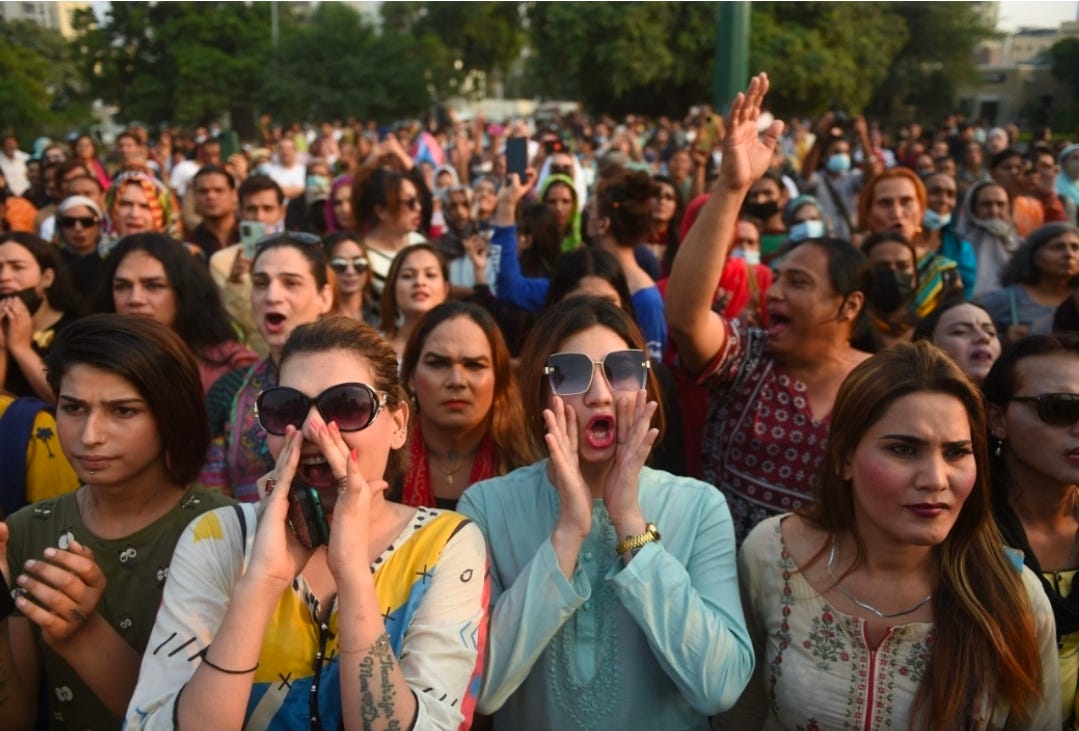
Mishi was killed and Tara was wounded after an unidentified assailant opened fire near Raja Ground Bridge in Peshawar. They had reportedly gone there to retrieve a phone and money from a friend when an altercation occurred and someone chose to use a gun.
Police have not publicly established the shooter’s identity, motive, or relationship to either victim. The reported dispute belongs in the factual record, but it does not explain away the violence or move responsibility toward Mishi and Tara. They went to retrieve property. Someone opened fire, killing Mishi and sending Tara to hospital with gunshot wounds.
Tara is not merely a witness to Mishi’s killing. She is a surviving victim whose recovery, safety, privacy, and access to justice remain part of the case. Mishi’s death and Tara’s injuries must stay at the center while police identify the shooter and prosecutors determine whether the person responsible will face meaningful consequences.
Officers transported Mishi’s body for a post-mortem examination and collected forensic evidence from the scene. Those are minimum duties after a person has been shot dead. The harder test is whether police will preserve ballistic and digital evidence, protect Tara and other witnesses, examine whether anti-trans hostility played any role, arrest the shooter, and build a case that survives after public attention fades.
Arzoo Khan, president of Khyber Pakhtunkhwa’s Transgender Community and executive director of the Manzil Foundation, condemned the shooting and demanded immediate punitive action. She called on the government to protect trans people and end the impunity and fearlessness surrounding violence against the community.
That fearlessness develops when attackers see repeated violence followed by weak investigations, delayed prosecutions, few visible convictions, and government promises that do not change conditions on the ground. Impunity is not only the absence of a conviction. It is the expectation that a trans person can be targeted without serious institutional resistance.
Mishi’s killing occurred inside a documented regional pattern. Trans people in Peshawar and across Khyber Pakhtunkhwa have repeatedly reported shootings, killings, intimidation, and public attacks while community leaders have demanded protection. Every unresolved case teaches future attackers that trans lives may carry less weight inside police stations, prosecutors’ offices, and courtrooms.
The motive in this shooting has not been established, so the case cannot responsibly be labeled an anti-trans hate crime without evidence. That factual boundary does not erase the larger reality. Mishi and Tara were trans victims attacked in a region where trans people have repeatedly faced lethal violence and where advocates have warned that attackers operate with growing confidence.
Pakistan’s legal framework makes that failure more visible. Trans people have had pathways to legal gender recognition, and the Transgender Persons Act of 2018 established formal rights and anti-discrimination protections. Those gains matter, but they do not erase the violence trans people continue to face or the organized efforts to weaken those protections.
Recognition written into law is not the same as protection delivered in a street, hospital, police station, or courtroom. Identity documents, anti-discrimination clauses, and provincial policies have force only when officials enforce them, survivors can access their protections, and attackers expect consequences for violating them.
Pakistan can recognize Mishi and Tara as people with rights while still failing to keep them safe. Community leaders had warned authorities that trans people were being targeted, and provincial officials had announced policies. Mishi was still killed, Tara was still wounded, and another investigation began only after the bloodshed.
Khyber Pakhtunkhwa announced a transgender policy intended to address protection, welfare, employment, shelter, and institutional support. Mishi’s death now tests whether that policy had any material force beyond the document announcing it.
Protection must mean more than committees, launches, or promises made after community pressure. It requires emergency systems trans people can access without humiliation, police procedures that treat threats seriously, survivor support after violence, secure shelter, legal assistance, coordination with community organizations, and prosecutions strong enough to deter future attacks.
Authorities must explain what protection mechanisms existed in Peshawar before Mishi and Tara were shot. They must show whether police had procedures for responding to violence against trans people, whether community organizations were consulted, whether known threats were monitored, and whether earlier killings produced arrests, prosecutions, and convictions.
If previous attacks ended without meaningful consequences, those failures became part of the danger surrounding Mishi and Tara. State abandonment does not remain confined to old case files. It shapes what future attackers believe they can do.
The reported phone-and-money dispute cannot be used to narrow the shooting into an ordinary private disagreement while the regional pattern disappears. Whatever words were exchanged, someone escalated the encounter to lethal force. Responsibility belongs to the person who fired, not to Mishi or Tara for being present.
Police must preserve phone records, messages, surveillance footage, witness accounts, ballistic evidence, location data, and communications showing why Mishi and Tara went to Raja Ground Bridge. Investigators must also determine whether the shooter knew they were trans, whether threats preceded the meeting, and whether hostility toward their identities shaped the violence. Examining that possibility is part of a complete investigation, not a declaration of motive before evidence exists.
Tara’s protection is urgent. A surviving victim may face intimidation, retaliation, pressure to change an account, or public exposure from people seeking to stop the case from moving forward. Police have a duty to protect her without treating her identity as a source of suspicion or shame.
Her medical recovery also cannot be separated from the justice process. Trans people may encounter misgendering, ridicule, loss of privacy, or discriminatory treatment while seeking care. Tara must receive treatment, protection, and legal support without being turned into a spectacle.
Mishi’s community is carrying several burdens at once. They are grieving a death, supporting a wounded survivor, demanding police action, preserving the public record, and trying to protect themselves from another attack. The state’s failure forces the community under threat to perform the work of mourning, advocacy, documentation, and survival simultaneously.
That burden changes how trans people move through Peshawar. Ordinary tasks become calculations about whether a meeting place is safe, whether police will respond, whether a hospital will offer respectful care, and whether retrieving personal property is worth the risk of public exposure.
Violence produces control even when no new law is passed, and politically vulnerable legal rights offer little safety when bureaucratic refusal, hostile interpretation, police indifference, and public campaigns can empty them of force. The answer is not to dismiss legal recognition as meaningless. It is to force the government to make those rights real through prevention, prosecution, dignified healthcare, survivor support, and institutions trans people can actually reach.
Peshawar police carry the immediate responsibility to identify the shooter, establish the sequence of events, protect Tara and other witnesses, release meaningful updates, and prevent the case from becoming another unresolved file. Prosecutors must carry the evidence forward without allowing delay or public prejudice to weaken the case.
Khyber Pakhtunkhwa’s government and Pakistan’s national institutions must answer for the broader protection failure. Officials should disclose what funding supported the provincial transgender policy, which agencies were responsible, what emergency systems existed, and what happened in earlier attacks. The public deserves to know how many cases led to arrests, trials, and convictions, where investigations stalled, and whether trans people became materially safer after officials announced protection measures.
Mishi went to retrieve a phone and money and did not return alive. Tara survived the same gunfire and must now recover while the shooter may still be unidentified. Their case exposes the distance between formal recognition and actual survival.
Arzoo Khan’s demand to end fearlessness must be treated as an institutional warning. Attackers become afraid when police identify them, prosecutors charge them, courts impose consequences, and governments prove that violence against trans people will not be absorbed as routine.
The investigation must produce more than paperwork collected after the shooting, and Khyber Pakhtunkhwa’s transgender policy must mean more than promises written before it. Pakistan recognized trans people in law. It must now prove that recognition carries enough force to protect Tara, deliver justice for Mishi, and make the next person considering an attack understand that a trans life will not be treated as disposable.
Trans United documents the laws, institutions, and public campaigns that place trans people in danger while demanding silence from those forced to survive them. This work preserves the record, names the actors behind individual acts of punishment, and refuses to let institutional language erase the human beings carrying the consequences.
Subscribe to Trans United and help keep trans lives, trans survival, and violence against the community in the public record.