

Content warning: violence, murder, sexual assault, family threats, and medical abuse.
Pakistan once had one of the region’s most visible legal protections for transgender people. The Transgender Persons (Protection of Rights) Act of 2018 recognized self-defined gender identity and promised protections in areas including inheritance, education, employment, healthcare, public access, and official documentation.
Then came the rollback.
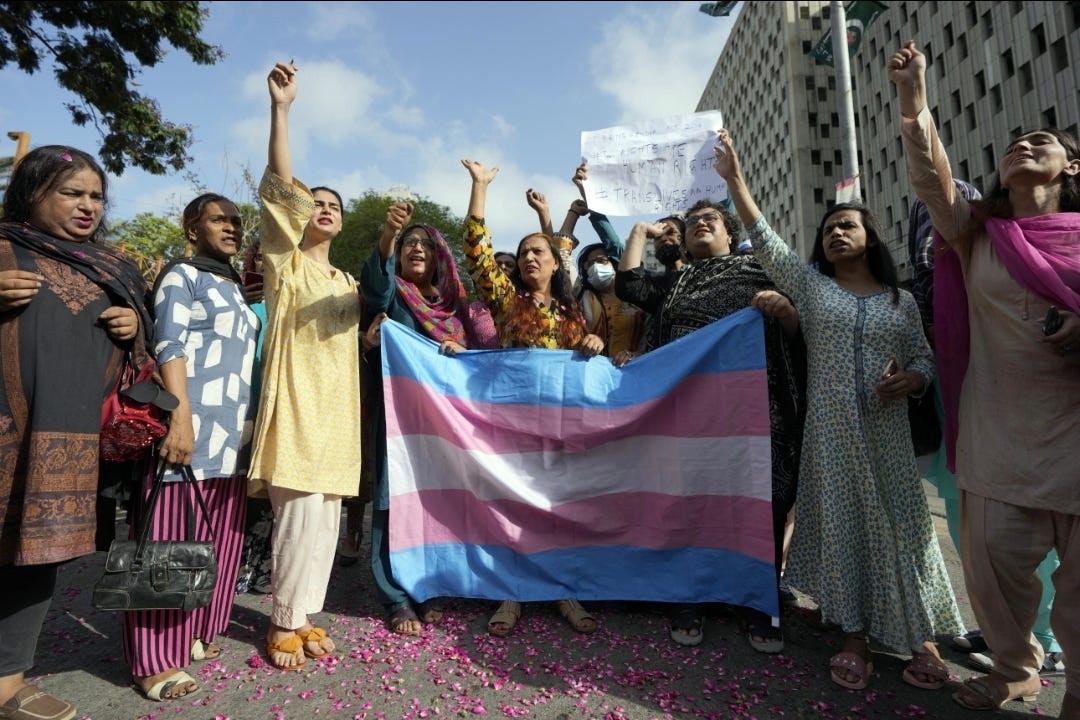
On May 19, 2023, Pakistan’s Federal Shariat Court struck down key sections of the law, including provisions tied to self-defined gender identity and inheritance. The court’s decision was framed around claims that the act could allow men to enter spaces reserved for women. But advocates and rights groups warned that stripping legal recognition from trans people would not make anyone safer. It would make trans people easier to exclude.
Years later, trans people in Pakistan are describing what that rollback looks like in daily life: medical care that exists on paper but disappears in practice, families that push trans people out, jobs that become inaccessible, public spaces that become dangerous, and violence that follows trans people from streets to homes.
The legal fight is not symbolic. Legal recognition affects whether a person can document who they are, inherit property, seek work, access services, enter public institutions, and move through society without being forced back into a category that erases them. When recognition is stripped back, the harm does not stay inside court documents. It moves into hospitals, homes, police stations, workplaces, and streets.
Before the court decision, Amnesty International urged Pakistani lawmakers to reject changes that would weaken the 2018 act, warning that such changes would violate international human rights laws and standards. The warning was clear: rolling back the law would expose trans people to deeper discrimination, not protection.
That warning now reads less like a prediction and more like a record.
Gender-affirming care remains legal in Pakistan, but legal access does not mean actual access. For many trans people, care is expensive, scarce, and pushed into unsafe or underground settings.
One trans woman, Bunty, described having to seek breast augmentation from one of the only willing and qualified doctors she could find. She said she was charged twice what a cisgender customer would have paid and that the procedure took place in an underground environment. After surgery, she said she was forced to leave within hours while in extreme pain.
That is not healthcare access. That is survival through medical abandonment.
Bunty’s story also shows how legal and social rejection compound. She described being shunned by her family, forced to change her name, pushed out of her career, and eventually forced into sex work. Each harm narrowed the next set of options: family rejection narrowed housing, employment exclusion narrowed income, medical discrimination narrowed safe treatment, and public stigma narrowed the paths left for survival.
This is how institutional exclusion becomes a survival trap.
Reem Sharif, a member of a dera, a communal household for trans people in Pakistan, described public hospitals turning away trans people seeking gender-affirming services. She quoted one healthcare worker asking, “Have fear of God, how can you try to do this?”
That sentence carries the shape of the problem. It is not only that care is unavailable. It is that trans people seeking care can be treated as shameful for needing it at all.
A dera can provide community, shelter, shared resources, and emotional survival. But community networks should not have to replace state protection, public healthcare, family safety, and equal access to work. When trans people are forced to rely on each other because institutions reject them, solidarity becomes lifesaving. It should not become the only safety system left.
The violence described in recent reports is severe.
In September 2025, three trans women were shot and killed outside a restaurant while begging in Karachi. Only months later, Zehrish Khanzadi and Bindiya Rana, two trans women leading the Gender Interactive Alliance Pakistan, were reportedly at home when armed gunmen fired through their front door. Khanzadi said Rana narrowly escaped all three bullets.
The attack matters not only because it targeted trans women, but because it reached into the home of people doing advocacy work. A front door is supposed to mark some boundary of safety. For trans advocates under threat, even that boundary can collapse.
Another attack came when a trans woman named Nadira was begging in Karachi and was stabbed after rejecting a man’s sexual advances. She reportedly needed a blood transfusion and dozens of stitches. The details are brutal, but the larger pattern is just as important: poverty, public exposure, sexual harassment, and anti-trans violence collide in the same places where trans people are forced to survive.
Begging and sex work should not be used to stigmatize trans people. They should be read as evidence of economic exclusion. When families reject trans people, employers refuse them, schools fail them, and legal systems strip recognition away, survival work becomes one of the few remaining paths to food, shelter, and community support.
That is not moral failure. That is institutional failure.
A trans man named Zarun Ishaqu described threats inside his own family. He said his brother threatened to kill him and demanded that he be thrown out of the house, blaming him for damaging the family’s honor and reputation.
That kind of threat shows how gender policing operates inside family systems as well as public institutions. Legal erasure gives social rejection more room to breathe. When the state weakens recognition, families and communities can hear permission to punish people who refuse to disappear.
The harm is not only legal. It is cultural, medical, economic, and physical.
It is also not the whole story.
Even under pressure, trans people in Pakistan continue to build survival networks, defend each other, name themselves, and claim joy. Zarun and another trans man, using the pseudonym Haroon, spoke about the violence around them but also about the truth of living as themselves. Haroon said his inner self had come out and that he was happy with his life that way.
That line matters because trans survival should not be reduced only to suffering. Violence must be documented. Medical exclusion must be named. Legal rollback must be challenged. But trans people are not only victims of the systems attacking them. They are people building life, community, identity, and joy inside conditions designed to deny them all four.
The danger is that law can either protect that life or make it easier to target.
Pakistan’s 2018 act recognized that trans people needed more than tolerance. It recognized documentation, inheritance, healthcare, education, employment, public access, and protection as connected rights. The 2023 ruling struck at that framework by attacking self-defined gender identity and related protections.
Once recognition is weakened, every other right becomes harder to hold. Healthcare, inheritance, employment, family safety, public protection, and access to institutions all become easier to deny when trans people are treated as problems instead of people entitled to protection.
That is why legal recognition is not paperwork. It is a survival condition.
The stories coming out of Pakistan show what happens when recognition, healthcare, safety, and economic access are treated as optional for trans people. Rights are not removed in isolation; legal rollback can move through hospitals, families, workplaces, streets, and survival economies until public vulnerability becomes danger.
This is the chain that legal rollback helps create.
The answer is not to treat trans people in Pakistan as helpless or to turn their lives into international pity. The answer is to recognize the specific systems failing them and the local advocates resisting those failures. Trans communities in Pakistan have built organizations, households, support networks, and legal resistance under pressure. They are not waiting to be saved. They are demanding that the state, medical systems, families, and public institutions stop making survival more dangerous.
The lesson reaches beyond one country. When governments weaken gender recognition, the result is not an abstract legal adjustment. It changes whether trans people can access documents, healthcare, inheritance, housing, work, and safety. It gives social hostility more institutional cover.
Pakistan’s trans communities are describing the cost of that cover in real time.
The court ruling may have struck at sections of a law. The harm that followed did not stay in court. It followed trans people into clinics, homes, streets, workplaces, and survival economies.
That is why this record matters. Legal recognition is not symbolic. Healthcare access is not symbolic. Safety is not symbolic. When trans protections are stripped back, the consequences are counted in pain, displacement, poverty, and lives at risk.
Legal rollbacks do not just change statutes. They make trans people easier to exclude, overcharge, displace, attack, and erase.
Upgrade to a paid subscription to support documentation of these fights because trans people deserve safety, healthcare, housing, legal recognition, and survival support before institutions turn their lives into policy battlegrounds.