

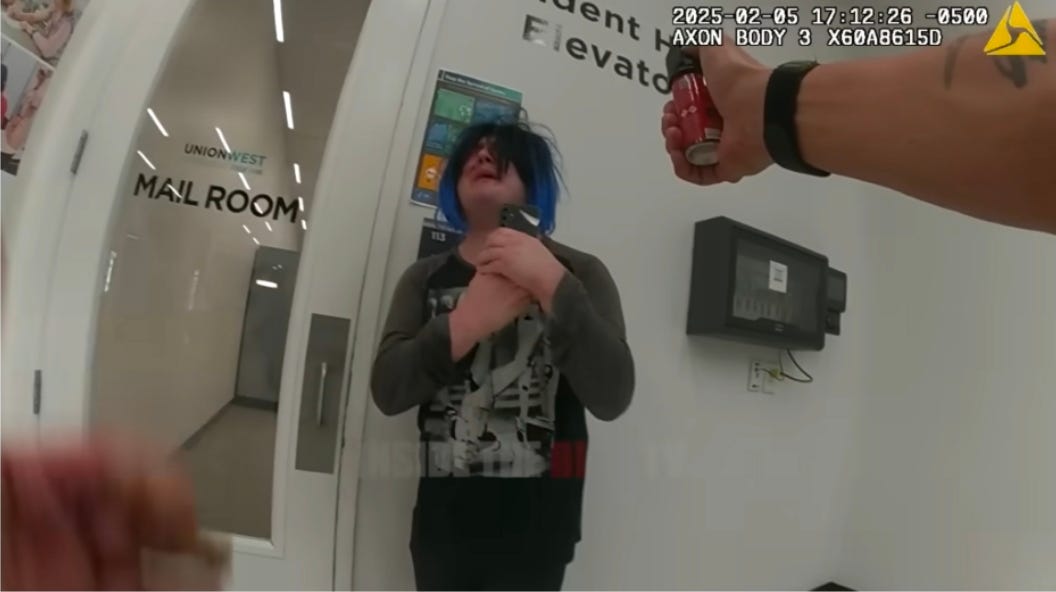
The headlines arrived more than a year after the arrest, but they were written to make the humiliation feel new.
A trans University of Central Florida student had “freaked out.” She had “melted down.” She had staged a “tantrum,” screamed at police, become “combative,” and produced a “shocking outburst.” Search results placed those descriptions beside selected images of Jarrett Preston Vick crying, shouting, being restrained, and standing before officers during an encounter that ended with pepper spray, a Taser, handcuffs, and arrest. Several outlets also misgendered her.
The coverage did more than report that police arrested a trans woman. It repeated the degradation visible inside the footage, converted her most vulnerable moments into clickable images, and taught audiences to treat her identity and distress as the joke.
The encounter occurred on February 5, 2025, while UCF police were responding to a matter involving a possible stolen vehicle near the UnionWest complex. Reporting reviewed for this article does not identify Vick as the person suspected of stealing it. She became involved while officers were already present.
The publicly circulated bodycam footage shows Vick speaking loudly and challenging the officers. During the escalating interaction, an officer refers to her with male language. She immediately corrects him and repeatedly says “she.” She later asks a university employee to tell officers to use the correct pronouns because the continued misgendering is causing her distress, leaving no ambiguity about how she identifies or how she asked to be addressed.
One officer displayed and later deployed pepper spray. Additional officers arrived. Police alleged that Vick kicked or swung toward officers before another officer used a Taser. She was placed in handcuffs and taken into custody.
Reports identify charges of battery on a law-enforcement officer, resisting an officer without violence, and disorderly conduct. Vick pleaded not guilty. Reports conflict over the case’s final status, and the underlying disposition was not available in the records reviewed for this article.
That unresolved record does not change what the footage shows: officers repeatedly misgendered a trans woman after she corrected them, then used chemical and electrical force during the encounter. It also does not justify what happened when the footage reappeared in July 2026.
Inside The Blue TV uploaded the bodycam video under the title “Misgendered Student Turns Violent After Pronoun Dispute.” The framing placed Vick’s gender identity, reaction, and alleged violence at the center before viewers had seen the encounter. The upload helped launch a new media cycle around footage recorded approximately seventeen months earlier.
The New York Post described the video as “chaotic,” said Vick “freaked out,” and used male pronouns while reporting on footage in which she explicitly demanded to be recognized as a woman. The Sun promoted a “dramatic moment,” a student who “screams,” and a “shocking outburst.” Bored Panda announced that a trans student had “melted down.” Syndicated coverage used phrases such as “freaks out” and “violent reaction.”
Those descriptions told audiences where to look, whom to ridicule, and which person’s conduct should define the story. Police force became background material, repeated misgendering became an excuse for mockery, and Vick’s distress became the product.
The footage could have prompted scrutiny of why officers continued using male language after being corrected. It could have raised questions about the decision to deploy pepper spray and a Taser, the conduct of each officer, the completeness of the released footage, and whether all force reports and supervisory reviews were made public. It could have examined why an old police recording entered a new national media cycle and who selected its most humiliating frames.
Instead, outlets centered Vick’s voice, face, movements, and gender identity as evidence against her.
A person does not lose the right to be correctly identified because she is upset. A trans woman does not become a man because police arrest her. Her pronouns do not become optional because an officer, publisher, or audience disapproves of her conduct.
Misgendering was part of the encounter before it became part of the coverage. Vick corrected the officers in real time. Publishers then encountered the same record and repeated the harm while quoting her insistence that she was a woman.
The damage was not confined to one article. Search engines gathered the headlines into a wall of ridicule. The same images and descriptions spread across publishers, aggregators, social feeds, and reposts. A police encounter from 2025 became a searchable identity imposed on Vick in 2026.
The arrest created one record. The media created another.
That second record can follow her long after any criminal case ends. It attaches her name, face, trans identity, visible distress, and exposure to police force to permanent search results engineered for outrage. Employers, landlords, classmates, strangers, harassers, and anti-trans accounts can now encounter the spectacle before encountering her as a person.
Vick told the New York Post that police had harassed her and that the renewed coverage was causing further harassment. That statement should have forced outlets to confront their role. Instead, the same publications continued using the images, language, and misgendering that made the harassment easier.
The harm is not erased because bodycam footage is a public record. Public access does not require publishers to strip a person of dignity, select only the most vulnerable frames, repeat degrading language, or turn state force into entertainment.
Body-camera footage can support accountability only when the public receives enough context to scrutinize the officers as well as the person they arrested. When outlets adopt police language, allegations, selected images, and emotional focus without serious examination, the recording becomes promotional material for the state’s version of events.
That danger intensifies when the person under police control is trans. One distressed trans woman can be replayed as proof of every hostile stereotype attached to trans people: unstable, threatening, unreasonable, deceptive, and undeserving of recognition. The individual disappears inside a political script built around her most vulnerable minutes, and Vick’s arrest was treated as valuable because it could be forced into that script.
The coverage also imposed a respectability test no trans person can safely pass. Vick was expected to remain calm while being misgendered, threatened with confinement, pepper-sprayed, surrounded, Tasered, restrained, and arrested. Her distress was then used to discredit the legitimacy of that distress.
That standard protects every institution involved. Police force becomes a response to her emotions. Media cruelty becomes a response to her behavior. Misgendering becomes an incidental detail rather than a repeated act she identified during the encounter. The trans woman is required to perform perfect composure while everyone around her is permitted to escalate, record, publish, mock, and profit, even though trans people do not earn dignity through compliance.
The record must remain precise. The footage does not establish that misgendering was the sole reason for Vick’s arrest. Police allegations concerning her conduct remain allegations, and the final court disposition has not been independently confirmed here. Those factual limits do not require accepting the media’s framing because what is established is enough to expose the harm.
Vick repeatedly identified herself as a woman. Officers continued using male language. Police deployed pepper spray and a Taser. She was handcuffed and arrested. More than a year later, media outlets revived the footage, selected her most distressed moments, misgendered her again, and sold the encounter as entertainment.
The publications involved had choices. They could have reported the charges without humiliation. They could have used her correct pronouns. They could have described the force visible in the recording with the same intensity they applied to her reaction. They could have investigated the delayed release, the missing official records, the force reviews, and the unresolved court disposition. Instead, they chose spectacle.
That choice extended the encounter beyond the hallway where it began. Police exercised force over Vick in 2025. Media companies shaped how millions of people were instructed to see her in 2026 through repetition, search visibility, ridicule, and permanent digital exposure, creating a second punishment outside any courtroom.
Jarrett Preston Vick should not have to disappear from public life because publishers decided that her arrest, gender identity, and distress could generate traffic. She should not be forced to compete forever with headlines that misgender her and reduce her to the worst minutes captured by a police camera.
Every outlet that published the footage this way has a responsibility to correct the pronouns, remove the mocking language, stop presenting pepper spray, Taser deployment, handcuffing, and public distress as entertainment, and disclose what records were reviewed, what footage was omitted, and what remains unknown.
A trans woman under police force is not a punchline, a reaction clip, or raw material for another anti-trans spectacle. She is a person whose dignity did not vanish when the camera turned on.
Trans people are being targeted not only through laws and state policy, but through media systems that turn their fear, pain, and public exposure into profitable content. Trans United documents that harm while keeping trans people—not the institutions exploiting them—at the center of the public record.
Support independent trans-accountability reporting and help sustain this work.
When I was younger (in my 20s), I had similar outrages like this. You're absolutely right about the sickening psychopathy displayed against Jarrett and others like her. The United States should not be a nest of demons extracting pleasure like bloodsucking insects from the torment of targeted minorities.
🤬🤬🤬🤬🤬