
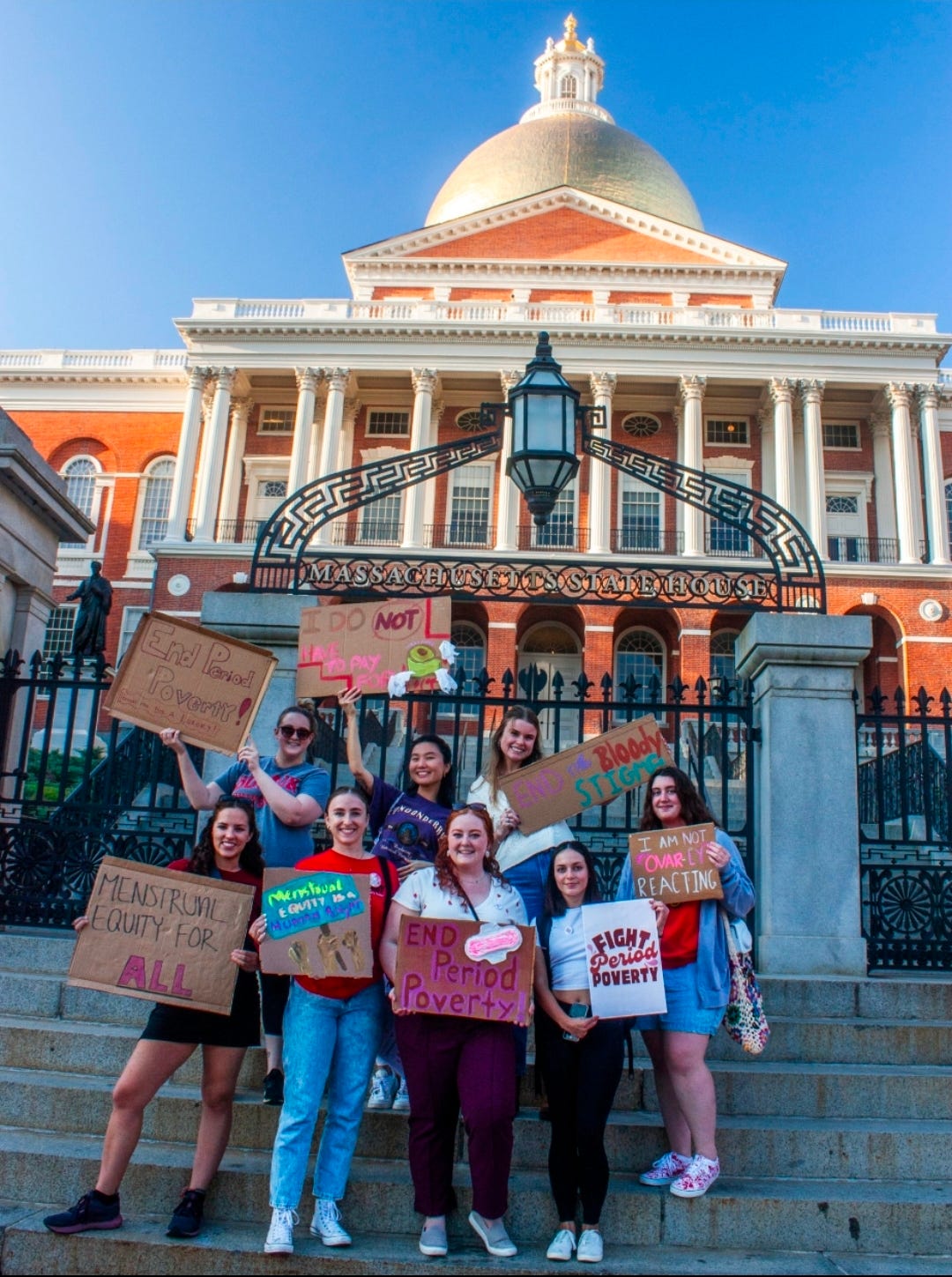
People arriving for free menstrual products, period underwear, food, and conversation had to walk past protesters filming and shouting at them. They were not entering a political rally or confronting anyone else’s rights. They were attending Trans Period Pride, a small Boston gathering created for transgender, nonbinary, and intersex people who menstruate. Right-wing media had already turned the event into an outrage target, threats forced organizers to abandon its original Boston Public Library venue, and the intimidation followed attendees to the protected replacement location. Anti-trans actors manufactured the danger, then forced the people they targeted to carry the cost of surviving it.
Mass NOW and the Massachusetts Transgender Political Coalition organized the event around menstrual equity, health information, dignity, and community. Attendees could receive menstrual products and period underwear, share food, and speak openly about experiences frequently erased from public-health conversations. The gathering existed because menstruation does not belong exclusively to women and because trans, nonbinary, and intersex people deserve information and care that recognize their bodies without misgendering them. The event answered isolation with community and stigma with practical support.
Trans people who menstruate can face hostility in spaces that should be routine. Buying products, using a public restroom, asking a medical question, or discussing a period can expose someone to misgendering, unwanted attention, or pressure to explain their identity. Health information is often written as though every person who menstruates is a woman, leaving others to search for language and care that do not erase them. Public restrooms can carry the additional danger of confrontation or being outed. Trans Period Pride created a space where attendees did not have to defend their existence before receiving basic information or supplies.
Right-wing media stripped that purpose away and replaced it with a spectacle. Agitators framed trans-inclusive menstrual care as political extremism, amplified false claims about public money, and treated the presence of trans people as evidence of institutional corruption. The coverage did not function as an honest examination of funding or policy. It removed context, provoked anger, and directed that anger toward a vulnerable community gathering. Once the outrage machine identified the event as a target, online hostility became a real-world safety problem.
Organizers had to abandon the original venue and find another location. They protected the replacement site, developed a security plan, managed access, and redirected time and attention that should have gone toward the gathering itself. That move was not a harmless scheduling change. It was the material consequence of anti-trans intimidation. A health-and-community event was driven from a public institution because strangers made open access unsafe.
The burden did not end when the gathering moved. Sasha Goodfriend, executive director of Mass NOW, said protesters still appeared at the replacement location, held signs, filmed attendees, and shouted at people entering. The replacement site had been protected because organizers understood the threat, yet anti-trans protesters tracked the gathering into its new space anyway. They turned arrival into another test of safety and dignity. People seeking period products and community had to decide whether to walk past strangers documenting and condemning them.
That surveillance was part of the harm. Filming people at a trans-focused gathering can expose attendees who have not disclosed their identities publicly, place images into hostile online networks, and extend intimidation long after the event ends. Shouting at people as they enter leaves them watched, exposed, and unsafe. The protesters did not need to stop the gathering physically to impose a cost. They forced attendees to absorb fear and public hostility before they could access health information, supplies, food, and community.
Inside, the gathering remained what it had always been: people sharing food, receiving products, discussing menstruation, and finding community. The ordinary nature of what happened inside exposes the cruelty of what was built around it. There were people meeting health needs that mainstream institutions often ignore. Nothing inside justified the threats, secrecy, intimidation, or protest line outside. The danger existed because anti-trans actors brought it with them.
Anti-trans politics frequently works by transferring the consequences of its aggression onto the people it targets. Right-wing outlets generate outrage, online agitators spread it, and protesters carry it into physical space. Organizers then have to conceal locations, manage entry, prepare attendees for confrontation, and build protection around activities that should require none. Trans people must decide whether receiving care is worth the possibility of being filmed, identified, or harassed. The aggressors manufacture the threat while the targeted community is forced to organize, absorb, and navigate its own safety burden.
That pressure produces isolation. It tells trans people that gathering openly will attract surveillance, that asking for inclusive care will provoke hostility, and that public institutions may become unusable once right-wing media points a crowd toward them. The effect is to pressure people to stay home, avoid visibility, and accept that basic care must happen in secrecy. Exclusion does not always require a law or formal ban. Make participation dangerous enough, and access begins to disappear on its own.
The original Boston Public Library venue matters because libraries are supposed to provide information, public space, and community access. Anti-trans agitators made that access unsafe for the people the gathering was meant to serve. They converted a public meeting into a liability and forced organizers to retreat to a protected location. The result was not merely inconvenience. It showed how threats can push marginalized communities out of institutions that are supposed to belong to everyone.
The gathering continued because organizers and attendees refused the isolation being imposed on them. They relocated, secured the space, crossed the protest line, and met anyway. That persistence should not erase what was taken from them. They lost the ability to gather openly without security planning, to enter without being filmed, and to treat menstrual care as the ordinary health matter it is. Survival does not make intimidation harmless.
Trans Period Pride was necessary before the backlash and became even more necessary because of it. Trans, nonbinary, and intersex people still need menstrual products, accurate information, affirming care, and places where their experiences are not treated as contradictions. Right-wing outrage did not make those needs disappear. It only proved how aggressively some people will fight to deny trans people ordinary dignity. The community’s response was not to debate its own existence but to continue caring for one another.
People came for food, menstrual products, period underwear, honest conversation, and community. They should not have needed a protected location and a security plan to receive any of it. The gathering itself was never the threat. The danger came from the people who turned trans bodies and basic health care into targets, drove the event from its original venue, and followed attendees to intimidate them anyway. Anti-trans agitators tried to turn care into fear. The community entered anyway.
A small event built around menstrual care became a test of whether trans people could gather without being driven into hiding.
Upgrade to a paid subscription for exclusive Trans United reporting, deeper analysis of anti-trans institutional harm, and continued documentation of the people, policies, and movements placing trans lives at risk.