

The anti-trans movement is not only trying to restrict rights. It is building systems of erasure.
That erasure does not always announce itself with open hatred. It can arrive through healthcare rules, legal definitions, school policies, identity documents, public records, funding decisions, data categories, and official language that decides who counts, who is believed, who receives care, and who can be protected. It can appear in the language of caution. It can be defended as neutrality. It can be packaged as evidence-based policy. But the outcome matters more than the label. When a policy makes trans people harder to recognize, treat, protect, document, house, or keep alive, the policy is not neutral.
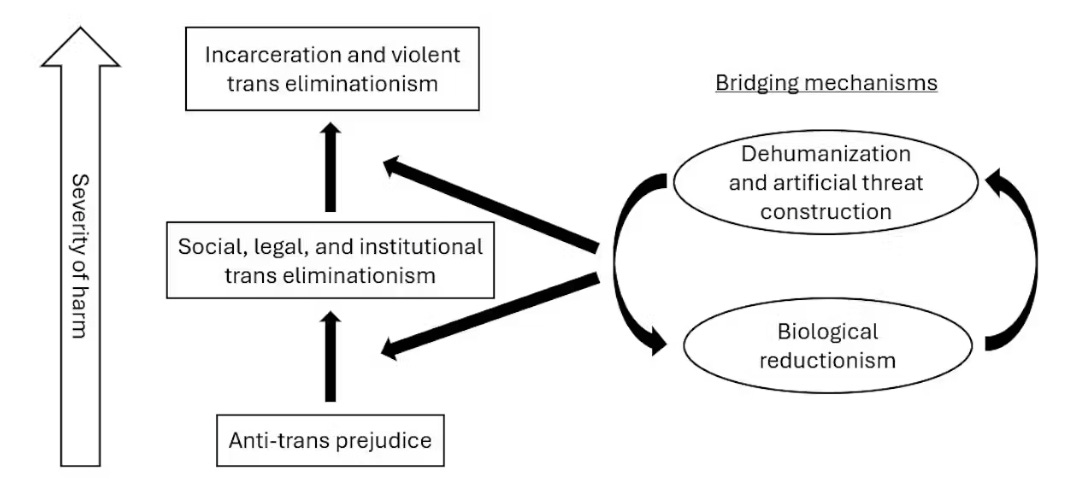
A recent framework on trans eliminationism gives clearer language for what is happening. Instead of treating every anti-trans policy as a disconnected restriction, the framework describes how anti-trans ideology can escalate from prejudice into systems that remove trans people from social, legal, institutional, conceptual, and physical life. That distinction matters because “anti-trans” is a broad label. It can describe many kinds of hostility, bias, or exclusion. Trans eliminationism names something more specific: political and institutional efforts that make trans existence harder to sustain.
The point is not that every anti-trans policy has the same severity or that escalation is inevitable. The point is that the pattern needs to be recognized early. Eliminationist politics does not begin only at the stage of direct violence. It can begin when institutions narrow the definitions of sex and gender so trans people become legally impossible. It can begin when healthcare systems deny care while calling that denial caution. It can begin when schools remove trans life from curriculum, when governments restrict identity documents, when public agencies erase gender recognition, and when political actors frame trans people as threats rather than as human beings.
The framework identifies several mechanisms that help prejudice become policy. One is biological reductionism. In public language, biological reductionism means reducing trans people to a single assigned or reproductive category and treating that category as the only truth that matters. Under this logic, lived identity, embodiment, social role, medical need, legal recognition, and self-understanding are dismissed as irrelevant or deceptive. The result is not just a disagreement over language. It becomes a tool for deciding whether trans people can access healthcare, update documents, enter public spaces, play sports, be protected by law, or be recognized by institutions.
Another mechanism is dehumanization. Trans people are portrayed as confused, dishonest, predatory, unstable, dangerous, contagious, or less credible than cisgender people. Once that framing takes hold, restrictions become easier to justify. A person who is treated as fully human has testimony, needs, dignity, and rights. A person framed as a threat becomes a problem to manage. That shift is how public cruelty becomes policy logic.
The third mechanism is threat construction. Anti-trans politics repeatedly casts trans people as a danger to children, women, schools, healthcare, sports, public safety, or social order. This construction creates urgency. It tells the public that discrimination is not discrimination, but protection. It allows political actors to argue that removing trans people from care, records, bathrooms, classrooms, teams, or legal recognition is a necessary act of safety.
Together, these mechanisms build the conditions for erasure. Biological reductionism defines trans people out of legitimacy. Dehumanization lowers the social cost of harming them. Threat construction turns that harm into a supposed public good.
This is why the language of “restriction” is often too small. A healthcare ban is not only a restriction on care. It can be a system telling trans people their embodied needs are not real enough to deserve treatment. A document rule is not only paperwork. It can decide whether a trans person can move through employment, housing, travel, healthcare, schools, shelters, courts, and public agencies without being exposed or denied. A school policy is not only a local rule. It can teach trans kids that their names, pronouns, histories, and safety are conditional.
Legal erasure works through ordinary systems. It can happen when sex and gender are redefined so trans people cannot be accurately recorded. It can happen when civil rights protections are narrowed so discrimination becomes harder to challenge. It can happen when public records force a trans person into an identity that does not match their life, body, community, or safety needs. It can happen when healthcare reports claim caution while the practical effect is denial.
This can look like a state refusing to update identity documents, a school forcing a trans student into records that expose them, a healthcare system treating gender embodiment care as suspect by default, or a government redefining sex so narrowly that trans people become impossible to recognize in law. These measures may appear technical on paper, but the consequence is practical: a trans person becomes easier to deny, misgender, exclude, surveil, or endanger.
Medical erasure is especially dangerous because healthcare is not symbolic. For trans people who need gender embodiment care, mental health support, HIV prevention, hormone access, surgery, reproductive care, emergency care, or trauma-informed treatment, exclusion can shape survival. When institutions make care unavailable, delayed, stigmatized, or legally risky, the result is not a neutral pause. It is harm.
The impact does not land evenly. Trans kids are targeted through schools, sports, healthcare, family surveillance, and public narratives that turn their existence into a controversy before they are old enough to vote on the policies shaping their lives. Black trans women are forced to navigate anti-trans hostility alongside racism, misogynoir, housing discrimination, employment barriers, policing, and violence. Unhoused trans women face erasure in shelter systems that may misgender them, exclude them, or place them in danger. Incarcerated trans people can be stripped of recognition, denied appropriate placement, denied healthcare, and exposed to violence inside institutions that already operate through control and punishment.
Disabled trans people, poor trans people, migrant trans people, and trans people without family support face added barriers when policy turns recognition into a maze. The more a person depends on public systems, the more dangerous administrative erasure becomes. A law that looks abstract to someone with money and protection can become immediate survival risk for a trans woman trying to access housing, medication, identification, transportation, safety, or emergency care.
That is why Trans United’s frame is not only rights language. Rights matter, but survival is broader than rights. Trans people need healthcare that recognizes them, records that do not endanger them, schools that do not erase them, shelters that do not expose them, courts that do not misname them, and public systems that do not treat their existence as a problem to be solved.
The anti-trans movement understands the power of institutions. It knows that erasure can be built through definitions, eligibility rules, record systems, licensing standards, school policies, insurance exclusions, funding choices, and official guidance. It knows that if trans people can be made illegible inside those systems, the harm will continue even when no one uses openly violent language. A person does not have to be physically removed from public life all at once to be pushed out of healthcare, documents, schools, housing, safety, and social recognition piece by piece.
That is what makes “neutral” policy language so dangerous when it is used to hide predictable harm. A policy should be judged by what it does. If it makes trans people harder to recognize, it is not neutral. If it makes healthcare harder to access, it is not cautious. If it exposes trans people to danger through documents or records, it is not administrative housekeeping. If it removes trans lives from schools and public language, it is not protecting children. If it treats trans existence as a threat to be managed, it is part of the machinery of erasure.
None of this means escalation cannot be stopped. The framework’s warning is useful precisely because it identifies the mechanisms early. Harm can be interrupted when dehumanization is named, when threat narratives are challenged, when biological reductionism is exposed as a political tool, and when institutions are forced to answer for the consequences of their policies. Resistance begins with refusing to accept the story that erasure is merely caution.
The public does not need softer language for what is happening. It needs more accurate language. Anti-trans politics is not only a backlash. It is not only a debate. It is not only a series of disconnected bills. In its most dangerous form, it is an effort to make trans people less visible, less credible, less protected, less treatable, less documentable, and less able to survive inside the systems that govern everyday life.
That is why trans eliminationism matters as a framework. It names the movement from prejudice to policy, from policy to erasure, and from erasure to conditions where greater harm becomes easier to justify. The danger is not only the loudest rhetoric. The danger is the quiet normalization of systems that tell trans people they are too controversial to protect, too illegitimate to recognize, and too threatening to exist in public life without restriction.
Erasure escalates one definition, one denial, one restriction, one record, and one compromise at a time. It can be interrupted, but only if it is recognized before institutions finish building it.
Trans erasure does not only happen in slogans. It happens through systems.
It happens when healthcare is denied, records are rewritten, schools erase trans kids, shelters endanger trans women, and public institutions treat trans existence as a problem to manage instead of a life to protect.
Trans United documents these harms because policy erasure is not abstract. It lands on real trans kids, real trans women, Black trans women, unhoused trans women, incarcerated trans people, disabled trans people, and communities forced to fight for recognition, care, safety, and survival.
Upgrade to a paid subscription to support Trans United and help keep this documentation going.