

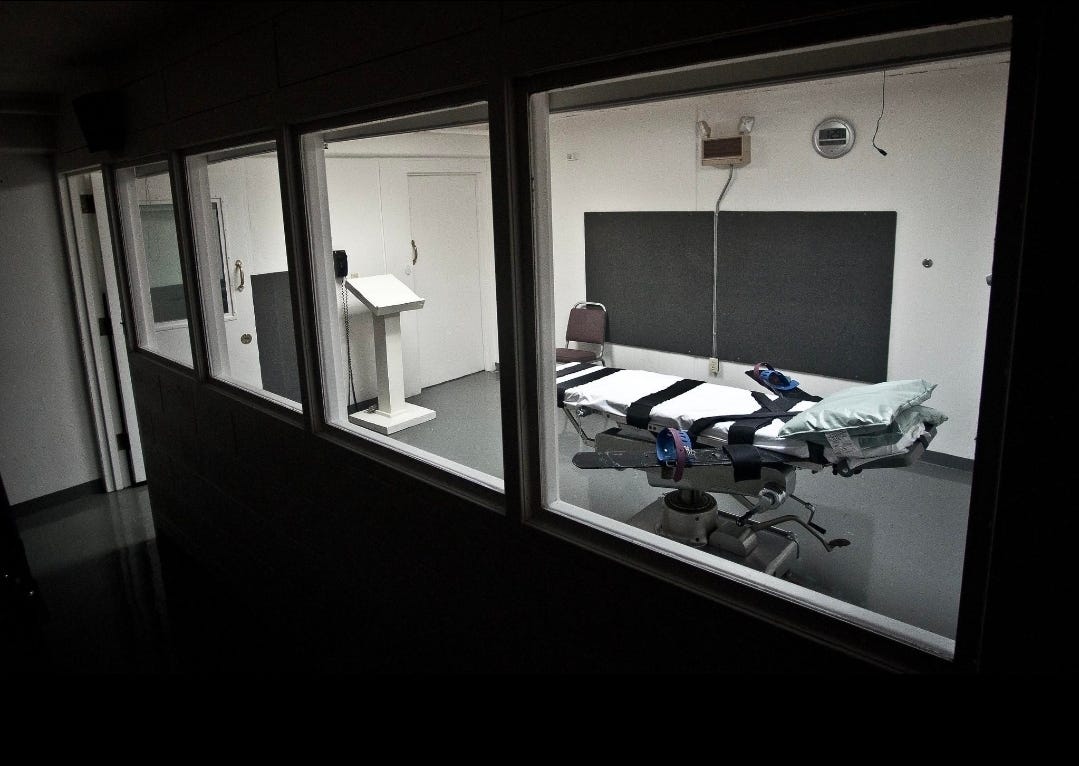
Six known trans women currently live under death sentences in the United States. Most are confined in men’s prisons, dependent on the state for housing, medical treatment, physical protection, legal access, and recognition of who they are. Their convictions gave the government enormous control over their lives. That control is being used to impose forms of suffering that were never ordered by a judge or jury.
Their underlying crimes were grave, and the people harmed or killed in those crimes remain part of the record. Criminal responsibility does not authorize prison officials to place trans women in predictably dangerous conditions, interrupt medically necessary treatment, disregard sexual-assault risks, erase them through official records, or treat contempt for their identities as an ordinary part of confinement.
The sentence imposed in court is the sentence. Forced detransition, unsafe placement, medical deprivation, sexual-violence exposure, and institutional humiliation are additional punishments created through anti-trans power.
Amber McLaughlin reached the most extreme end of that machinery on January 3, 2023, when Missouri executed her by lethal injection. She became the first openly transgender person known to have been executed in the United States. That distinction should not turn her death into spectacle. The more consequential record is how Missouri obtained and exercised the authority to kill her.
Jurors at McLaughlin’s trial did not unanimously agree that she should receive the death penalty. Missouri law allowed the trial judge to take the decision from the deadlocked jury and impose death himself. Retired judges, members of Congress, and McLaughlin’s attorneys urged then-Gov. Mike Parson to commute the sentence, arguing that the state’s capital-sentencing system had placed the life-or-death decision in the hands of one person after the jury failed to reach unanimity.
Parson denied clemency. Missouri carried out the execution.
McLaughlin became historically visible at the precise moment the government made her disappear. The state controlled where she lived, what treatment she received, how officials identified her, whether her pleas were heard, and ultimately whether she continued to breathe.
Prism identified six trans people currently under death sentences, all of them women. That figure is the best documented count available, not a permanently complete census. Prison systems collect gender-identity information inconsistently. Some incarcerated people do not disclose that they are trans because disclosure may expose them to violence. Others transition or begin publicly identifying as trans after conviction. Official records can remain attached to former names and classifications that erase the person the institution is holding.
That uncertainty has not stopped Republican officials and anti-trans media figures from portraying transgender prisoners as a sweeping threat to prison order and public resources. A tiny population has been inflated into a national political enemy because incarcerated trans people are among the easiest people for the government to isolate, control, and publicly degrade.
Donald Trump converted that hostility into federal prison policy on the first day of his second administration. His executive order directed federal agencies to recognize sex through a rigid birth-based classification, ordered prison policy to follow that framework, and instructed the government to stop funding treatment intended to support an incarcerated person’s transition.
The order specifically targeted where trans women could be housed and whether they could continue receiving gender-affirming medical care.
For a person in custody, those decisions are not abstract disagreements over classification. They determine who surrounds her while she sleeps, showers, changes clothes, seeks treatment, and reports abuse. A trans woman in federal prison cannot leave a dangerous unit, independently select another physician, purchase medication without authorization, or escape staff who refuse to recognize the risks surrounding her.
When the government transfers her into a men’s prison or disrupts established treatment, the government creates the danger and then controls every possible route away from it.
Federal courts have intervened in cases brought by trans women challenging the administration’s housing and medical restrictions. The resulting orders did not resolve every dispute or create one permanent nationwide rule, but they recognized that transfers and treatment disruptions could expose incarcerated trans women to immediate physical and medical harm.
The administration continued attempting to impose those restrictions through federal prison policy even while litigation remained active.
Trump presented the policy as administrative clarity. For the women affected, it became forced vulnerability. A housing classification could place them among populations where the government already knew their risk of assault was elevated. A treatment restriction could force them through physical and psychological deterioration while officials described the suffering as policy compliance.
Government data and independent research have documented extraordinary rates of sexual violence against trans people in custody. One analysis of federal survey data found that roughly 40% of transgender people in state and federal prisons reported sexual victimization, compared with about 4% of cisgender prisoners. In jails, the disparity was similarly severe.
Those figures make categorical placement policies impossible to describe as neutral. A government that knows trans people face vastly elevated risks cannot erase individualized safety decisions and then deny responsibility for what follows.
The Prison Rape Elimination Act was enacted because sexual violence in confinement is not an unavoidable feature of incarceration. It is a government failure. Standards developed under PREA require officials to consider each person’s safety individually, take a trans person’s own assessment of risk seriously, and regularly reassess placement decisions.
Removing those protections does not restore neutrality. It removes safeguards from people the government already knows are disproportionately vulnerable.
Prisons often respond to the danger they create by placing trans women in isolation and calling it protection. That can mean extended confinement alone because officials refuse to provide safety without taking away movement, programming, communication, and ordinary human contact.
The institution places a woman where she is endangered, then answers the resulting danger with another deprivation.
Medical care is subjected to the same manipulation. Anti-trans politicians present hormone treatment and other gender-affirming care as indulgences purchased for people who do not deserve them. That framing hides the reality of state custody.
A person held for years or decades cannot independently obtain ordinary treatment. The government has made itself the gatekeeper for every prescription, appointment, diagnosis, and procedure. Medical necessity does not disappear because a patient is imprisoned or politically despised. A death sentence does not authorize prison authorities to manufacture untreated suffering during the years before an execution.
Victoria Drain’s case shows how anti-trans bias can reach beyond prison administration and into the legal representation on which a capital defendant’s life depends.
Drain’s attorneys argued that her trial lawyer’s hostility toward her transgender identity affected the defense she received, including his refusal to use her name and pronouns. Courts did not accept every claim advanced on her behalf, but the allegations raised a question deeper than courtroom courtesy: whether an attorney who holds contempt for a trans client can build trust, investigate mitigating evidence, communicate effectively, and fight with the commitment required when the government is seeking death.
A capital defense lawyer does not need to approve of a client’s conduct. The lawyer must still recognize the client as a human being whose life the state is attempting to take. When anti-trans hostility enters that relationship, it can corrode the representation before a court ever decides whether the legal standard for constitutional failure has been met.
Jenna Rogers raised a related question about severe gender dysphoria and legal capacity. She argued that her condition affected her ability to waive a jury during the penalty phase of her trial and later waive legal representation.
The issue was whether courts evaluating life-or-death waivers adequately considered serious psychological distress connected to untreated dysphoria. Capital proceedings require confidence that a defendant’s decisions are knowing, competent, and voluntary. A legal system that dismisses gender dysphoria as illegitimate cannot honestly claim to have assessed those decisions without bias.
Courts are not the only institutions shaping how incarcerated trans women are treated. Media outlets help create the public permission that makes abuse easier to impose.
The pattern is familiar. A woman’s crime is repeatedly foregrounded while her transition is treated as a second scandal. Her former name is revived. Her pronouns become optional. Her healthcare is presented as an insult to taxpayers. Her gender identity is insinuated to be evidence of deception, instability, or violence. Officials are then allowed to erase her while claiming they are merely responding to public concern.
That coverage does not simply describe punishment. It extends punishment into the public record.
Linda Hayes, Jessica Hann, Skylar DeLeon, Victoria Drain, and other incarcerated trans women have been subjected to coverage that turns their identities into grotesque curiosities. In the most dangerous versions, transition is presented as connected to criminal violence without evidence. That false association feeds a political campaign that depicts trans people as inherently threatening and then uses the supposed threat to justify stripping rights from people far beyond the prison system.
Media outlets do not have to minimize a crime to report on a trans defendant without dehumanizing her. They must decide whether they are documenting state power or supplying propaganda for its abuse.
These women are punished in layers. Politicians create categorical anti-trans policy. Prison officials impose the housing and medical decisions. Courts determine whether the resulting harm receives meaningful relief. Defense attorneys decide whether transgender clients receive committed representation. Media outlets decide whether the public sees a human being under government control or a spectacle whose suffering should provoke applause.
No institution creates the entire system alone. The harm becomes durable because each institution strengthens the others.
The six women on death row sit at the most extreme edge of conditions affecting thousands of trans people in state and federal custody. The same mechanisms appear throughout prisons and jails: unsafe placements, interrupted hormones, denial of medically necessary care, official deadnaming, retaliatory discipline, isolation described as protection, and political campaigns portraying their continued existence as a threat.
Death row makes the structure easier to see because the state’s control is nearly absolute. A woman awaiting execution cannot leave an abusive prison, select another medical provider, determine how the court identifies her, or correct every public account that treats her transgender identity as another offense.
The state cannot control where a woman sleeps, what medicine enters her body, whether she is protected from assault, how she is named in official records, and whether she lives or dies—then deny responsibility for the conditions it deliberately creates.
A death sentence gives the government power over whether a person will live. It does not give prison officials, politicians, courts, lawyers, or media outlets permission to turn transgender identity into an additional punishment.
These six women expose what happens when custody becomes an excuse for erasure: the state does not merely confine them for their crimes. It uses their total dependence on government power to make being transgender another condition of suffering.
Trans United keeps the public record open. Paid subscriptions fund the deeper legal analysis, institutional tracking, and sustained reporting required to document what governments, prisons, courts, and media institutions do to trans people when they believe no one is watching.
Upgrade to paid and help fund the record they would rather leave buried.
In the UK there's a saying, if you can't do the time, don't do the crime. If someone ends up on death row it's because they've been found guilty.