

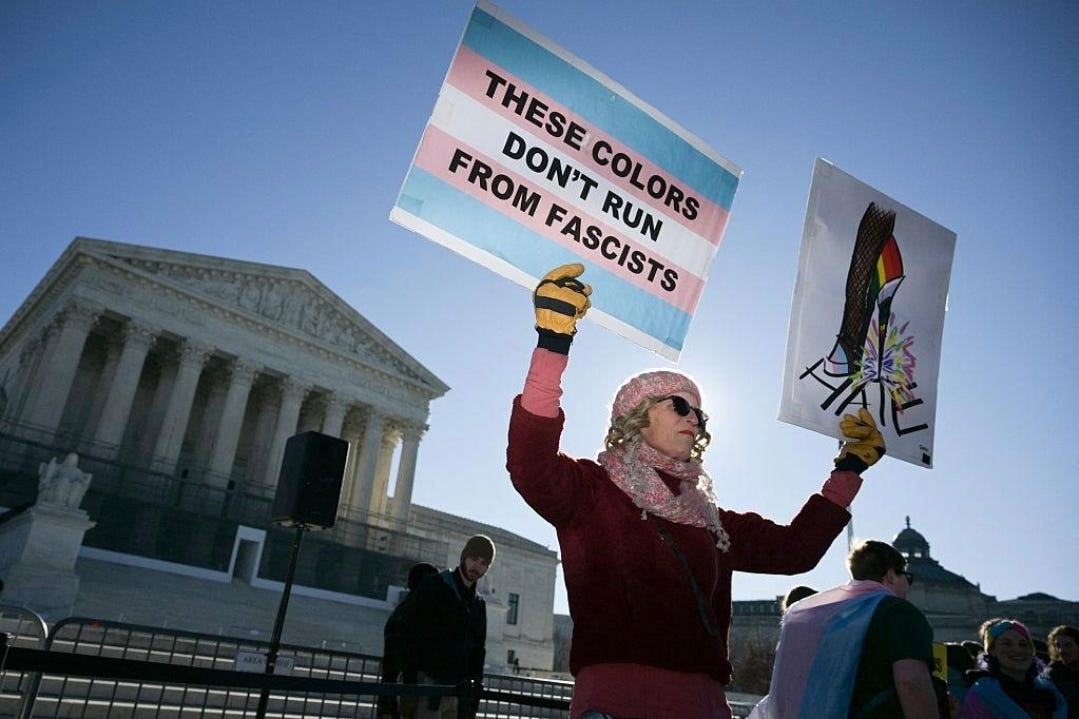
The Supreme Court is not only deciding who can play on school sports teams. It is being asked whether states can use trans kids as the test case for narrowing equal protection.
That is the danger underneath Little v. Hecox and West Virginia v. BPJ. Both cases are publicly framed around school sports, fairness, and sex-assigned-at-birth rules. But the legal machinery beneath that framing is larger than athletics. These cases ask whether states can classify trans students out of participation, force their bodies into government definitions, and defend exclusion as neutral policy.
For trans youth, the harm is immediate. These laws decide whether a trans girl can participate with other girls, whether her school can treat her identity as real, whether classmates or adults can question her body, and whether the state can make her existence conditional inside public education. The fact that these cases may also affect broader constitutional doctrine does not make trans kids symbolic. They are the direct targets.
Little v. Hecox comes from Idaho’s 2020 law restricting participation on girls’ and women’s school sports teams based on sex assigned at birth. The law did more than exclude trans girls and women. It also created a process for questioning a student athlete’s sex and pushing her toward medical verification. That matters because a policy written in the language of sports can become a system for body policing.
West Virginia v. BPJ comes from a similar ban requiring public school sports teams to be designated by “biological sex.” The case involves a trans girl who sought to continue participating on girls’ teams. West Virginia’s law is defended as a sports rule, but the legal question reaches deeper into Title IX and the 14th Amendment’s guarantee of equal protection.
The public argument is familiar. States claim these bans protect fairness, safety, and opportunity in girls’ sports. That language is designed to sound narrow and reasonable. But Trans United’s concern is the machinery being built under that language: sex-assigned-at-birth classifications, school enforcement, medical scrutiny, legal suspicion, and the idea that trans students can be treated as exceptions to equal protection because their rights are politically contested.
That is why the “sports” frame is too small.
A sports ban does not stay on the field. It follows a student into locker rooms, rosters, school records, medical files, parent meetings, disciplinary systems, and public debate over whether her body is legitimate. It teaches schools to look at trans girls as problems to manage. It teaches adults that suspicion is a policy tool. It teaches other students that a trans classmate’s participation is open to challenge.
The Idaho law’s medical verification mechanism shows how quickly this moves from athletics into bodily control. When a student’s sex can be questioned, the issue is no longer simply team assignment. The state has created a path for scrutiny. A girl can be forced into a defensive posture around her body because someone else decides she does not look, move, compete, or exist in a way the state recognizes.
That harm does not only fall on trans girls. Cisgender girls who are perceived as masculine, too strong, too fast, too tall, too Black, too brown, too visibly outside narrow expectations of femininity, or otherwise “suspicious” can also be pulled into this enforcement logic. But that broader harm begins with anti-trans law. The state targets trans girls first, then builds systems that make body policing easier for everyone.
The constitutional danger is not abstract. Equal protection is supposed to mean the government cannot simply decide that one group is easier to exclude because that group is unpopular, small in number, or politically vulnerable. When the Court hears arguments about whether a law is constitutional for most people but harmful to a smaller subclass, the question becomes whether the Constitution protects the person standing at the edge of the majority’s comfort.
That is where these cases become especially dangerous for trans youth. The state’s argument depends on making the harmed group look narrow enough to dismiss: a small number of students, a sports-specific rule, a single category, a limited policy. But constitutional injuries do not become harmless because the target is small. A right that disappears for one trans student is still a right the state has learned how to narrow.
Justice Ketanji Brown Jackson and Justice Sonia Sotomayor pressed that concern during oral argument. Their questions pointed toward the human beings inside the legal categories. A court can talk about percentages, subclasses, and broad applications, but a trans student does not experience exclusion as an abstraction. She experiences it as the moment the state tells her that other students receive a kind of recognition she does not.
That is the part anti-trans policy tries to hide. These bans are sold as neutral rules about categories, but the categories are doing the harm. “Biological sex” becomes the state’s preferred phrase for refusing to recognize trans students. “Fairness” becomes the public slogan for exclusion. “Protection” becomes the justification for treating trans girls as threats before they are treated as children.
This is not only about whether one athlete wins or loses a race. It is about whether a state can build law around the premise that trans girls are not really girls when recognition matters. Once that premise is accepted in schools, it can be extended into bathrooms, records, healthcare, shelters, prisons, identification documents, and every other institution where trans people need recognition to survive safely.
That is why these cases sit inside a larger anti-trans legal pattern. The same political project that attacks trans youth in sports has also attacked gender-affirming care, identity documents, military service, bathroom access, school policies, names, pronouns, and public records. The strategy is not only to win one issue. It is to make trans existence legally unstable across systems.
Sports bans are effective vehicles for that strategy because they are emotionally easy to market. Politicians can point to girls’ teams and claim protection. They can avoid saying they want broader anti-trans exclusion. They can frame the law as narrow while building doctrine that may help states defend wider restrictions later.
That is why Trans United cannot treat Little and BPJ as routine sports cases. The issue is not whether people have different opinions about athletics. The issue is whether the Court will allow states to make trans youth the place where equal protection becomes weaker.
If the Court gives states broad permission to exclude trans students under sex-assigned-at-birth rules, the impact could reach beyond sports. Schools will read the ruling. Legislatures will read it. Agencies will read it. Anti-trans organizations will read it as permission to expand the same logic into new areas of public life. The legal language may be technical, but the consequences will land in classrooms, doctor’s offices, records systems, shelters, families, and daily survival.
The most dangerous part of this moment is the attempt to make trans youth seem like a narrow exception: outside full inclusion in girls’ sports, outside sex discrimination protection, outside school recognition, and outside the full promise of constitutional equality. Once a government learns how to carve out one group, the carve-out becomes a template.
Trans kids should not have to carry that burden.
They should not have to become the test case for whether the 14th Amendment still protects people whose lives are unpopular with state lawmakers. They should not have to watch adults debate their bodies as legal categories. They should not have to prove that their exclusion matters enough to count.
The Court may describe these cases in terms of statutes, scrutiny, classifications, and educational policy. But the public should be clear about the stakes. A ruling that lets states treat trans youth as exceptions to equality would not be neutral. It would tell schools and legislatures that anti-trans policy can survive when it is dressed up as fairness.
The question is not only whether trans kids can play. The question is whether the Supreme Court will allow states to build constitutional exceptions around trans youth and then call that equal protection.
That is why these cases matter. Not because trans kids are symbols for everyone else, but because they are the ones being targeted first.
Trans rights cases are not abstract legal debates.
They decide whether trans kids are protected in schools, whether trans people can be recognized in public systems, whether healthcare and records can be used as tools of erasure, and whether survival is treated as a right or a political controversy.
Trans United documents these fights because anti-trans law does not stay inside courtrooms. It reaches classrooms, homes, shelters, clinics, records, housing, safety, and the lives of trans people forced to survive the consequences.
Upgrade to support Trans United and help keep this documentation going.