

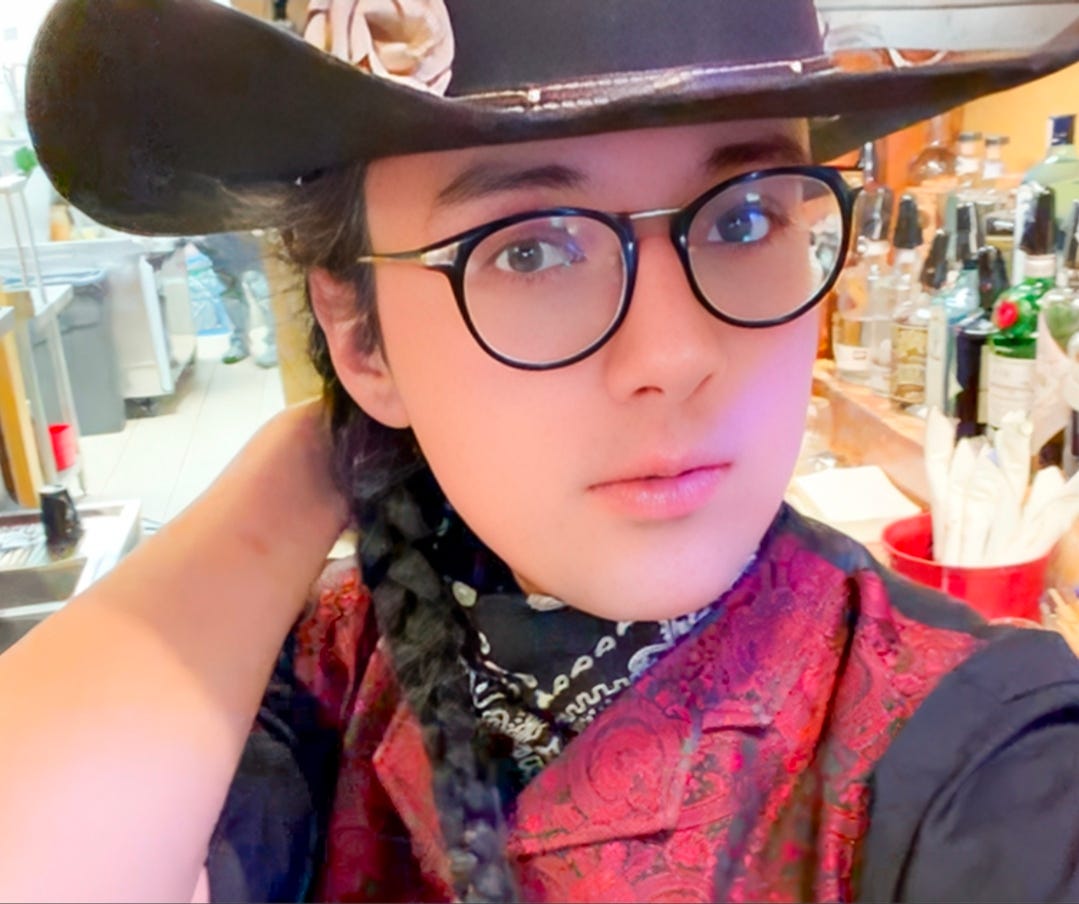
Ríhanna Kelver says she was threatened outside a Laramie bar, knocked to the ground, and forced to decide in seconds how to stop the confrontation from escalating.
Now Kelver, a trans bartender, is the person facing felony charges and possible prison time.
The case began outside the Crowbar in downtown Laramie, Wyoming, shortly before Kelver’s shift was supposed to begin. According to Kelver’s account, what started as shouting from a group of men across the street escalated into targeted harassment, anti-LGBTQ+ slurs, threats, physical force, and a moment in which she says she reached for a handgun because she believed she was in danger.
Published reporting identifies the charges against Kelver as aggravated assault and possession of a deadly weapon with unlawful intent. Those felony charges alone could carry years behind bars if she is convicted. The man Kelver says assaulted her has not been charged.
That imbalance is the center of the story.
This is not a simple gun case. It is not a clean courtroom abstraction. It is a case about a trans woman who says she was harassed, threatened, knocked down, and then treated as the criminal threat after she drew a weapon she says she did not intend to fire.
Kelver says the confrontation began before her shift, around 10 p.m., when she noticed three men across the street from the bar. She says the men first directed criticism toward the Crowbar, but that the confrontation became personal after she responded. Kelver says the men used homophobic and transphobic slurs and made threats, including language suggesting physical violence.
The account is disputed. The man identified in reporting and court documents as Durham has denied Kelver’s version of the confrontation and has said the comment was directed at the bar, not at Kelver personally. That dispute matters because the facts have not been resolved by a jury. But the existence of a dispute does not erase the question at the heart of the case: how does the legal system treat a trans person who says she was afraid?
Kelver says the situation turned physical when she was knocked or pushed to the ground during the confrontation. Reporting on the case says video evidence shows Kelver drawing and pointing a handgun after the fall. Kelver says she did not intend to fire. Her defense argues that she used the weapon to stop the threat and protect herself in a moment where retreat was not realistically available.
The prosecution’s position is different. Prosecutors argue there is enough evidence for the felony case to proceed under Wyoming law, including statutes that criminalize threatening or displaying a firearm when the use of force is not legally justified. A judge has allowed the case to move forward, meaning Kelver’s self-defense argument has not ended the prosecution at this stage and will have to be tested later in court.
That court posture is important. A judge allowing a case to proceed does not decide every contested fact. It does not mean a jury has rejected Kelver’s account. It means the prosecution met the initial burden required to move the case forward. Kelver’s defense can still argue that she acted in self-defense.
But the human consequence is already real. Kelver is the one facing felony exposure. Kelver is the one whose fear has been converted into a criminal case. Kelver is the one who must now defend her response in court while the man she says knocked her down remains uncharged.
That is the legal imbalance this case forces into view.
For trans people, fear in public is rarely theoretical. It can happen outside a bar, on a sidewalk, at work, in a bathroom, on public transit, or walking home. It can begin with slurs and become physical before anyone else decides it is serious. When a trans person says they were afraid, the question is not only what happened in the seconds after. The question is whether their fear is treated as credible in the first place.
The legal system often claims to evaluate facts neutrally. But self-defense is never only about the mechanics of force. It is also about perception. Who gets to be seen as afraid? Who gets to be seen as reasonable? Who gets the benefit of the doubt when they say they believed they were in danger?
Those questions become sharper when the person claiming self-defense is trans.
Kelver’s case sits inside that uncomfortable space. Her defense says she was outnumbered, knocked down, and responding to a threat. Prosecutors say the firearm display was serious enough to justify felony charges. The court has not yet resolved the final question of whether her response was legally justified. But the public record already shows a stark pattern: the trans woman who says she was targeted is the person facing the heaviest legal consequence.
That does not mean every contested fact should be treated as settled. It means the structure of the case deserves scrutiny.
If Kelver was knocked to the ground, why is the person she says knocked her down not facing charges? If she drew the weapon only after the fall, how should that sequence shape the self-defense analysis? If anti-LGBTQ+ slurs and threats were part of the confrontation, how should that affect the understanding of fear, danger, and reasonable response?
Those are not side questions. They are the questions that determine whether the legal system sees Kelver as someone who survived a threat or someone who became the threat by trying to stop one.
For Trans United, the issue is not whether the court should ignore evidence. The issue is whether the evidence will be interpreted in a way that recognizes trans vulnerability, public harassment, and the reality of being outnumbered during a confrontation. A self-defense claim should not become less credible because the person making it is trans.
Kelver’s case also resists the easy framing that often follows weapons charges. The gun cannot be separated from the moments Kelver says came before it: the slurs, the threats, the fall, the feeling of being surrounded, and the need to stop the confrontation. Centering only the weapon erases the fear. Centering only the charge erases the alleged harm that led to it.
That is why this case matters beyond one night outside one bar. It asks whether trans people are allowed to be afraid in ways the law recognizes. It asks whether a trans woman can claim self-defense without being immediately transformed into the danger. It asks who is believed as vulnerable and who is prosecuted as violent.
Kelver will still have to make her case in court. The facts will still be tested. The prosecution will still argue its theory, and the defense will still argue that her actions were justified. But the public question is already visible: when a trans bartender says she was threatened, knocked down, and forced to defend herself, why is she the one facing prison?
That question should not be softened.
A legal system that treats trans fear as less credible can turn survival into prosecution. It can turn a person’s attempt to stop harm into the basis for years of punishment. And it can send a message far beyond one courtroom: that when trans people are targeted, they may still be the ones forced to prove they had any right to be afraid.
Trans people deserve safety in public, at work, on sidewalks, in bars, in bathrooms, and in every space where survival should not require calculation.
Trans United documents the violence, court cases, public threats, and survival conditions that make trans life more dangerous — including what happens when trans people are treated as threats for trying to protect themselves.
Support Trans United by upgrading to a paid subscription.
She was protecting herself!