

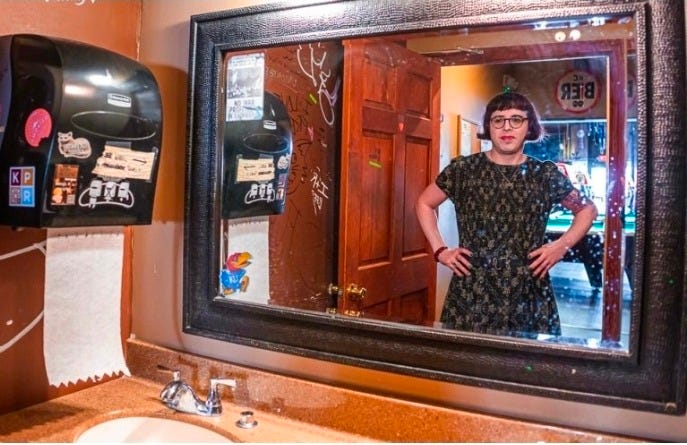
Siobhán Kirchstein had used the women’s restroom at the University of Kansas for years without incident. She went to work, did her job as a janitor with the Kansas Geological Survey, and used the same facilities other women used during the workday. Then Kansas changed the law, one person reported her, and an ordinary part of her workplace routine became an employee-relations matter.
The report reached Siobhán through Katie Varner, the university’s director of employee relations, who told her that the institution had an obligation to follow up. The message offered her an opportunity to respond and explained the process available to her, but someone’s objection to a trans woman using the restroom had already been given enough legal force to enter her workplace through HR.
Siobhán had not been accused of threatening anyone, harassing anyone, damaging property, or disrupting university operations. Her presence was the alleged violation. Kansas lawmakers transformed the act of walking into a restroom into something another person could report, forcing a public employer to open a formal process around an employee whose conduct had never caused a problem.
SB 244 was designed to make that possible. The law restricts restroom access in public buildings according to sex assigned at birth, allows private individuals to pursue civil damages, and exposes public institutions to severe financial penalties when complaints are made. Kansas did not need to station officers outside every restroom because it created a system in which coworkers, students, visitors, and strangers could police trans people for the state.
That structure makes suspicion enough to start the machinery. A person does not need to show that a trans woman harmed anyone inside the restroom. They need only decide that she does not belong there and make a report. Once the accusation reaches a government institution, the threat of penalties gives administrators a reason to document, investigate, notify, and protect the institution from liability, carrying civilian surveillance into a trans employee’s workplace through administrative process.
Siobhán described being in complete shock because she had not heard of the law being widely enforced. Her experience shows why a law does not need constant enforcement to control people. One complaint can activate it, while the possibility of being reported follows trans workers through every ordinary workday.
A trans employee entering a restroom must now consider who may be watching, who may complain, whether that complaint will reach a supervisor, and whether her employer will begin treating her presence as a legal risk. The pressure exists even when no report is filed because the threat of surveillance becomes part of the workplace itself.
The university reportedly told Siobhán that she could request reassignment to an area containing all-gender, single-use restrooms. Presented administratively, that may sound like an available option. In practice, it places the burden created by Kansas lawmakers onto the employee targeted by the law.
Siobhán would be the person expected to move. She would have to change where she works, how she moves through the university, or which facilities she uses because someone else objected to her identity. The complainant would retain access to the shared workplace, the institution could reduce its exposure, and the trans employee would absorb the disruption. That is coerced segregation presented as a solution rather than equal workplace access.
Siobhán rejected that burden directly. She asked why she should move herself to another building merely to make other people more comfortable. She said she would continue using the restroom that made her comfortable because she is a human being with dignity. She also made clear that she had no intention of complying and would remain until the university fired her if that was the consequence Kansas and the institution chose to impose.
Her refusal is not reckless defiance. It rejects the demand that trans people reorganize their lives around other people’s discomfort and defends the same ordinary workplace access she had before lawmakers decided her presence should become legally suspicious.
The law has turned that defense of dignity into an employment risk. Siobhán now knows that using a restroom can generate another complaint, another institutional notice, another appeal, or greater pressure on the university to act against her. Every trans employee working in a Kansas public building can see the same warning.
A coworker, visitor, student, or stranger can report a trans worker without alleging that she harmed anyone. The employer may then contact her, document the accusation, and decide how to respond under the threat of state penalties. Her restroom use can enter an HR process even when her conduct toward everyone around her was entirely ordinary.
The attack does not stop at restrooms. The same state campaign has forced trans Kansans to surrender identification documents that reflect their gender and accept records rewritten according to sex assigned at birth. Kansas is using law to push trans people out of public recognition, then carrying that erasure into licenses, government buildings, workplaces, and daily movement.
A driver’s license controls whether a person can move through the state without legal risk. Restroom access determines whether a worker can complete an ordinary shift with dignity. An HR notice shows how quickly identity can be transformed into workplace liability. Together, these mechanisms communicate that Kansas considers trans people’s accurate documents, public presence, and ordinary participation subject to correction, surveillance, and punishment.
Kansas lawmakers created that system. The University of Kansas did not write SB 244, but it still controls how Siobhán is treated inside the process the law forced open. The university decides whether she is protected from retaliation, whether her employment remains secure, whether she is pressured to relocate, and whether a discriminatory complaint is allowed to become an employee-conduct problem.
The larger public consequence is already visible. SB 244 teaches people that trans presence is suspicious and reportable, teaches public institutions to view trans employees as financial exposure, and teaches trans workers that using a restroom may invite surveillance, litigation, an HR notice, or pressure to remove themselves from shared space. It makes participation in public employment conditional on enduring state-defined humiliation.
Siobhán Kirchstein had used the women’s restroom for years without incident. Kansas lawmakers changed the law, one person filed a report, and the state’s anti-trans surveillance system entered her workplace through HR. Now the burden is being pushed back onto her through the suggestion that she consider moving herself elsewhere.
Her refusal is not a demand for special treatment. It is a refusal to surrender ordinary dignity, equal workplace access, and her right to exist without being reported to the state.
Trans workers should not have to risk surveillance, segregation, or employment pressure simply to use a restroom during the workday.
Support Trans United’s work documenting anti-trans harm and strengthening safety, housing, healthcare, and survival infrastructure.