

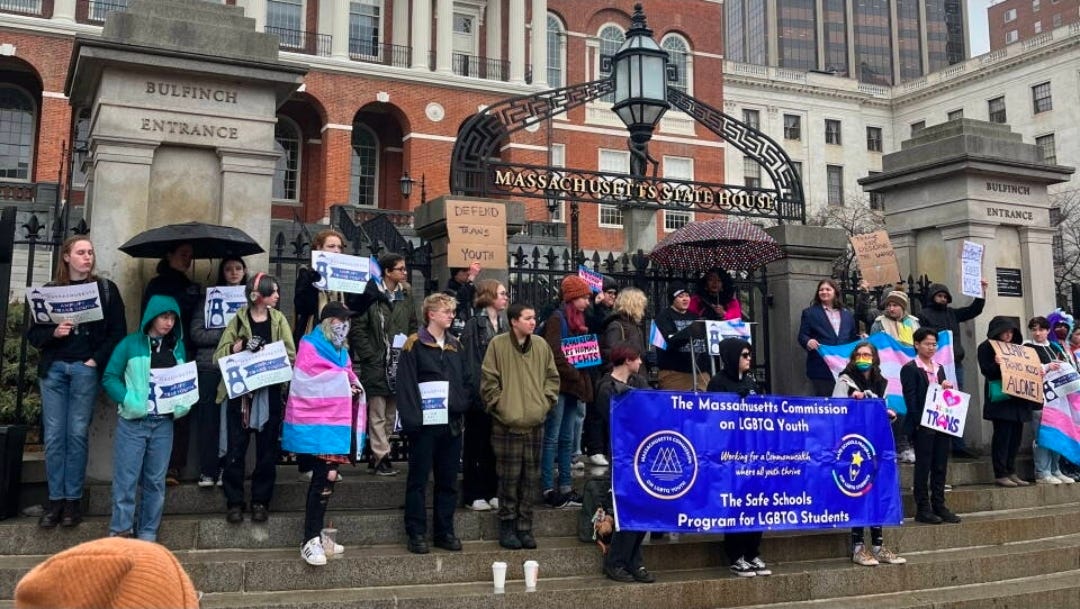
A young trans person in Massachusetts can live in a state where gender-affirming care remains legal, protected by state policy, defended in court, and supported with public money — and still lose access to the provider they depended on.
That contradiction is already unfolding across Massachusetts. Fenway Health, Baystate Health, and Outer Cape Health Services have halted or restricted gender-affirming care for patients 18 and younger amid escalating federal pressure. State officials continue to say the care is lawful, but the clinics pulling back show why legal protection alone does not guarantee that treatment will remain available when a patient needs it.
For trans youth and their families, that gap is immediate. A state can legally protect access to treatment, but that protection becomes harder to exercise when clinics narrow programs, providers disappear, or families must begin searching again for someone willing and able to continue care. The question stops being whether treatment is technically permitted and becomes much more basic: where can a patient actually receive it?
Massachusetts has repeatedly tried to answer the federal attack with legal protection. Attorney General Andrea Campbell has reaffirmed that gender-affirming care for minors remains lawful in the state and that Massachusetts protections prohibit discrimination based on gender identity in healthcare settings. The state also maintains shield-law protections intended to prevent outside jurisdictions from punishing patients, families, and providers for healthcare that is legal in Massachusetts, but those protections have not stopped federal pressure from reaching the clinics themselves.
The Trump administration has cut federal Medicaid and CHIP support for specified gender-affirming care for young people, turning healthcare funding into leverage over whether treatment remains financially sustainable. Massachusetts has responded by committing state resources to preserve coverage for minors who rely on public insurance. The state has also pointed to its Affirming Health Care Trust Fund as part of the effort to keep affirming providers operating while federal support is withdrawn, meaning Massachusetts is now spending its own money to defend access to healthcare that remains legal under its own laws. Even with that response, some providers have still pulled back.
Fenway Health, Baystate Health, and Outer Cape Health Services are important because their decisions expose the limits of protection on paper. A court ruling cannot make a clinician remain available, a shield law cannot automatically reopen a program after a provider restricts it, and state funding can replace some lost federal money without instantly rebuilding access when healthcare institutions decide that continuing treatment carries too much federal risk.
For trans patients, those institutional decisions are not abstract. Losing a provider can interrupt continuity of care and force families to search for alternatives. The burden of rebuilding that care falls on the patient and family whose treatment was disrupted.
Massachusetts has also been winning important legal battles against federal attempts to restrict gender-affirming care. Courts have blocked or struck down federal actions that threatened providers or would have made certain care more expensive and harder to access. Those victories preserve important rights and prevent some federal restrictions from taking effect, but they do not automatically restore a clinic that has already retreated.
That failure is already visible on the ground. Massachusetts can win a case, preserve insurance protections, fund care with state money, and shield families from outside interference while a trans young person still discovers that the provider they relied on will no longer treat them. The difference between legal protection and lived access is where federal pressure does much of its damage.
The federal government does not need Congress to enact a single nationwide ban in order to shrink gender-affirming care. Funding restrictions can make treatment more expensive for states to preserve, investigations and compliance pressure can raise the institutional cost of continuing programs, and hospitals and clinics can respond by narrowing services. When that happens, the formal legality of care survives while the infrastructure needed to deliver it begins disappearing around the patient.
Providers still make choices inside that pressure. Federal coercion does not erase the consequences of institutional retreat. When a healthcare system limits or ends a program, it is the trans patient who loses the appointment, the clinician, or the continuity they had been relying on.
Provider accountability is also part of the story because institutions that serve trans communities cannot be discussed only as passive victims of federal policy when their decisions determine whether patients still have somewhere to go. Federal pressure explains the environment in which those decisions are being made; it does not make the resulting loss of care disappear.
Massachusetts is fighting back through litigation, state funding, shield protections, and public commitments to preserve access. That resistance matters because it demonstrates that states are not powerless against federal attacks on trans healthcare, but the experience of trans youth also shows that resistance measured only in statutes and court orders is incomplete. The real measure is whether a patient can still receive care.
A young trans person should not have to navigate federal reimbursement policy, multi-state litigation, shield laws, provider liability, and institutional decisions simply to determine whether the healthcare legally protected in their state will actually remain available. Yet that uncertainty is exactly what sustained federal pressure can create.
The contradiction Massachusetts now faces is therefore larger than one clinic or one federal rule. The state has built legal protections around gender-affirming care, defended those protections in court, and committed public money to keeping treatment available. Federal pressure is still reaching patients through the institutions that are pulling back.
Even with state protection, insurance coverage, court victories, and shield laws behind them, a patient in Massachusetts can still lose the clinician who was providing their care. Until patients can reliably reach the treatment those protections promise, the right remains legally protected but practically vulnerable.
When lawful trans healthcare can disappear clinic by clinic, documenting who is withdrawing care — and what pressure is driving those decisions — becomes part of accountability.
Trans United tracks where protections fail trans people in practice and keeps those failures in the public record.
Upgrade to a paid subscription to support independent Trans United reporting and accountability work.