

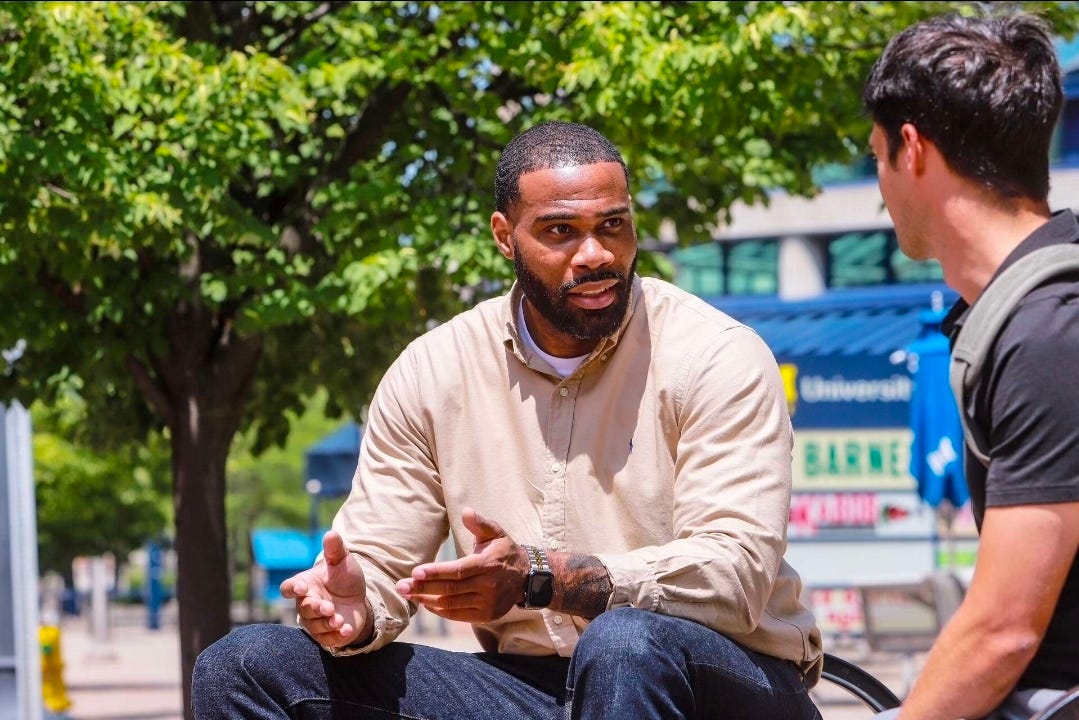
Amir Hassan says a trans woman used the same restroom as his daughter, and he has offered no documented misconduct, contact, threat, or harm. Yet Hassan presents that woman’s presence as the moment he “drew the line” and entered politics. He took one alleged encounter involving an unidentified trans woman, converted her ordinary use of a public facility into evidence of danger, and built a congressional campaign seeking restrictions against trans people who had nothing to do with him, his daughter, or the event he described. Donald Trump has now endorsed that campaign for Michigan’s 8th Congressional District.
Hassan told the Midland Daily News that his daughter was younger when, in his words, “a man identifying as woman walked into the same restroom as her.” He followed that description by declaring, “That’s why I drew the line.” The woman remains unidentified, and Hassan’s account does not establish that she approached his daughter, spoke to her, behaved improperly, or threatened anyone. Hassan did not need to document harm because he treated the presence of a person he understood to be trans as harm by itself. Her presence became the accusation, while his fear became the evidence.
The unidentified woman disappears from Hassan’s story as a human being and reappears as a political symbol. She is given no voice, context, intention, or right to public space. Her body is made to carry the accusation, while Hassan’s role as a father supplies moral authority. This is how anti-trans politics converts ordinary existence into presumed danger: place a trans person near a child, imply a threat without proving one, and use parental grievance to demand restrictions against an entire community. Everyone else is then told that exclusion is protection.
Hassan’s campaign does not stop with one restroom or one alleged encounter. His official platform places anti-trans policy under the heading “Protecting our Children from Indoctrination and the Far-Left Agenda” and declares that what it calls “boys becoming girls, using girls bathrooms, and playing girls sports has got to stop.” The platform promises that Hassan will join Trump’s campaign against diversity initiatives and what Hassan calls “radical ideologies” in Congress. Those words turn one private grievance into a public program aimed at trans students, trans athletes, LGBTQ+ families, educators, and anyone whose existence contradicts the gender order Hassan wants the federal government to enforce.
Children remain the emotional weapon throughout that agenda. Hassan’s daughter gives his restroom story its political force, while his campaign repeatedly casts LGBTQ+ people, inclusive education, and public visibility as threats to children. PinkNews reported that Hassan promoted a local Drag Queen Story Hour with the words “Left AGENDA” written across it and captioned the post, “Our children are their target.” When accused online of obsessing over LGBTQ+ people, he described himself as “a father that is fighting to bring change.” The pattern is direct: place children at the center of an invented emergency, cast LGBTQ+ people as the source of danger, and present the candidate demanding exclusion as the parent brave enough to act.
That framing does not protect children. It teaches them that trans people are threats before any trans person has done anything. It tells trans students that their bathroom use, participation in sports, classroom presence, and identities are political offenses. It tells other students that suspicion toward their trans classmates is responsible and that exclusion can be renamed safety. It also places LGBTQ+ families in the position of defending their existence against a campaign that has already declared their inclusion to be indoctrination. The people forced to absorb that hostility are children, parents, teachers, and community members whose safety and access are being turned into campaign material.
Hassan has also argued that public education dollars should follow children into religious or alternative schools when parents object to lessons involving sexual orientation or gender identity. He framed the issue around family faith and values, but the practical target remains LGBTQ+ inclusion in public education. His proposal would allow parental objection to LGBTQ+ people and topics to become a basis for redirecting taxpayer-funded education money. It asks public policy to reward withdrawal from schools that acknowledge LGBTQ+ people and to treat accurate, age-appropriate inclusion as an institutional offense.
The escalation is clear. An unidentified trans woman allegedly used the same restroom as Hassan’s daughter. No documented harm was established. Hassan turned that encounter into the moment he says moved him into politics, then built an official platform against trans people in bathrooms, schools, sports, and education. He is not asking voters merely to agree with his interpretation of one event. He is asking them to convert that interpretation into federal power.
Donald Trump’s endorsement gives that project national political backing. The National Republican Congressional Committee announced on June 22 that Trump had given Hassan his “Complete and Total Endorsement” for Michigan’s 8th District. PinkNews later reported another endorsement message posted to Truth Social on July 28, in which Trump praised Hassan as someone who would “NEVER LET YOU DOWN!” Trump placed his name and national political power behind a candidate whose stated political origin and official platform are openly built around anti-trans exclusion.
Hassan is seeking the Republican nomination in Michigan’s 8th Congressional District, which includes Flint, Saginaw, Bay City, and Midland. The August 4 primary winner is expected to face Democratic incumbent Kristen McDonald Rivet in November. Hassan has presented economic development, manufacturing, skilled trades, health care, and regulation as major district issues, but hostility toward trans people has become a defining moral cause in his campaign. His restroom story explains not simply a position he holds but the line he says moved him into politics. That makes anti-trans suspicion central to the political identity he is offering voters.
The public danger extends beyond whatever legislation Hassan might propose if elected. When a congressional candidate says a trans woman’s mere presence in a restroom with his daughter was the moment he “drew the line,” he teaches voters to interpret trans people as threats before any misconduct occurs. That message follows trans people into stores, schools, airports, restaurants, offices, stadiums, and government buildings. It gives strangers a political script for questioning, filming, misgendering, exposing, and physically blocking anyone they decide does not belong. The campaign turns parental fear into permission for public surveillance.
The harm does not fall only on trans women. A trans man can be challenged for entering a men’s restroom or forced into a women’s facility where his appearance may trigger the same suspicion Hassan has helped normalize. A gender-nonconforming person can be subjected to demands for proof, identification, or explanation. A trans child can learn that a candidate for Congress considers their existence evidence of indoctrination and their participation in school life something that “has got to stop.” Anti-trans bathroom politics produces scrutiny of anyone whose body or presentation fails a stranger’s gender test.
This is collective punishment built from an allegation without a victim. Hassan’s platform does not seek action against one person accused of misconduct. It seeks restrictions against trans people as a class because one unidentified woman allegedly used a restroom with his daughter years ago. The campaign replaces the absence of harm with presumed danger, then asks voters to legislate that presumption. Hassan is asking voters to take rights away not because misconduct was established, but because fear is politically useful.
The unidentified woman Hassan placed at the beginning of his political story remains the clearest measure of what his campaign is doing. Hassan says she used a restroom. No documented harm has been established. He turned her presence into a threat, turned that threat into his political identity, and turned that identity into a congressional platform aimed at trans people who never met him, his daughter, or the woman he described. Donald Trump’s endorsement gives that grievance national political backing. The danger was not established in the restroom. It was manufactured afterward, carried into a campaign, and offered to voters as a reason to take rights away from trans people.
Amir Hassan turned an alleged restroom encounter involving his daughter and a trans woman into a congressional campaign targeting trans people in bathrooms, schools, sports, and public life.
Upgrade to a paid subscription for exclusive Trans United reporting, deeper analysis of anti-trans political campaigns, and continued documentation of the people, policies, and institutions these attacks endanger.
So, an alleged trans woman used the same bathroom as his daughter. There was no incident of any kind of abuse, or even confrontation. The trans woman remains unidentified…probably never even got her name. But apparently she’s now going to be his perfect political scapegoat. He says his daughter wasn’t safe… he’s against LGBTQIA+, and drag queens reading stories to children. It’s all “unsafe” around children. Yet…. he accepted an endorsement nomination from a rapist/ pedophile, and 34x convicted felon, a man who is also a racist, and has no respect for the law. Does he not see the hypocrisy??? Make it make sense. You can’t.
Hate is an intoxicating drug to the stupid.