

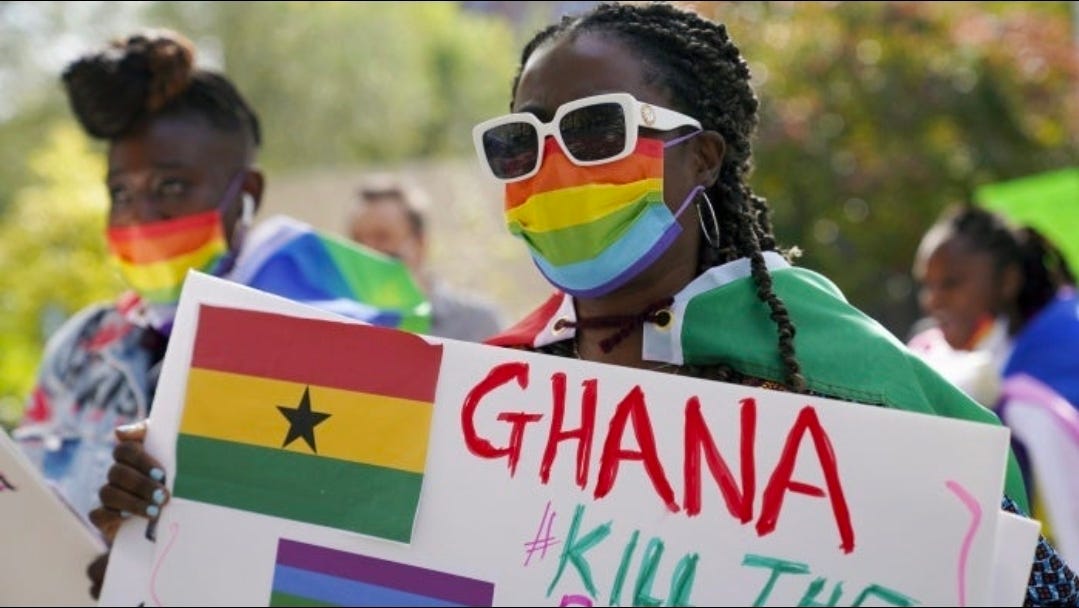
Across West Africa, governments are expanding the legal machinery used to imprison, surveil, expose, and isolate LGBTQ+ people. Senegal’s National Assembly passed a measure that would raise the maximum sentence for same-sex relations to 10 years and criminalize the promotion or financing of homosexuality. Niger, Mali, and Burkina Faso recently outlawed consensual same-sex relations for the first time. Ghana’s Parliament passed a sweeping anti-LGBTQ+ bill in 2026, but the measure had not received presidential assent when the Guardian published its report.
These measures reach far beyond private intimacy. They expose LGBTQ+ people to arrest, dismantle support networks, disrupt HIV prevention, drive advocates and healthcare workers underground, and give police and military forces broader authority to target trans women. Political leaders and participating religious organizations are turning queer and trans people into criminal targets while presenting repression as a defense of religion, culture, sovereignty, and “family values.”
Senegal’s National Assembly passed the measure in March 2026. The measure would double the maximum prison sentence for same-sex relations to 10 years and impose criminal penalties for promoting or financing homosexuality. The United Nations human rights chief urged the president not to sign it, warning that the measure would deepen discrimination and endanger LGBTQ+ people, human-rights defenders, healthcare workers, and organizations serving affected communities.
Niger’s new criminal code outlawed consensual same-sex intimacy for the first time in the country’s history. Human Dignity Trust reports that prison sentences under the framework can reach 20 years and carry heavy fines. Rights advocates have also reported arrests, threats, and severe disruption to LGBTQ+ community networks and HIV-support work.
Mali’s Transitional National Council criminalized consensual same-sex relations in October 2024. Burkina Faso’s Transitional Legislative Assembly followed in September 2025, imposing prison sentences of two to five years and substantial fines. These military-led governments created new criminal prohibitions rather than merely retaining older laws already on the books.
Ghana’s Parliament passed the Human Sexual Rights and Family Values Bill in 2026. The measure expands punishment beyond same-sex conduct to the promotion, advocacy, sponsorship, and support of LGBTQ+ activity. It had not received presidential assent when the Guardian reported on the regional crackdown, leaving the president responsible for signing or rejecting it.
Regional activists describe these laws as political tools. Anthony Oluoch of Pan Africa ILGA called the pattern political opportunism, while an activist in Burkina Faso told the Guardian that LGBTQ+ people had become the easiest scapegoats for leaders seeking to maintain power. The material consequence is expanded government authority to arrest, intimidate, surveil, and silence people whose lives have been recast as political threats.
An HIV worker in Burkina Faso told the Guardian that 13 trans women were detained without trial between June and November 2025 and reported being beaten by the military unit that imprisoned them. The worker also described police entrapping LGBTQ+ people through social media and pressuring arrested people to identify others in their communities. He later fled after someone in custody named him.
That enforcement turns ordinary parts of life into potential evidence. Phones, dating platforms, clinics, friendships, and community organizations can become routes to arrest. Seeking healthcare may expose a patient, contacting an advocate may expose an entire network, and trusting another person may create a path back to police.
Trans women face distinct danger because authorities can target their clothing, gender expression, identification documents, healthcare needs, and public visibility as well as their relationships. In the Gambia, same-sex relations already carry severe criminal penalties, while restrictions on gender expression give authorities another route to harass and punish trans women. The regional spread of harsher laws increases that danger across borders.
Criminalization also attacks public health. HIV prevention depends on confidentiality, outreach, testing, treatment, and trust between patients and providers. When patients fear exposure and workers fear arrest, governments make healthcare more dangerous to seek and more dangerous to provide.
Activists told the Guardian that Senegal’s crackdown was obstructing HIV-prevention work for men who have sex with men and trans women while placing lawyers representing LGBTQ+ people under greater pressure. In Niger, arrests and threats disrupted organizations providing HIV-related support. People delay testing, disappear from treatment, and lose contact with outreach workers because the state has made care a potential path to punishment.
For some people, flight becomes the only available protection. A Gambian HIV worker told the Guardian that about 100 people fled Senegal for the Gambia in 2026, but most returned because they lacked money. They crossed into another country where same-sex relations are already criminalized and where trans women face additional policing through restrictions on gender expression.
Flight without housing, money, legal status, medical care, or durable protection is not safety. It is displacement under conditions that can force people back into the jurisdiction that threatened them.
The laws are national, but the political infrastructure supporting them crosses borders. Ghana’s Parliament hosted the fourth African Inter-Parliamentary Conference on Family, Sovereignty and Values from June 3 through June 6, 2026. Representatives from 20 African countries gathered under a conference theme focused on advancing an African Charter on Family Values and Sovereignty.
The proposed charter attacks comprehensive sexuality education, reproductive rights, and legal recognition of gender diversity. Conference participants promoted it as a framework capable of shaping national legislation, public policy, education, healthcare, and regional human-rights institutions. Its promoters are using the charter and conference network to build a legislative pipeline through which shared anti-rights language can move into national statutes and police enforcement.
Family Watch International and Christian Council International have participated in the broader conference network, according to reporting and organizations tracking transnational anti-rights campaigns. These networks circulate political language and legislative priorities targeting LGBTQ+ rights, abortion access, and comprehensive sexuality education. Their participation exposes the contradiction inside the sovereignty campaign: political leaders condemn LGBTQ+ equality as foreign interference while international conservative organizations reinforce efforts to criminalize queer and trans people.
West African countries do not share one government, one culture, or one political system, but the same enforcement mechanism is spreading across borders. Political leaders identify LGBTQ+ people as threats, lawmakers convert that hostility into criminal authority, and police or military forces impose the consequences through detention, beatings, entrapment, surveillance, healthcare exclusion, and forced displacement.
Those consequences fall on trans women who reportedly endured detention and beatings, LGBTQ+ people entrapped through social media, patients pushed away from HIV care, healthcare workers driven underground, and displaced people left without the money or protection required to remain safe. Governments built these criminal systems, lawmakers authorized them, police and military forces enforce them, and participating religious organizations and transnational anti-rights networks help spread and legitimize them. The people surviving that machinery—not the governments operating it—remain at the center of this record.
Governments are criminalizing queer and trans lives while expanding surveillance, healthcare exclusion, and displacement. Paid subscriptions support the reporting that documents the laws, actors, and harm—and keeps trans people at the center of the record.