

Young women are naming attraction, identity, and sexual possibility beyond the old heterosexual script.
New research from the Human Sexualities Research Lab at the State University of New York, published through The Conversation, examined 15 years of responses from more than 10,000 public university undergraduates in New York State between 2011 and 2026. The researchers also reviewed more than 700 open-ended responses from 2024 and 2025 in which students described how they came to understand their sexual identities.
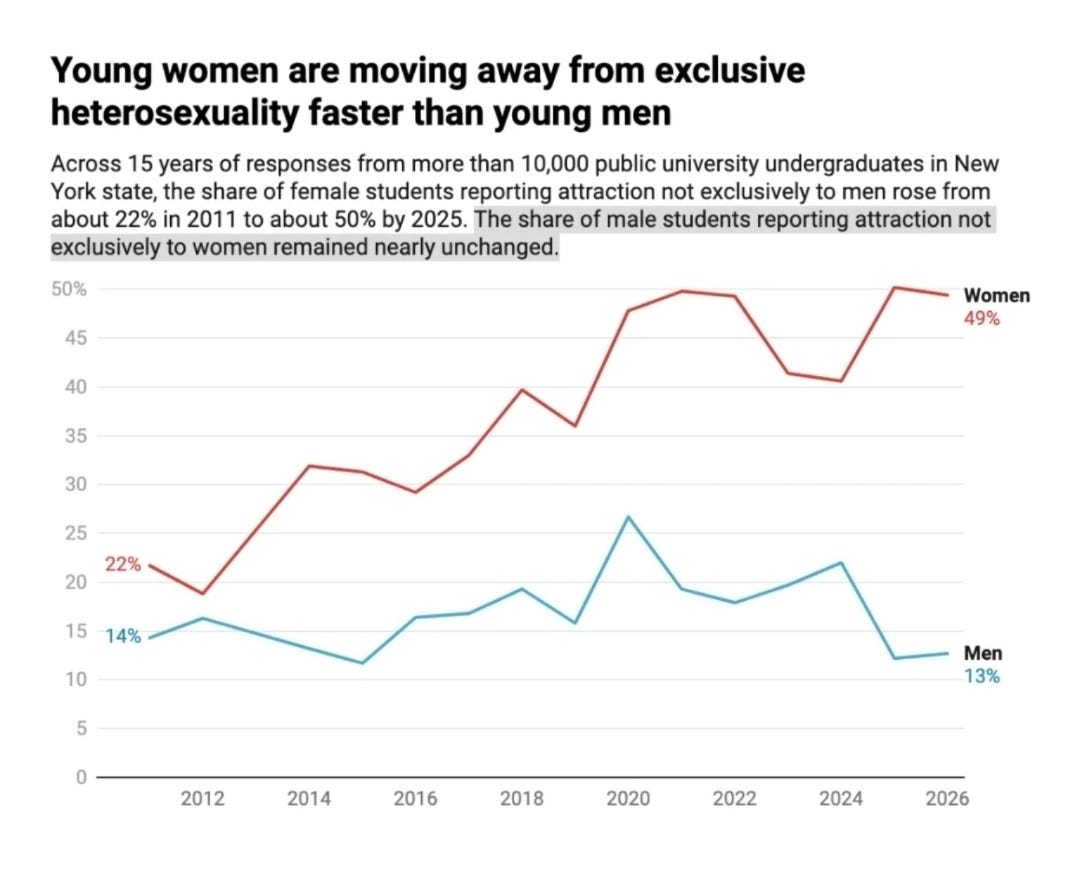
The finding is sharp. In 2011, about 22% of female students reported attraction that was not exclusive to men. By 2026, that number had risen to nearly 50%. Over the same period, young men’s reported attraction not exclusively to women remained largely unchanged overall.
That difference matters because the shift is not only about attraction. It also appears in reported sexual behavior and identity. The share of women who reported not having exclusively male sexual partners rose from 8% to 35%. The share identifying as something other than exclusively heterosexual rose from 18% to 44%.
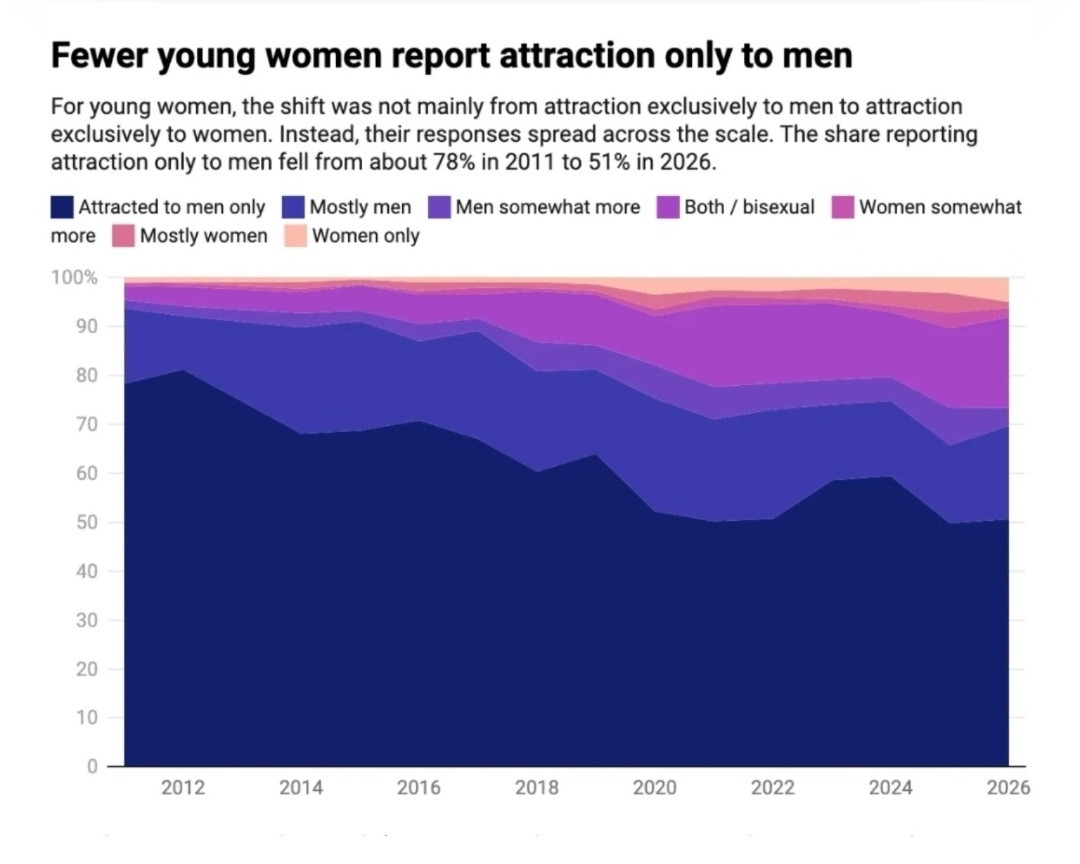
The study does not show a simple move from one fixed category into another. Young women’s responses spread across the scale, from mostly attracted to men to mostly attracted to women, with the largest change appearing in the decline of exclusive attraction to men. That matters because bisexuality and sexual fluidity are often erased when public debate tries to force sexuality into rigid boxes.
One study of New York public university undergraduates cannot speak for every young person, and the sample matters: the geography, the population, and the university setting all shape what the data can show. But the pattern inside this record is still significant. Over 15 years, more young women in this student population reported attraction, identity, and behavior beyond exclusive heterosexuality.
The deeper story is social possibility: for much of modern public life, heterosexual partnership was treated as the expected center of women’s futures. Marriage to men, attraction to men, dependence on men, family formation with men, and social legitimacy through men were not just private options. They were cultural instructions. They shaped how women were expected to imagine adulthood.
That script has weakened as feminist movements expanded women’s access to education, paid work, contraception, divorce, political rights, legal protections, and life outside compulsory marriage. LGBTQIA+ visibility expanded the public language available for desire, gender, and identity. Same-sex marriage made queer partnership more legally and socially visible. Online queer communities gave people words and examples they may not have had in their immediate homes, schools, or towns. #MeToo challenged the idea that women’s relationships to men should be organized around silence, obligation, or male entitlement.
Those forces did not create desire from nothing. They made more desire speakable.
The research is not simply showing that young women are changing labels. It is showing what happens when more women have room to name attraction honestly without forcing themselves back into the old heterosexual default.
The pattern among young men looks different. According to the researchers, the share of male students reporting attraction not exclusively to women was about 14% in 2011 and 13% in 2026, with pandemic-era increases that later dropped. Men’s responses remained more concentrated in exclusive heterosexuality overall.
That does not mean men have no sexual complexity. It means gender norms still police male ambiguity more aggressively. The researchers noted that young men who identified as something other than exclusively straight were more likely to report exclusively gay identities than young women were to report exclusively lesbian identities. That pattern reflects a culture that often leaves men less room to describe uncertainty, bisexuality, fluidity, or attraction that does not fit neatly into either straight or gay.
The study suggests young women had more room to report attraction across the scale, while young men remained more tightly sorted into fixed categories.
That gender difference belongs in the public record because sexuality is not only private feeling. It is also shaped by language, stigma, permission, safety, expectation, and the categories people believe they are allowed to use. When one group reports more fluidity and another remains more fixed on paper, the question is not only who feels what. It is who has enough social room to say what they feel.
Bisexuality is central to the finding. Public debate often treats sexuality as a straight-versus-gay binary, but the study’s data points to a broader middle that cannot be dismissed as confusion or reduced to a phase. More young women are reporting attraction beyond men without necessarily reporting attraction only to women. That matters because bisexual and fluid people are often made invisible by both mainstream heterosexual assumptions and narrow public narratives about queer identity.
Attraction that is mostly toward men but not exclusive to men is not accurately captured by “straight.” Partnerships that are not exclusively with men do not fit a system that only recognizes heterosexuality or lesbian identity. When women name themselves as bisexual, queer, fluid, or something other than exclusively heterosexual, they are giving language to realities that compulsory heterosexuality often tried to flatten.
The increase in non-exclusive heterosexuality among young women should be read through that lens: as a visibility shift, a language shift, a social-permission shift, and a record of how public conditions shape private honesty. When queer futures become easier to imagine, more people can recognize themselves in them. When heterosexual marriage is no longer the only legitimate path, desire has more room to be described without apology.
The study’s timing matters, too. Researchers observed shifts around the COVID pandemic, when lockdowns disrupted dating behavior and gave many people time for introspection. But they also wrote that the broader trend among women was already visible before 2020 and continued afterward. COVID may have intensified reflection, but it did not create the movement.
The longer arc is more important than the pandemic spike. Young women’s reported attraction, behavior, and identity changed over a period marked by expanding queer visibility, digital community, feminist politics, and a wider range of possible adult lives. The result is not a single new category replacing an old one. It is a broader field of self-description.
The language of “exclusive heterosexuality” matters because the shift is not only toward one identity. It is away from a compulsory default. Fewer young women in the study are reporting that their attraction, partners, and identities fit only inside heterosexuality. More are reporting lives that are mixed, fluid, bisexual, queer, or otherwise not exclusively organized around men.
That finding belongs in LGBTQIA+ public record because it documents how visibility changes what can be said. Expanded rights and language can alter the map of self-understanding, and attacks on queer education, LGBTQIA+ visibility, gender language, and public inclusion are never just symbolic. Those attacks try to narrow the field of possibility again.
Without words, examples, protections, and visible futures, compulsory heterosexuality becomes easier to enforce. With more language, community, legal recognition, and cultural permission, old defaults lose some of their power.
Young women are reporting less exclusive heterosexuality because more lives are visible now. Queer, bisexual, partnered, single, child-free, professional, activist, caregiver, and mixed forms of adulthood can exist together without being treated as contradictions.
It is not just a change in attraction numbers. It is evidence that the old heterosexual script no longer holds the same authority over young women’s lives. The study shows a generation of women reporting more complexity, more fluidity, and less exclusive attachment to the categories that once defined what women were supposed to want.
Among this group of New York public university undergraduates, young women are reporting attraction, identity, and behavior beyond exclusive heterosexuality at much higher rates than they did 15 years ago. Young men’s reported patterns have not changed in the same sustained way. The difference reveals both expanding possibility for women and continuing limits around male sexual ambiguity.
More young women are naming what the old script could not hold.
Sexual fluidity is not confusion. It is part of the public record of how people name themselves when more futures become visible.
Trans United documents LGBTQIA+ rights, queer visibility, bisexuality, anti-LGBTQIA+ backlash, public safety failures, and the systems that try to narrow the right to live openly.
Support the work.