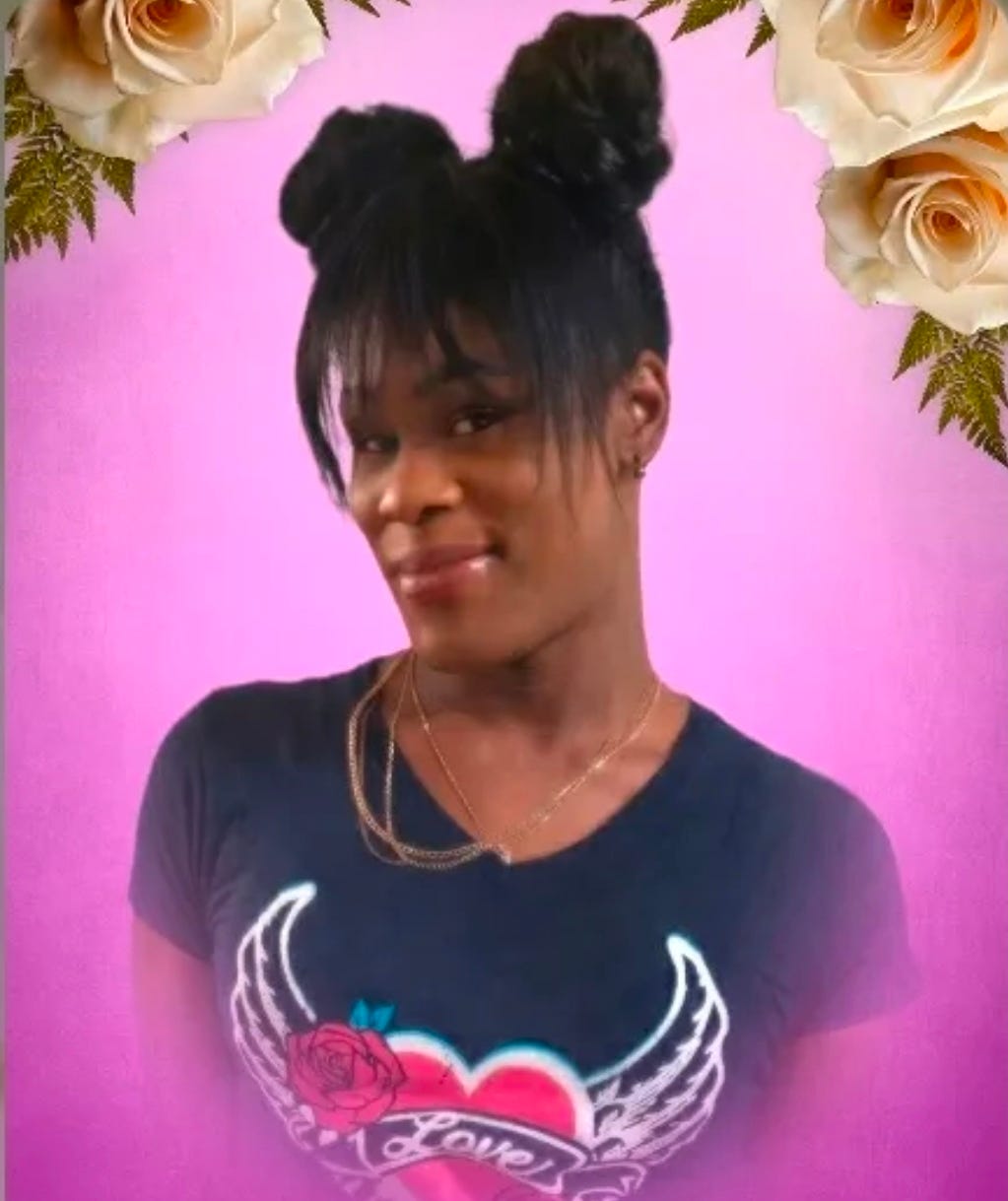
Aleanna Belcher, a Black Trans Woman Murdered in Binghamton, Deserved Safety in Life and Dignity in Death
How anti-trans violence kept moving through deadnaming, church rejection, and public erasure after Aleanna Belcher was murdered
Aleanna Belcher was 31 years old when her life ended on Friday, April 17, 2026, after she was stabbed in the stairwell of a housing complex in Binghamton, New York. Police say she knew the man accused of killing her, though the nature of their relationship remains unclear. An arrest was made. Second-degree murder charges were filed. The investigation remains active.
That is the bare outline of what happened.
It is not enough.
Aleanna’s story is not only about the violence that took her life. It is also about what happened immediately after: the misgendering, the deadnaming, the institutional indifference, and the familiar burden placed on grieving loved ones to fight for the truth while they are still in shock. Even now, the same pattern keeps repeating. Trans communities, friends, and families are expected to correct the record, defend the dignity of the dead, and build a public memory strong enough to survive systems that keep trying to erase them.
Aleanna Belcher deserved better than that.
She deserved safety in life. She deserved truth in death. She deserved dignity in mourning.
Instead, the violence continued after she was gone.
According to reporting from WBNG and information released by the Binghamton Police Department, Aleanna was found with a significant stab wound to the abdomen at a housing facility on Virgil Street. She was taken to the hospital, where she died. Police say the case remains under investigation, and they have asked anyone with information to contact the Detective Bureau.
Those facts matter. So does accuracy. But the public record too often acts as though facts about trans lives begin and end with the violence done to them. That is one of the cruelties built into this kind of reporting. A trans woman is reduced to an incident, a body, a police statement, a court charge, a local headline. The person disappears beneath the procedure.
Aleanna should not disappear beneath procedure.
She was born in Las Vegas. She was also known as Aleanna Royal and Queen Freakii. She studied at the University of Nevada, Las Vegas. She moved through the world as a DJ, promoter, dancer, model, artist, and more. Friends remembered her love for music, movement, and the rave scene that gave her joy and community. They described someone who loved dubstep, bass, drum and bass, and house music. Someone who danced. Someone who showed up. Someone who made things brighter.
That kind of detail matters because it restores the scale of what was taken.
Aleanna was not only a victim of homicide. She was a full life.
Her family and loved ones describe her as an artist who loved to draw, someone who could light up a room simply by entering it. They describe a person who brought people together, who was loved deeply, who helped in the community, who was good with kids, who protected others, and who never liked seeing anyone down. “Aunty Aleena” was remembered as the life of the party, someone who brought positive energy wherever she went.
That is the human truth of this story.
And that truth makes what followed even harder to ignore.
As with so many other cases involving trans women, media outlets misgendered and deadnamed Aleanna after her death. That failure is not small. It is not cosmetic. It is not a side issue to brush aside while the “real” story is discussed somewhere else. It is part of the harm. It tells the public that even in death, a trans woman’s identity is still treated as negotiable. It tells grieving families and friends that they must spend their first days of mourning correcting strangers instead of resting in grief. It tells trans communities that public recognition remains unstable even at the moment of loss.
This is one of the most vicious features of anti-trans erasure: the dead are not even left in peace.

The cruelty did not end there.
According to Aleanna’s brother, the church where she grew up and where her family had expected to hold her funeral service withdrew that offer after learning she was trans. A grieving family, already carrying shock, loss, and the demands of burial, was forced to absorb another rejection. Another door closed. Another institution deciding that its comfort mattered more than the woman at the center of the funeral, more than the family trying to bury her, and more than basic human decency.
There is no moral confusion in that act.
To turn away a grieving family after first saying yes is cruelty. To do it because the person they are mourning was a trans woman is anti-trans cruelty, plain and direct. It is not pastoral care. It is not religious conviction. It is not a difficult administrative decision. It is the public humiliation of a family in mourning. It is a message about whose lives are considered worthy of respect and whose memory can be pushed aside.
Aleanna’s family should never have been put through that.
This is what makes the question of justice larger than a courtroom.
An arrest matters. Charges matter. Accountability for the person accused of killing Aleanna matters. But justice cannot be reduced to a single criminal case when so many other institutions participate in stripping away a trans woman’s dignity. If the media misgenders her, if public memory blurs her truth, if churches reject her family, and if the larger recordkeeping systems fail to count trans dead honestly, then the violence has already moved beyond the individual assailant. It has become social. Institutional. Structural.
And that is exactly the context Aleanna’s story enters.
Earlier this year, I wrote about the Trump administration’s removal of gender identity questions from federal crime survey systems. That change was not abstract. It was not a technical adjustment with neutral consequences. It was part of a broader erasure campaign. When trans people are stripped out of the data, violence against trans communities becomes harder to track, harder to measure, harder to describe, and easier to dismiss. Journalists lose one of the systems they rely on to identify patterns. Researchers lose a way to measure harm. Policymakers gain more room to pretend the crisis is smaller than it is.
And families are left fighting for visibility in the dark.
That wider assault on trans reality helps explain why so many stories now arrive damaged. The misgendering. The deadnaming. The silence. The partial record. The late discovery. The sense that violent deaths are surfacing not through functioning systems of public accountability, but through fragments, feeds, chance encounters, and community correction. This is not how a society committed to truth documents violence. It is how erasure works in practice.
You do not always erase a trans woman by deleting her name outright.
Sometimes you erase her by making sure the systems meant to see her no longer can.

Aleanna is the fourth trans person whose violent death has been reported in the United States in 2026. She is the fourth trans woman, the third Black trans woman, and the youngest person on this year’s reported list. Even those numbers carry uncertainty. They do not describe the full reality. They only describe the reality that has managed to break through.
There is every reason to believe other deaths remain hidden by neglect, bias, local reporting failures, family silence, institutional indifference, and systems that make trans victims harder to identify. That uncertainty does not weaken the crisis. It deepens it.
Without reliable official databases, communities are left documenting the dead through improvisation. One name appears in a feed. Another is surfaced by a friend. Another arrives before the last memorial is even published. This is not documentation worthy of the scale of the violence. It is triage. It is grief work being done by those least protected and most exhausted.
Aleanna’s story makes that failure impossible to ignore.
Her family appears to have embraced her fully and publicly. They have asked for more information. They have asked for justice. That matters. Love matters. Public affirmation matters. Refusing erasure matters. But no family should have to carry all of that alone while also navigating homicide, funeral costs, public correction, and church rejection.
The family’s crowdfund for final expenses reportedly came within just a few hundred dollars of its goal. That detail says something too. Communities keep being asked to do what institutions refuse to do. Loved ones raise money. Friends correct the record. Trans communities preserve memory. While official systems stagger, delay, evade, and fail, ordinary people do the work of dignity by hand.
That should shame every institution that abandoned Aleanna and her family.
It should also sharpen what justice means here.
Justice for Aleanna Belcher means prosecuting the person accused of killing her. It means naming her correctly and refusing deadnaming and misgendering in every public account. It means rejecting the church cruelty that tried to mark her as unworthy even in death. It means understanding that media erasure is not separate from physical violence, but one of the ways a violent culture protects itself from feeling the full weight of what it has done. And it means confronting the role of the state in making trans harm harder to document, harder to prove, and easier to hide.
Aleanna should have had more time.
More music. More movement. More rooms to light up. More chances to gather the people she loved and be gathered by them in return. More opportunities to be exactly who she was without having to defend the fact of her own life to institutions that never deserved that power over her.
What remains now is memory, truth, and the refusal to participate in her erasure.
Aleanna Belcher was here. She was loved. She was known. She was a Black trans woman whose life had texture, talent, affection, community, and force. She was not a clerical mistake, not a debate topic, not an inconvenience to institutions, and not a body for local reporting to flatten into generic tragedy. She was a person with a name, a world, and a place in the lives of others.
That is where justice begins: with telling the truth.
The violence against Aleanna did not end with the stabbing. It continued through public misnaming, through institutional rejection, and through a broader culture that still treats the dignity of trans dead as optional. That is why remembering her fully matters. That is why accuracy matters. That is why public record matters. That is why we cannot let her be folded into silence.
Rest in power, Aleanna.
The world needed more of your energy, your art, your motion, your joy, and your presence in it. What was taken from you cannot be repaired. But the truth can still be defended. Your name can still be held correctly. Your life can still be honored without compromise. And any real fight for justice must begin by refusing every system that tried to erase you after death.
May your memory be a revolution.

Trans people are being murdered, erased in the record, and denied dignity even in death. Trans United exists to push back against that silence — by documenting what institutions bury, honoring lives the media mishandles, and keeping public memory from being stripped away by fear, bias, and state erasure.
This work keeps trans people visible when institutions try to bury them. Support Trans United. Help fund the reporting, documentation, memorial writing, and public record work needed to make sure Aleanna Belcher and other trans people are named truthfully, remembered fully, and not pushed out of history.
Sources: WBNG reporting on Aleanna Belcher’s death and the Binghamton Police Department case details; statements and memorial details shared publicly by Aleanna Belcher’s family and friends; family fundraiser information for Aleanna Belcher’s final expenses.
Earlier Trans United reporting:


It’s just Terrible. R.I.P. horrible. They gotta get Justice.
Rest in peace, dear Aleanna.