

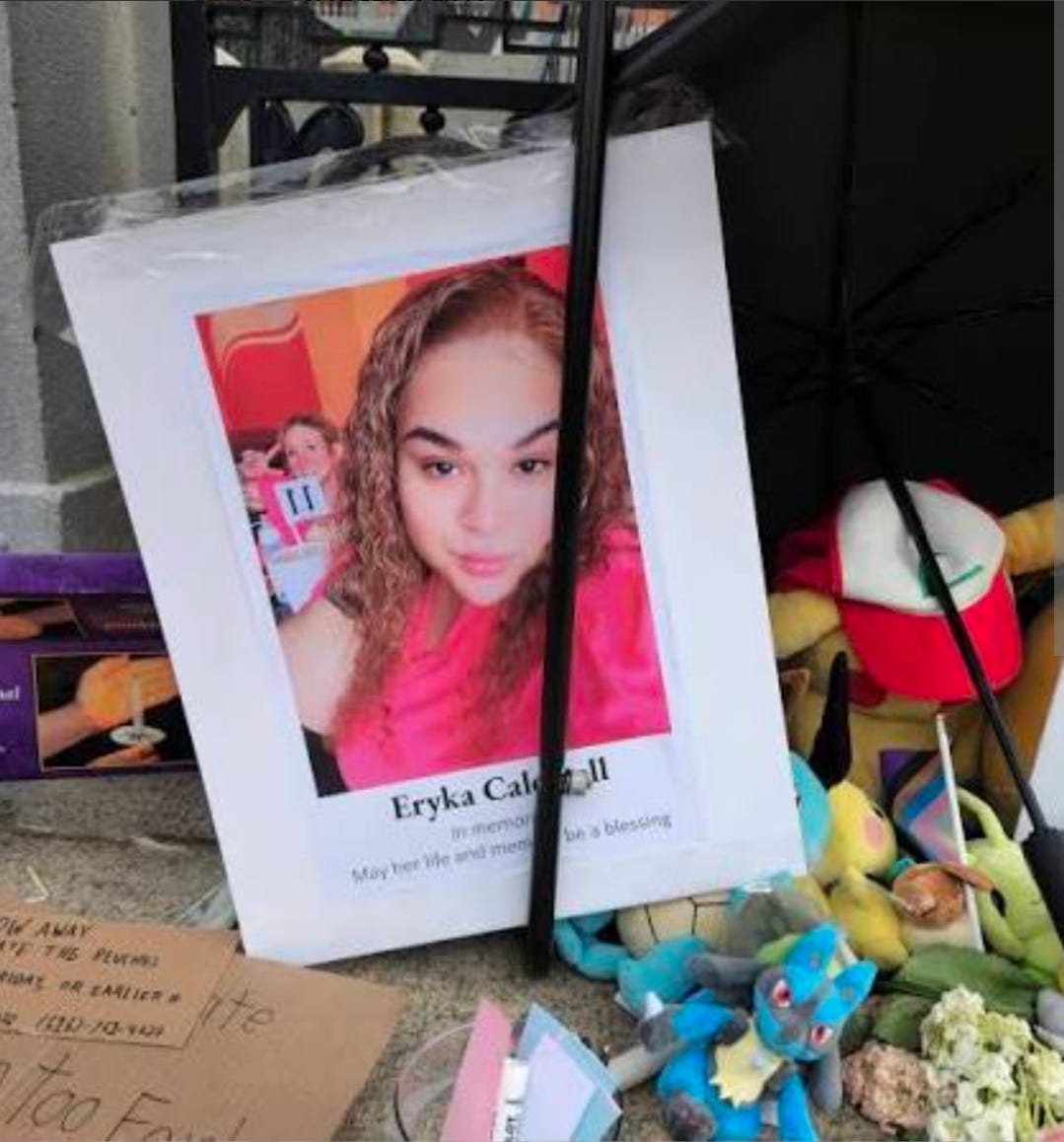
Eryka Caldwell was 41 years old, a Black trans woman, a daughter, a sister, a graduate, a neighbor, and a person whose life cannot be reduced to the violence that ended it. She had celebrated graduating from Bellevue University in 2023 and had recently moved into her Bushwick apartment, building a life that stretched far beyond the police report, the charge sheet, and the final morning when she was killed. A living memorial begins there, with the full person, because violence often narrows a life until the public remembers only the wound.
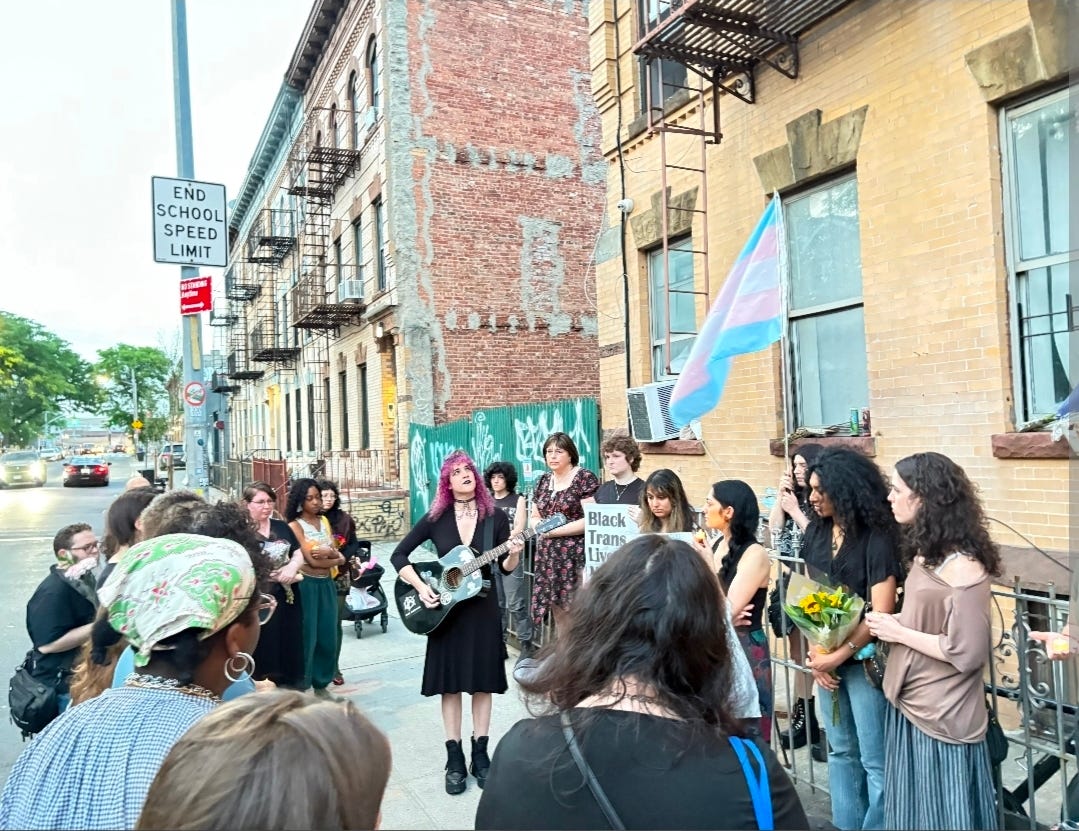
On Wednesday night, trans women, neighbors, friends, organizers, artists, and allies gathered in Bushwick to honor Eryka near the neighborhood where she had lived and died. They brought flowers, lit candles, stood beside trans flags, and placed her face where the public could see it. They spoke her name not as a headline, not as a statistic, and not as another entry in a growing list of trans women lost to violence, but as a person whose life deserved witness.
Eryka was fatally stabbed inside her Bushwick apartment on May 17. Police arrested 38-year-old Jonathan Fernandez at the scene, and he has been charged with murder and criminal possession of a weapon. News 12 reported that Fernandez was accused of killing Eryka inside their home on Cooper Street, and Them reported that her sister later said Eryka had previously hidden from Fernandez in domestic violence shelters. That detail belongs in the record because it shows what so many trans women already know: violence is not always sudden. Sometimes it circles, follows, survives the shelter, survives the move, survives the warning signs, and survives every attempt to get away.
Eryka’s death should not be treated as less urgent because officials and media describe it as domestic violence. That was one of the most important truths spoken at the vigil. Longtime activist Melinda Butterfield, who organized the gathering, said people had asked why the trans community would rally for Eryka if her death was domestic violence rather than explicitly anti-trans violence. Her answer was the answer the public needs to hold clearly: domestic violence against women and femmes is already reason enough to gather, and domestic violence cannot be separated from the social and political reality trans women are forced to survive.
That distinction matters because when a trans woman is killed by a partner, the public often tries to narrow the story until it becomes private. It becomes a “domestic dispute.” It becomes something inside an apartment, inside a relationship, inside someone else’s life. That narrowing is dangerous because it strips away the conditions around the violence: isolation, housing instability, transphobia, misogyny, economic vulnerability, fear of police, fear of being disbelieved, and the repeated failure of systems that are supposed to protect women before they are dead.
Eryka’s life deserves a wider frame than that. She was living in a city where trans women build community because the official systems are not enough. She was living in Bushwick, a neighborhood many trans people recognize as a place where they can see each other, move through the street, and feel less alone. She was living in a community that knows safety is not only about police presence or political statements. Safety is housing, healthcare, being believed, having somewhere to go, and someone noticing when danger is already close.
At the vigil, Taylor Brown, the trans director of New York City’s newly formed Mayor’s Office of LGBTQIA+ Affairs, said she saw parts of herself in Eryka. Brown spoke as a biracial Black trans woman who came to New York seeking education, gender-affirming care, safety, and acceptance. That moment mattered because it restored what violence tries to take away: connection. Eryka was not an abstraction. She was part of a shared story of Black trans women trying to live, study, heal, move, and build safety in a world that keeps making survival harder than it should be.
The vigil also held memory through music. Singer-songwriter Vi Viana performed in Eryka’s honor, including a cover of The Beatles’ “In My Life.” That song choice carried the room because memory was the center of the night. Not spectacle. Not performance. Memory. The fragile work of keeping someone present after the world has already tried to reduce her to how she died.
That is the heart of a living memorial. It does not only say that someone was killed. It says she lived. It says she had a face, a voice, a history, a softness, and a future people imagined with her. It says she should have been able to finish becoming whoever she was becoming. It says the community will not let the worst thing done to her become the only thing remembered about her.
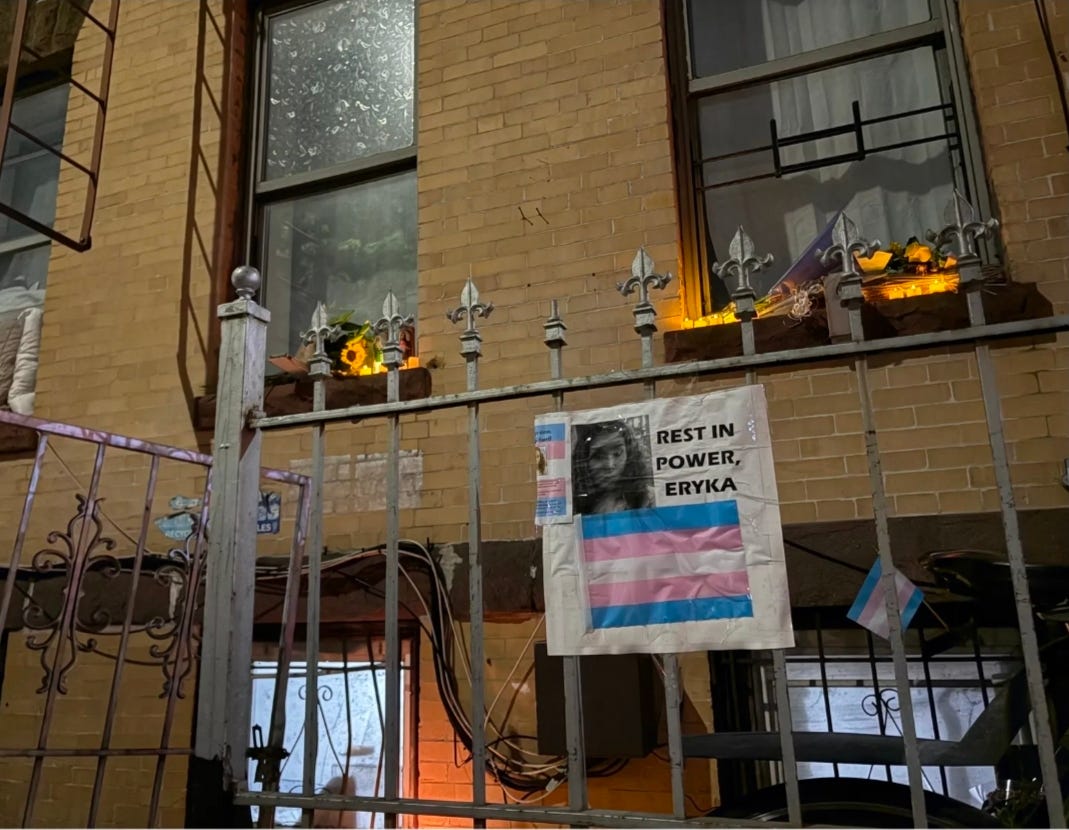
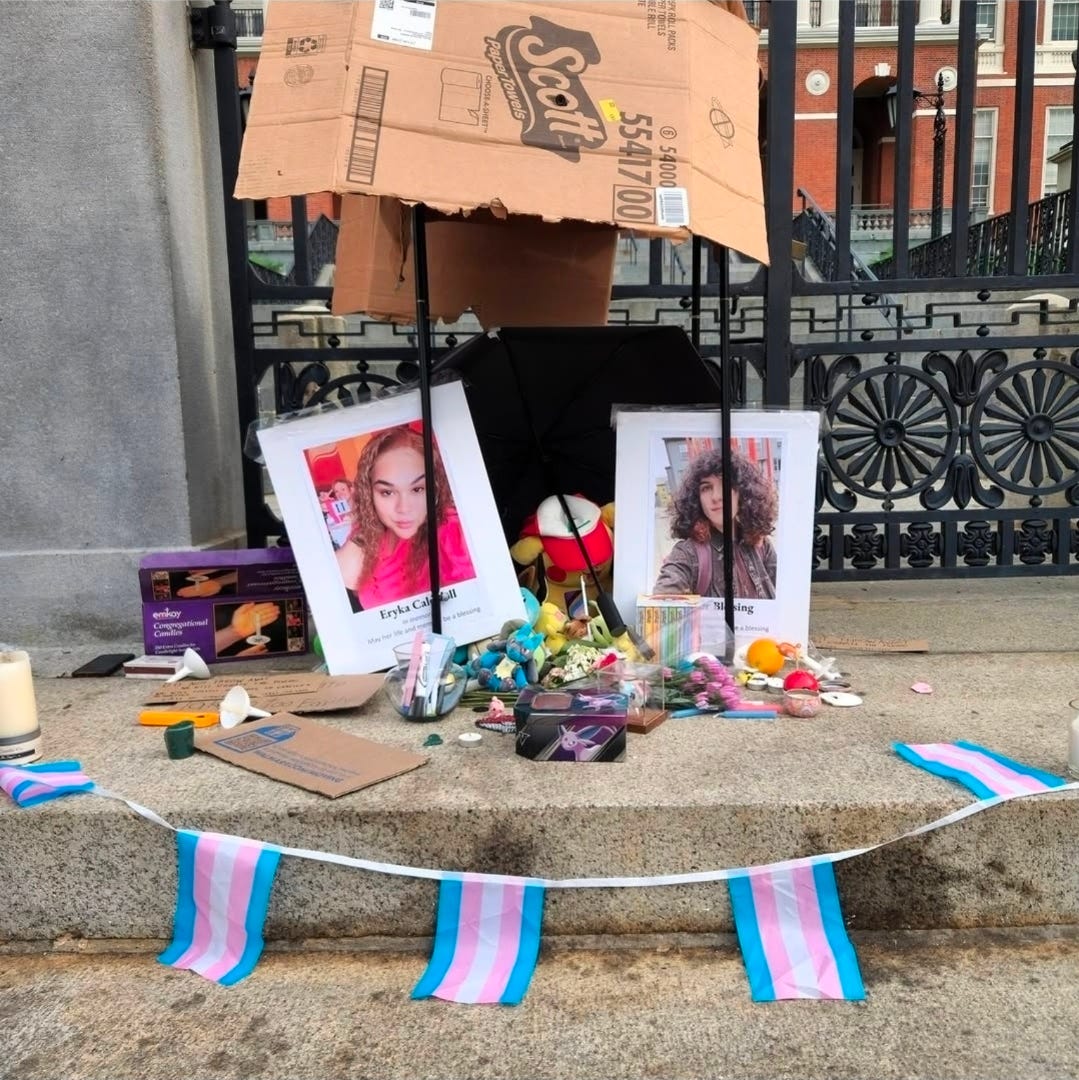
At the memorial site, flowers and candles had already been placed outside the apartment windows before vigil-goers added more. There were plush toys, handwritten signs, trans flags, framed photos, and small offerings of tenderness. These objects matter because they are how a community builds a record when institutions fail to hold enough of the truth. A candle says she mattered. A flower says someone came. A flag says she belonged. A photograph says look at her face and remember her.
The group also read the names of other trans people who have died under violent and tragic circumstances in recent weeks, including Luca RedBeard, Spot, Juniper Blessing, and Murry Foust.
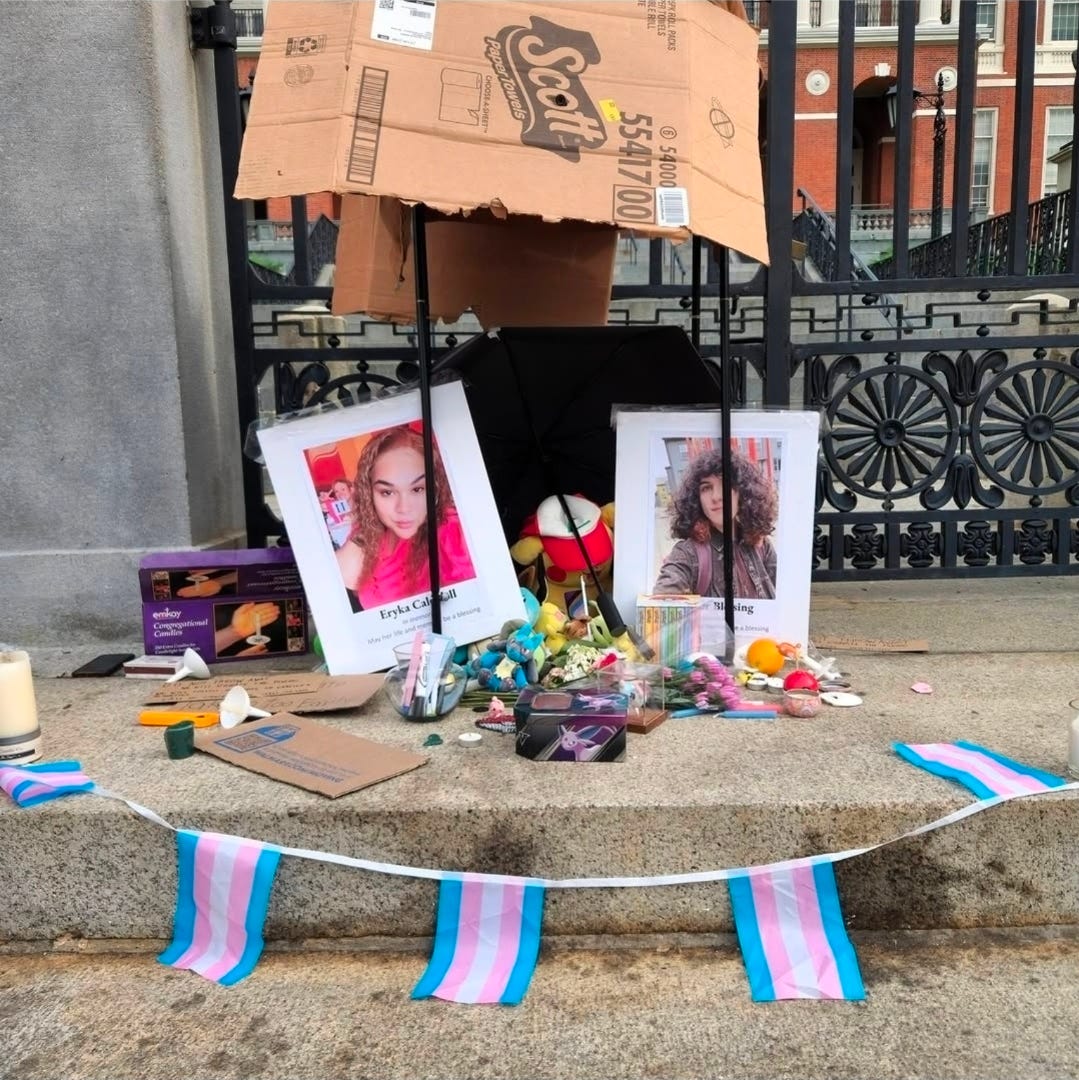
That list did not erase Eryka’s individuality. It placed her inside a wider grief that trans communities are being forced to carry over and over again. Each name is its own life. Each death has its own facts. Together, they reveal a pattern of trans life being threatened by violence, neglect, policy, isolation, and the constant demand that communities mourn faster than they can heal.
That is why living memorial work matters for Trans United. The record must hold more than death counts. It must hold the personhood that gets erased when trans women are misnamed, misgendered, sensationalized, blamed, or collapsed into a crime summary. It must hold the reality that domestic violence is not outside the fight for trans survival. It is one of the places where trans women are endangered, especially when housing, family support, money, healthcare, and legal protection are unstable or out of reach.
Eryka reportedly had sought safety before. Her sister said she had hidden in domestic violence shelters, and family accounts described a relationship marked by danger, prior calls to police, and earlier incidents involving Fernandez. That record should break something open in the public conversation because a shelter should not be a pause before a woman is found again. A move should not become temporary distance from danger. Calling for help should not become part of a record that only gets taken seriously after death.
What failed before May 17 must be part of the public record. Eryka’s story raises urgent questions about what protection was available, what protection was temporary, what protection was inaccessible, and what protection was too weak to keep her alive. For Black trans women, safety is too often discussed only after violence has already happened, while the systems meant to respond to abuse frequently fail women long before they fail trans women specifically.
Those questions do not turn Eryka into a policy example. They honor the fact that her life was worth protecting before people gathered with candles. They also force the public to confront the difference between mourning a trans woman after she is gone and building the support, housing, protection, and community infrastructure that might help keep trans women alive.
Bushwick’s grief also carries its own rupture. The neighborhood has long been understood as one of New York City’s visible trans cultural hubs, a place where trans women can walk, gather, recognize each other, and feel the small safety that comes from not being the only one. Eryka’s killing punctured that feeling. When violence happens in a place people associate with refuge, the harm spreads beyond one address. It reaches every person who thought, even briefly, that here, maybe, they could breathe.
That is why the turnout mattered. People came because grief needs witnesses. People came because the community needed to say Eryka’s name together. People came because no trans woman should vanish into the machinery of police language, court dates, and headlines. People came because remembering is not passive. It is a form of protection against erasure.
Closing image: Use the vigil flyer image taped to the pole.
Caption: A Bushwick vigil flyer invited neighbors and community members to honor Eryka Caldwell after her death.
The living memorial for Eryka Caldwell should say this clearly: she deserved love that did not hurt her. She deserved a home where she was safe. She deserved protection before the vigil. She deserved a future longer than 41 years. She deserved to be remembered as a full person, not only as a victim of fatal violence.
Her community gave her that dignity in Bushwick. Now the record has to keep it.
KEEP HER MEMORY PUBLIC
Eryka Caldwell’s life deserves to be remembered in full — not reduced to violence, not erased by domestic abuse framing, and not lost in the speed of another news cycle.
Trans United keeps these records public because trans women deserve memory, protection, housing, safety, and witness while they are alive.
Upgrade to a paid subscription to help keep this work going.
Earlier Report:
Eryka Caldwell, a Proud Trans Woman, Was Killed Inside Her Brooklyn Home

Before the public learned how Eryka Caldwell died, she had already told the world who she was. On Instagram, she described herself as a “Proud TS woman” and a “lover of everything sappy & mushy.” She shared pieces of…
Thank you, sister, for sharing your light with the world. Rest in Power. ❤️🔥💗💐🏳️⚧️🏳️🌈