

Idaho’s felony bathroom ban will not take effect exactly as written. But it has not been fully stopped.
U.S. District Court Judge Amanda K. Brailsford issued a preliminary injunction limiting enforcement of H.B. 752, the Idaho law that criminalizes transgender people for using restrooms consistent with their gender identity in government buildings and places of public accommodation. The law was scheduled to take effect July 1.
The ruling blocks enforcement in important situations. It also leaves a serious gap.
Under the order, enforcement is blocked when the restroom at issue is a single-user facility, when no single-user restroom exists on the same floor as the multi-user facilities, or when single-user restrooms on that floor are occupied or out of service.
That means the location and availability of a single-user restroom can still determine whether a transgender person is protected from enforcement.
If a single-user restroom is available on the same floor, a transgender person using a multi-user restroom consistent with their gender identity may still face risk under the law. That is the central practical danger left by the ruling.
H.B. 752 is among the harshest bathroom bans in the country. It reaches beyond schools and government offices into places of public accommodation, meaning private businesses and public-facing facilities can become sites of criminal enforcement. A first offense can be charged as a misdemeanor carrying up to one year in jail. A second offense can be charged as a felony carrying up to five years in prison. Repeated convictions could trigger harsher penalties under Idaho’s persistent violator statute.
The law turns ordinary bathroom use into a criminal risk calculation. It does not merely tell transgender people where the state says they may go. It threatens punishment based on which restroom they use inside a public building, a workplace, a store, a hospital, a campus, or a government office.
The ruling limits when the state can enforce that threat. It does not erase the threat itself.
That distinction matters for transgender people trying to move through ordinary public life. A person should not have to inspect a building floor by floor before deciding whether using the bathroom could put them at risk of arrest.
Under this limited injunction, protection may still depend on whether a single-user restroom exists nearby, whether it is on the same floor, whether it is occupied, and whether it is out of service.
That could matter in hospitals, airports, universities, shopping malls, convention centers, large retail stores, courthouses, libraries, municipal buildings, and state offices. Many of those spaces have both multi-user restrooms and single-user restrooms on the same floor.
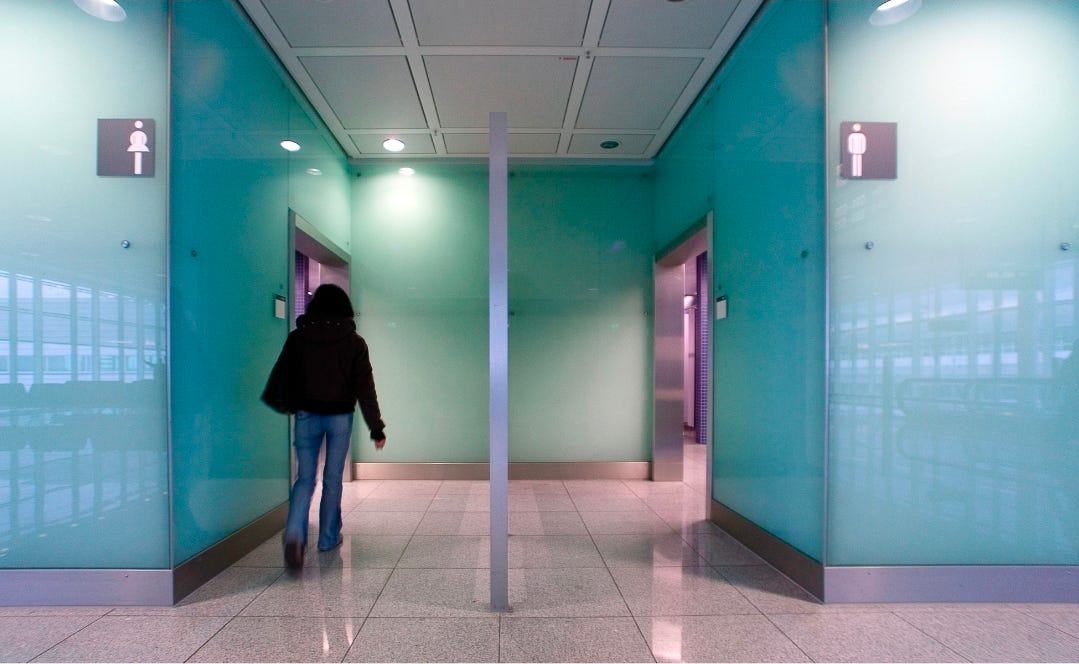
Those details matter because the ruling does not simply ask whether a trans person is using a restroom consistent with their gender identity. It asks what else is available nearby.
Single-user restrooms are often created for privacy, disability access, families, caregivers, and inclusion. They allow a parent to help a child, a disabled person to access a restroom with support, a caregiver to assist someone safely, or a trans person to avoid harassment when they choose privacy.
Under a ruling structured around whether those restrooms are available, that same infrastructure can take on a different function. A restroom added to expand access can become the condition used to separate trans people from everyone else.
That is the cruel practical turn in the injunction. The existence of an inclusive restroom can become the reason a transgender person is expected to use a separate option instead of the same public restroom as everyone else.
For trans people, that means the question is not only whether a bathroom exists. It is whether the state, a business, a security guard, a caller, or an officer later decides that a different bathroom was “available” at the time.
The court found serious problems with the law’s enforcement standards. H.B. 752 includes exceptions involving whether another restroom is “reasonably available” and whether someone is in “dire need,” but the court found those terms did not give clear enough guidance for enforcement.
The Idaho Chiefs of Police Association raised similar concerns, warning that the proposal created practical enforcement problems for officers in the field. The group said it was unclear how an officer responding to a call would determine whether someone was truly in “dire need,” leaving officers with an unenforceable standard.
If a law threatens criminal penalties, people need to know what conduct is prohibited and officers need clear standards for applying it. The court found H.B. 752 likely failed that test at this stage.
During oral argument, the state suggested that law enforcement could use DNA testing to determine a person’s sex for enforcement purposes. The court rejected that as a workable enforcement standard.
That exchange shows how invasive enforcement of this law could become. A bathroom law aimed at transgender people does not stay confined to a restroom door. It invites suspicion, investigation, and state scrutiny over who belongs in ordinary public space.
It also shows why vague enforcement rules are not abstract. When a law is unclear, the burden does not fall evenly. It falls on the person most likely to be questioned, watched, reported, or challenged.
For transgender people, that can mean being forced to explain themselves in a hallway, at a sink, outside a stall, near a security desk, or in front of strangers. It can mean someone else’s suspicion becomes the first step toward law enforcement contact.
The preliminary injunction still provides real protection in some settings. If a building has no single-user restroom on the same floor, enforcement is blocked for transgender people using restrooms consistent with their gender identity. That could cover many smaller businesses, restaurants, gas stations, and other public spaces without nearby single-user facilities.
But that protection is conditional. It depends on the building, the floor, and whether a single-user restroom is available at the moment a trans person needs to use the bathroom.
That creates an impossible public-life burden. A transgender person entering a building may have to scan signs, search hallways, ask staff, remember which floor they are on, determine whether a single-user restroom is occupied, and decide whether using a multi-user restroom could later be treated as a crime.
That is not ordinary access. That is a legal trap built into daily life.
Kell Olson of Lambda Legal told The Advocate that the lawsuit seeks to block the law as to all restrooms, but the preliminary relief is narrower. Olson acknowledged that enforcement scenarios remain possible while the case continues, including situations where a gender-neutral option is immediately available.
That clarification matters because the case is still moving. The preliminary injunction is not the final word. Plaintiffs may seek clarification or broader relief, and the court reserved other claims, including equal protection and informational privacy claims, for later stages of the litigation. A broader ruling could block more of the law later. The case is still moving, and an appeal is likely.
For now, H.B. 752 remains on the books with enforcement limited by the court’s order. That creates a dangerous middle ground for transgender Idahoans: the law is not fully enforceable, but it is not fully stopped.
That middle ground affects whether a trans person can enter a public building and use the restroom without calculating criminal risk.
That risk follows people through airports, campuses, hospitals, workplaces, stores, and government buildings — the ordinary places where public life happens.
It also affects the ordinary moments that rarely appear in legal filings: needing to use the bathroom during a long appointment, while waiting for a flight, during a shift, between classes, while caring for a child, or while trying to get through a public building without being noticed.
Trans people should not have to carry a legal map in their heads just to use the bathroom.
The court’s ruling recognizes that Idaho’s law has serious constitutional problems, especially around vagueness and enforcement. That is important. But the limited structure of the injunction means transgender people may still be exposed in places where a single-user restroom is available on the same floor.
The court limited Idaho’s bathroom ban, but it did not remove the criminal risk the law creates. For transgender Idahoans, the question of whether they are protected may still depend on the restroom layout of the building they are standing in.
Anti-trans laws do not only exist on paper. They create confusion, fear, and criminal risk in ordinary public spaces.
Trans United documents these laws because trans people deserve clear information, protection, and the right to move through public life without being turned into suspects.
Support this work by upgrading to a paid subscription.
Related report: Trans United previously covered Idaho’s H.B. 752 and the question at the center of the law: who gets investigated for looking trans?
Idaho’s Bathroom Ban Raises the Question It Cannot Answer: Who Gets Investigated for Looking Trans?

Idaho is preparing to make ordinary restroom use a criminal risk for trans people.
In many places I've been in California over 50 years have had single-use restrooms that say male or female either one can use it.