

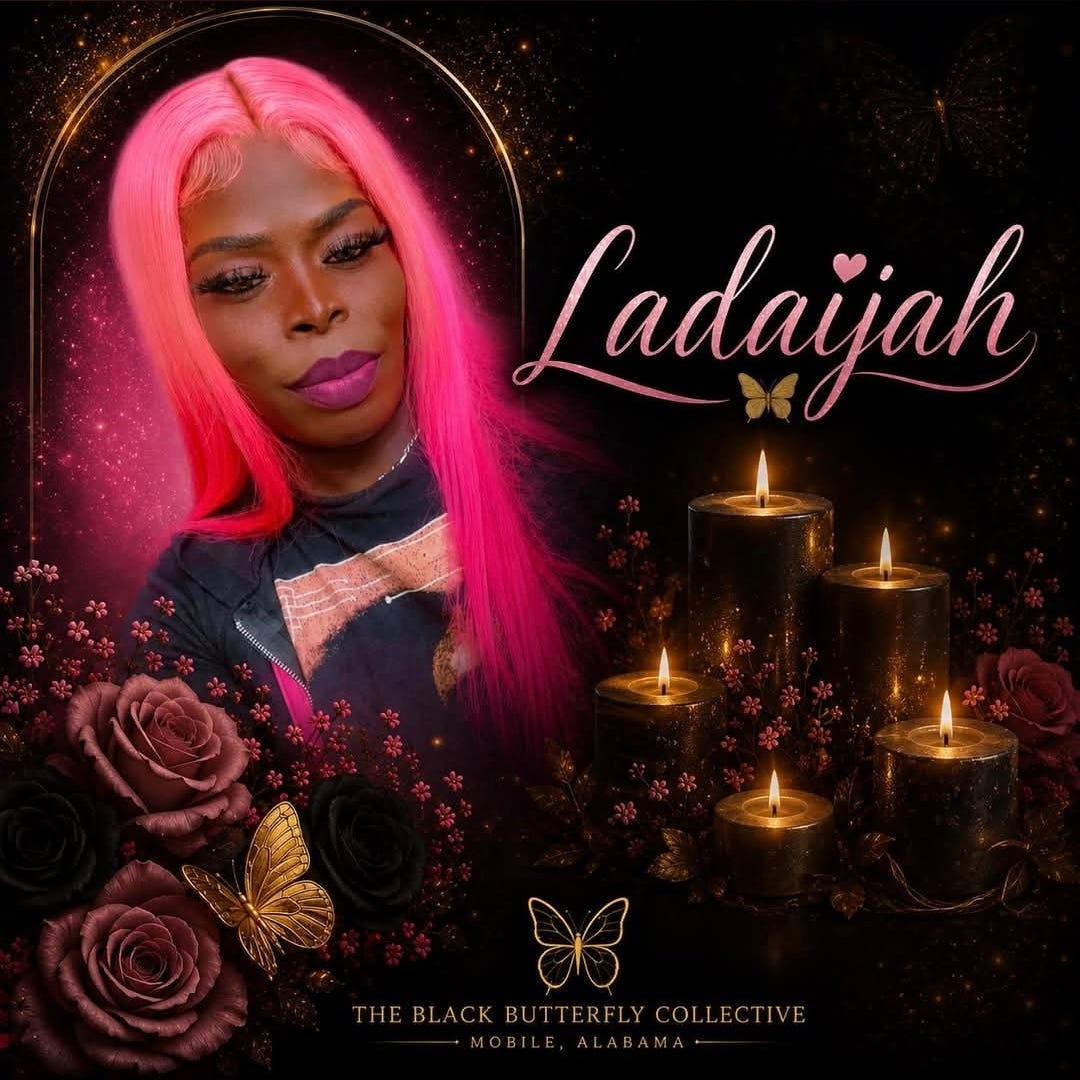
La’Daijah Walters was 32 years old when she was killed in Mobile, Alabama. She was a Black trans woman, born and raised in the city, remembered by people who knew her as vivid, funny, defiant, and fully alive.
The public still does not have a complete account of her death.
Mobile police reported that officers responded to a shooting at Plantation Apartments on Old Pascagoula Road at approximately 6:35 a.m. on June 22, 2026. According to the department’s release, officers found a victim with a fatal gunshot injury inside an apartment unit. Police said the case remained an active investigation and that no further information would be released at that time.
Community and LGBTQ reporting identified the victim as La’Daijah Walters, a Black trans woman from Mobile. That reporting also described a familiar harm in the aftermath of violence against trans people: official and local records can identify a victim in ways that do not reflect how she lived, how she was known, or how her community is grieving her.
That matters because misgendering after death changes how a killing is seen, counted, and remembered. It affects how violence is counted, how families and friends find coverage, and how researchers later understand what happened. It can turn a trans woman’s killing into another case that disappears inside categories that were never built to see her.
La’Daijah should not have to be recovered from the record by the people mourning her.
According to community reporting, La’Daijah attended Murphy High School in Mobile and spent time in Houston, Pensacola, and Atlanta. Her online life reflected ordinary joys and everyday presence: movies, family, jokes, memes, friendship, defiance, and the constant work of living openly in a world that too often punishes trans people for doing exactly that.
Friends and community members remembered her as someone who mattered beyond the circumstances of her death — a person whose life had texture, movement, humor, relationships, and future.
When a Black trans woman is killed and the first official accounts fail to name her accurately, the burden shifts to the community. Friends, advocates, and independent reporters have to correct the record while grieving. They have to prove what should have been treated with care from the start: that she was known, that she was loved, and that her identity was not optional information.
Police have not released a motive in La’Daijah’s killing, and the available record does not establish that her death has been charged or classified as a hate crime.
But her death still belongs in the documented pattern of violence against trans people because the aftermath shows a structural failure that follows too many cases: a trans person is killed, official language narrows the account, local reporting carries that narrowing forward, and community documentation becomes the only reason the public knows who was actually lost.
The danger grows when local misidentification meets federal data erasure.
The Williams Institute has warned that removing gender identity questions from the National Crime Victimization Survey weakens the ability of researchers, journalists, policymakers, and the public to monitor violence against transgender people. NCVS data has also shown that transgender people experience violent victimization at more than four times the rate of cisgender people.
Trans United has been documenting that same pattern for months: when systems stop asking who trans people are, the harm against them becomes easier to miss and harder to prove.
La’Daijah’s death shows what that looks like at ground level. Police released a narrow homicide record. Local reporting carried the official frame. Community sources had to identify her, name her accurately, and preserve the context that makes her death visible as part of the violence Black trans women face.
La’Daijah’s death also sits inside a broader Alabama record. Advocates and community reporters have documented multiple trans people killed or dying under suspicious circumstances in the state across recent years. Each case deserves its own documentation, its own verification, and its own care. Together, they point to a reality that should not be minimized: trans people in Alabama are living under conditions where violence, misidentification, and public neglect overlap.
The public often sees these deaths only after community members have already done the work institutions failed to do. Friends, advocates, and independent reporters are left to correct records, preserve memory, and carry grief that should never have been placed on them alone.
La’Daijah deserved better than a public account that had to be repaired after her death. She deserved to be remembered as she lived, not reduced to a category imposed by systems that too often fail trans people in life and death.
Her killing remains under investigation. Police have not released a motive, a suspect, or a complete public account of what happened inside that Mobile apartment.
Until that account exists, the public should at least be honest about who was lost.
Trans people deserve safety, housing, healthcare, and public systems that name anti-trans violence honestly.
Upgrade to a paid subscription to support Trans United’s work documenting anti-trans harm, preserving public memory, and helping keep trans people alive.
ARCHIVE CONTEXT
Trans United has previously reported on federal data erasure, state-level record changes, and the systems making violence against trans people harder to track:
The Trump Administration’s Erasure of Harm Against Trans People from the Internet — How Federal Data Changes Hide Violence

Have you noticed the sudden drop in media reporting about violence against transgender people? In recent months, fewer national stories have documented killings, assaults, and hate-motivated attacks targeting trans communities. That silence does not necessarily mean the violence has stopped. In fact, the explanation may lie elsewhere — in changes to the…
The State Can Still Erase Trans People After Death

A death certificate is supposed to be final. It is treated as neutral, administrative, unquestionable — the last official record of a life. It closes accounts, triggers insurance claims, settles estates, and fixes a person into the state’s archive.
THE TRUMP ADMINISTRATION IS BUILDING A CENTRALIZED SYSTEM TO TRACK TRANS PEOPLE ACROSS EVERY PART OF LIFE

The pressure many trans people are feeling right now is not coming from a single law, a single policy, or a single agency. It is coming from something more durable and far more difficult to reverse: the expansion of centralized identity syst…