

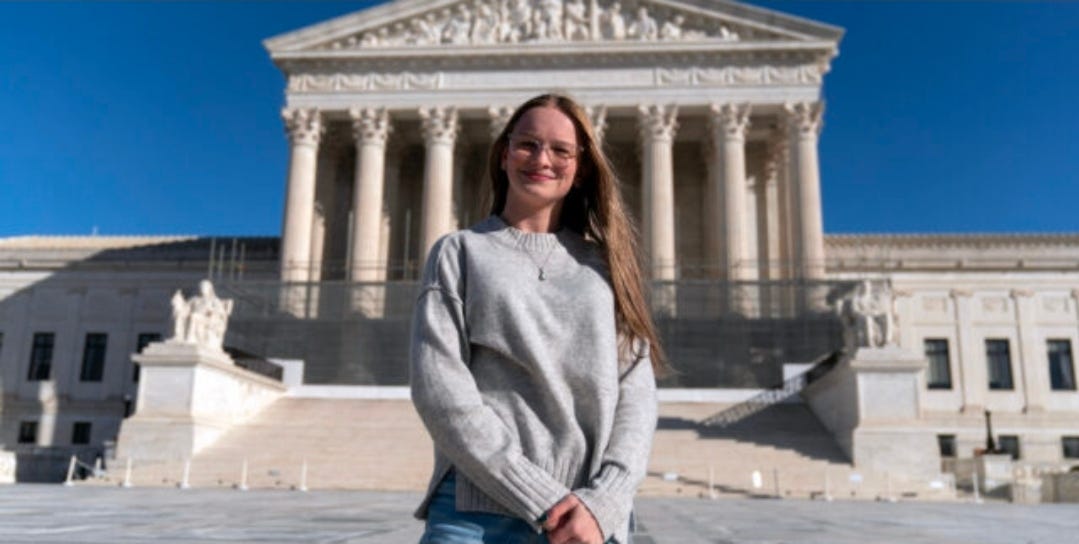
For trans girls, school sports are not an abstract legal category. They are practices, tryouts, bus rides, teammates, uniforms, ordinary routines, and the experience of belonging somewhere with classmates. On June 30, the final day of Pride Month, the Supreme Court ruled that states may deny that participation by defining girls’ and women’s school sports through what the majority called “biological sex.”
The ruling in West Virginia v. B.P.J. and Little v. Hecox does not require every state to ban trans athletes, and it does not order every school district to remove trans girls from girls’ teams. The opinion also states that it does not decide the separate question of whether schools may allow trans students to participate on teams matching their gender identity. That limit matters for accuracy, but it does not soften the harm of what the Court allowed.
But the decision still changes the legal ground beneath trans students. The Court held that Title IX allows schools to maintain women’s and girls’ sports teams defined by what the majority called “biological sex,” and it held that West Virginia and Idaho did not violate the Equal Protection Clause by limiting female teams to students the states classify as “biological females.” In practical terms, the Court gave states broader permission to exclude trans girls from school sports while treating that exclusion as consistent with federal law.
That permission carries consequences even without a nationwide mandate. Once the Supreme Court says states may draw the line this way, lawmakers, school boards, agencies, and legal groups backing anti-trans sports bans can use the ruling to defend bans and pressure schools away from inclusion. The immediate harm falls on trans students who now face a legal structure that can classify them before their individual circumstances are even considered.
A trans girl who wants to run track, play soccer, or join a school team can now be excluded by a state rule before anyone looks at her actual school, her medical history, her team, her sport, or whether her participation has harmed anyone. The point is not only that she may lose a roster spot. The point is that the state can treat her presence as a problem of classification before treating her as a student.
The majority framed the case around safety and competitive fairness. The dissent, written by Justice Sonia Sotomayor and joined by Justices Elena Kagan and Ketanji Brown Jackson, warned that the Court moved too quickly past the people affected. Sotomayor opened by centering B.P.J. as a transgender girl who sought the chance to do what many children love to do: play sports, and she criticized the majority for reaching the equal protection result while unresolved factual questions remained.
That dissent matters because the West Virginia ban did not arise from a documented crisis in the state’s schools. According to Sotomayor’s opinion, B.P.J. was the only transgender girl publicly identified in West Virginia who had sought to play sports with other girls during the five years the ban had been in place. The dissent also emphasized that the case involved a student who had never experienced endogenous male puberty and who argued that the state’s asserted safety and fairness justifications did not apply to students like her.
The West Virginia law replaced an individualized approach with a categorical exclusion. Before the ban, schools could evaluate participation through existing policies and consider whether a trans student’s participation would affect fair competition. The new law removed that process and made exclusion turn on the state’s classification instead of the student’s circumstances.
The Court upheld that structure under Title IX by reading the sports context differently from other anti-discrimination settings. The majority said Title IX, the Javits Amendment, and Title IX regulations permit schools to separate sports teams by what the majority called “biological sex,” and it rejected the argument that Title IX requires an exception for trans girls and women who have taken puberty blockers or hormones. For trans-inclusive schools, that holding narrows the federal protection available in school sports even as other Title IX questions remain outside the opinion.
The Court also rejected the argument that Bostock v. Clayton County controlled the result. Bostock held that firing someone for being gay or transgender violates Title VII’s ban on employment discrimination because of sex, but the majority said employment law and school sports present different statutory and factual contexts. Bostock survives, but this ruling makes clear that the Court will not automatically carry Bostock’s reasoning into every setting where trans students face exclusion.
For trans students, that distinction is not academic. Federal law may recognize anti-trans discrimination in employment while the Court now allows states to defend exclusion in school sports. A trans person can be protected in one public setting and left exposed in another, depending on how the Court defines the context and how much power it gives states to draw categorical lines.
The Equal Protection ruling deepens the consequence. The Court treated the West Virginia and Idaho laws as sex-based classifications and accepted the states’ asserted interests in safety and competitive fairness as important government objectives. It then held that the laws were substantially related to those interests, while also rejecting the argument that the laws should be treated as classifications based on transgender status.
The dissent warned that this approach cut off the factual process too soon. It argued that the Court should not have resolved the equal protection question without letting the record develop around whether the asserted justifications actually applied to the students before the Court. That warning is central to the harm, because a categorical rule can erase the facts of a student’s life before those facts are heard.
The danger for trans students is that the Court allowed the state to generalize. It did not require West Virginia to prove that B.P.J. created a specific safety problem, displaced another athlete in a legally meaningful way, or made competition unfair in the way the state claimed. For the majority, the classification itself was enough to sustain the law.
That is the legal structure trans students now face in states that choose exclusion. A school does not have to begin by asking who the student is, what sport she plays, what her medical history shows, or what evidence exists in her actual case. The state can begin with a category and let that category decide whether she belongs.
The majority’s sports analysis also gives anti-trans arguments more legal force by accepting a zero-sum theory of athletic participation. The opinion describes team membership, playing time, medals, and competitive opportunities as resources that can be displaced when athletes compete. That framing has already been central to campaigns against trans-inclusive school sports policies, and the ruling gives exclusionary states more language to cite.
The formal limits of the ruling remain important. The Court did not hold that inclusive states must exclude trans athletes, and it did not decide the separate question of whether schools may allow trans girls and women to participate on girls’ and women’s teams. States that choose inclusion still have room to defend those policies, but they now do so against a Supreme Court opinion that strengthens exclusionary state laws.
Legal permission is not the same as safety for the students affected. A school district may read this ruling and decide that supporting trans students carries too much risk. A state lawmaker may treat the opinion as permission to introduce a broader ban. A parent group, agency, or legal organization may use the Court’s language to challenge inclusive policies in places that still protect trans students.
The majority wrote that student-athletes on both sides want to play, that their desire warrants respect, and that no student should be ostracized or vilified. That language does not undo the consequence of the ruling. A trans student can be described respectfully in theory while still being removed from a team in practice, and the gap between respectful language and actual exclusion is where the harm sits.
The students affected by this decision are not legal abstractions. They are children and young adults trying to go to school, make friends, join teams, and move through public life without being treated as political emergencies. The ruling gives states more authority to decide that their participation can be excluded before their individual lives are considered.
The danger is not that the Court commanded every school in America to exclude trans students today. The danger is that it allowed states to treat exclusion as lawful, ordinary, and defensible. For trans girls entering school under those laws, participation can now be turned into a state decision before they are treated as students.
Trans students deserve schools that protect their dignity, safety, and right to participate.
Support Trans United’s work documenting anti-trans policy, legal attacks, and the systems making trans people less safe.
Upgrade to support the work ↓
I don’t understand why it’s anyone’s beeswax.
I am struggling to understand why even the funding was provided to go before the highest court all so that a (relative) handful of children, already victimized by their own bodies, could be prevented from going out and playing on a team. The amount of hate and prejudice that went into this is shocking.