

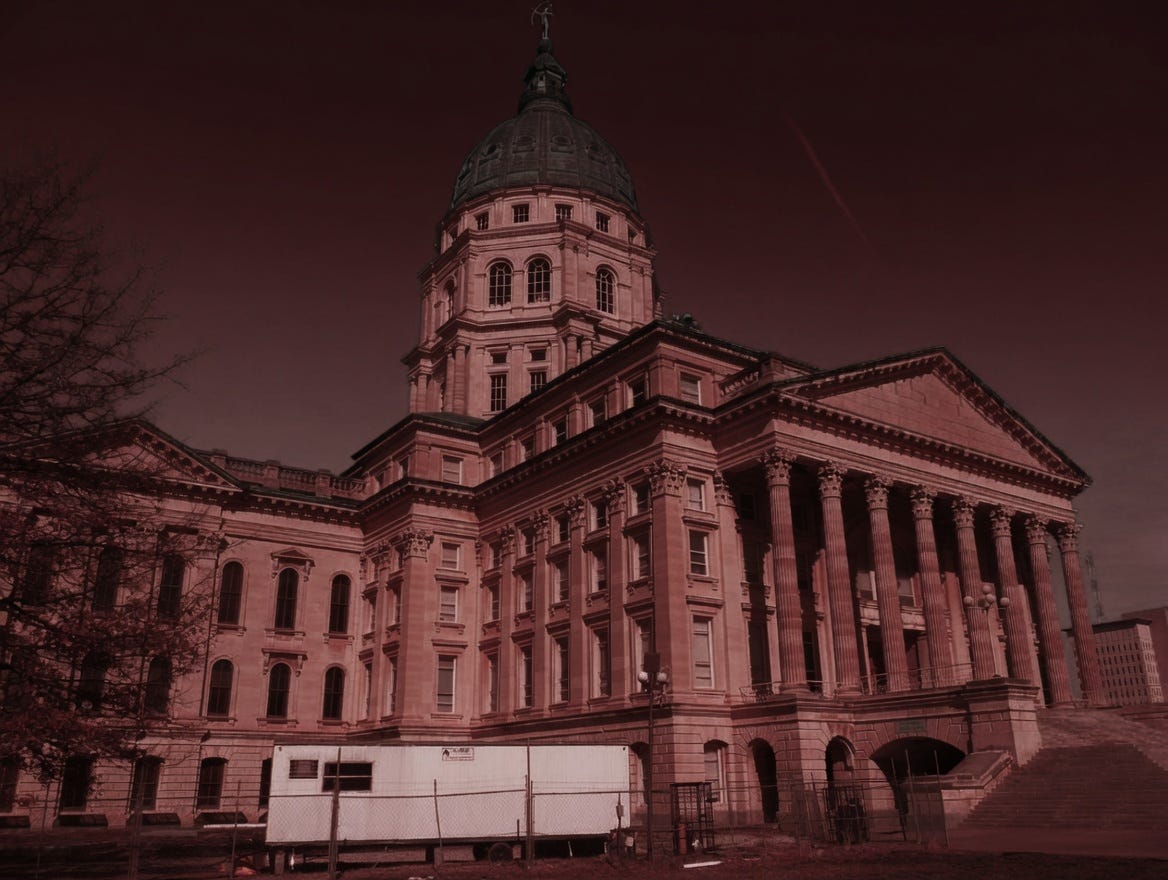
Kansas SB 244 is not only an ID law. It is a state classification system that can turn trans identity into an enforceable category across public life.
The public fight has centered on the visible parts of the law: driver’s licenses, birth certificates, gender markers, and restroom access. Those are real harms, but they are also the surface layer. The deeper danger is that Kansas is making sex assigned at birth the controlling state record, then attaching that record to documents and systems trans people are forced to use to survive.
That distinction matters. The government already holds records. It has birth records, DMV records, court records, school records, health paperwork, voter files, benefits systems, police systems, and jail systems. The threat is not only that information exists somewhere in a file. The threat is what happens when the state turns that information into a category that can be recognized, enforced, and carried through ordinary checkpoints.
Kansas SB 244 requires state-issued records to reflect sex assigned at birth instead of gender identity. ACLU Kansas says driver’s licenses with gender markers inconsistent with sex assigned at birth became invalid as of February 26, 2026, with no grace period. The group also says the Kansas Department of Revenue must provide written notice to affected license holders, and affected people have been directed to surrender credentials to the Kansas Division of Vehicles.
Reuters reported that Kansas invalidated driver’s licenses and birth certificates for more than 1,000 transgender residents under the law. The lawsuit challenging SB 244, Doe v. State of Kansas, also argues that the law bars trans Kansans and people born in Kansas from updating gender markers on state-issued birth certificates and driver’s licenses in the future.
That is not a narrow paperwork dispute. It is a state decision to force trans people into a record system that denies who they are and makes that denial usable elsewhere.
A document mismatch becomes active when a trans person is forced to prove who they are in a system that treats the state’s record as more real than the person standing there. That can happen during traffic stops, medical intake, school paperwork, shelter access, voting, employment verification, court appearances, or custody. In each setting, the same problem follows them: the state has made their identity administratively disputable.
This is why classification is different from scattered data. Records sitting in separate systems can already create danger, especially when officials are hostile to trans people. But a state-enforced classification makes the danger easier to repeat. Once the category exists, each checkpoint does not need to invent a new rule. It only has to apply the state’s existing one.
That is how a fight over gender markers becomes a system for controlling access to public life.
SB 244 also moves beyond documents into public-space enforcement. The ACLU says Doe v. State of Kansas challenges the law after it immediately invalidated driver’s licenses of transgender people across Kansas and authorized lawsuits against people suspected of being transgender for using the “wrong” restroom in government buildings.
That provision matters because it shows the law is not confined to files, counters, and records offices. It invites suspicion into public buildings. It makes restroom access a place where trans people can be watched, challenged, and exposed. It turns ordinary presence in government space into a possible legal conflict.
Kansas does not need to announce a formal trans registry for this structure to cause registry-like harm. A registry is not dangerous only because a list exists. It is dangerous because a label changes what happens to a person once the label is recognized by systems with power. A no-fly designation matters because it changes what happens at the airport. A gang database matters because it can shape surveillance and policing. These systems are not identical, but they show the same principle: classification becomes dangerous when it controls access, movement, scrutiny, and punishment.
Under this structure, privacy is not secrecy. For trans people, privacy is protection against forced exposure by the state. It is the difference between a document that helps someone move through life and a document that places them at risk. It is the difference between records existing in government systems and records being turned into an enforcement tool.
The state’s language may sound administrative: accurate records, biological sex, documentation standards, government consistency. The lived effect is not administrative. When official documents are made to contradict a trans person’s identity, ordinary systems become exposure points. Identification checks, school records, hospital paperwork, bathroom rules, voting requirements, and custody records can all become places where the state’s classification is used against them.
Kansas also matters beyond Kansas because this structure can be copied. Other states do not need the exact same language to reproduce the same mechanism. They only need to make sex assigned at birth the controlling state record, invalidate documents that reflect gender identity, block future corrections, and attach that classification to the public systems where documents are checked.
That is why the fight cannot stop at gender markers. The marker is the visible fight, but the classification system is the larger structure underneath it. Once the state forces trans people into an enforceable category, the harm can travel through every system where documents are checked.
Kansas SB 244 shows how anti-trans policy moves from rhetoric into infrastructure. It starts as a fight over words on a license or birth certificate, then becomes a system that follows trans people into public life. By the time that system is normalized, the state does not have to argue about whether trans people exist. It can make the official record deny them and let the paperwork carry the harm forward.
Trans people should not have to navigate public life under a state classification system built to expose, deny, and control them. Under SB 244, the danger is not limited to one license, one birth certificate, or one restroom rule. The danger is that state records can be turned into tools that make trans people administratively disputable wherever identification, access, or official recognition is required.
Once that category is integrated across state systems, anti-trans policy no longer stays in speeches or campaign language. It becomes part of the paperwork, databases, IDs, and checkpoints that decide how trans people move through public life.
That is the classification trap.
Trans people should not have to live under state classification systems built to expose, deny, and punish them.
Trans United documents these attacks because anti-trans policy does not stop at the headline. It moves through the records and institutions trans people are forced to use every day.
Upgrade to support Trans United and help keep this documentation going.
Related context:
This classification fight connects to a larger record-erasure pattern Trans United has documented before: when the state controls the official record, trans people can be denied, misgendered, or erased even after death.
The State Can Still Erase Trans People After Death

A death certificate is supposed to be final. It is treated as neutral, administrative, unquestionable — the last official record of a life. It closes accounts, triggers insurance claims, settles estates, and fixes a person into the state’s archive.