


AB Hernandez did what athletes are told to do. She trained, competed, cleared the marks, jumped farther, jumped higher, and won. At the California Interscholastic Federation Southern Section Division 3 finals, Hernandez finished first in the high jump, long jump, and triple jump. Her performance should have been the center of the story: a 17-year-old athlete won three events and moved closer to finishing her high school track career with another state title.
Instead, California’s athletic system made her victory conditional. Because Hernandez is trans, CIF’s pilot entry program allowed cisgender girls who finished behind her to receive first-place recognition too. In the long jump, Gianna Gonzalez reportedly stood alone on the first-place podium even though Gonzalez finished more than a foot behind Hernandez’s mark. In the high jump, Hernandez shared the top podium spot with Gwynneth Mureika despite beating her by two inches. In the triple jump, Hernandez finally stood alone in the top spot, but Malia Strange still received a gold medal as a co-winner even though Hernandez jumped nearly two feet farther.
That is not fairness. It is a system telling a trans girl she can win, but her win still has to be softened for everyone else. The policy does not erase Hernandez from competition, but it dilutes the public meaning of her victory. A trans athlete can do everything right, follow the rules, outperform the field, and still be told that winning is not enough to let her stand fully in the result.
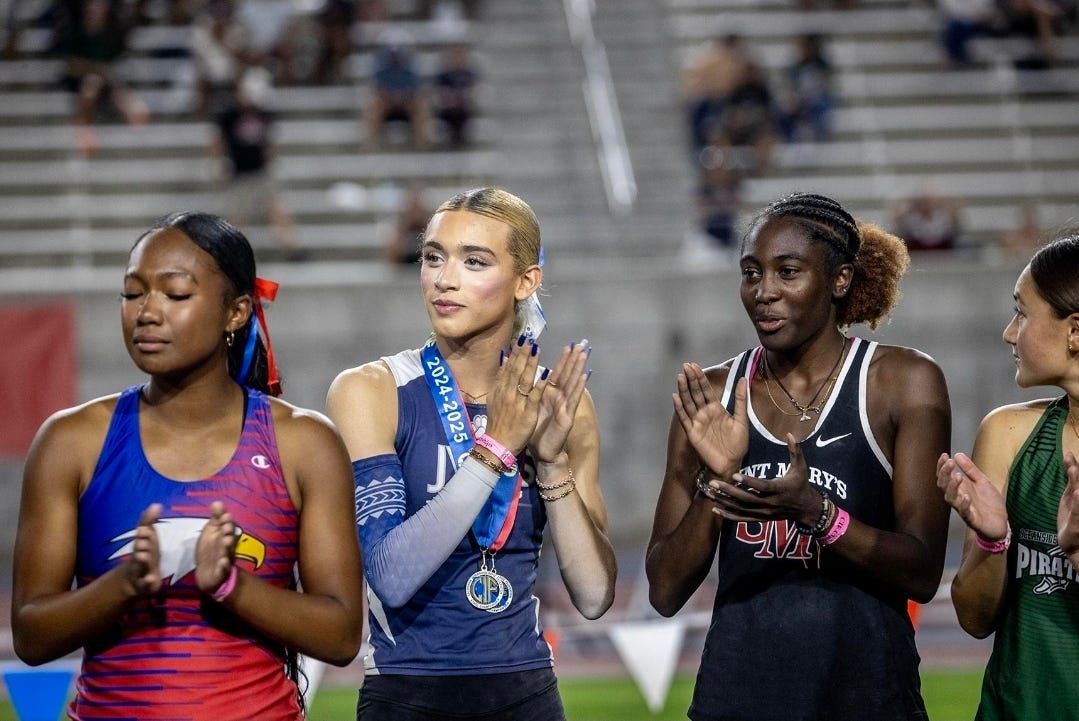
Hernandez is not being punished because she failed. She is being punished because she succeeded. That is what anti-trans pressure does to trans youth in public life. It does not wait for them to lose; it waits for them to win, then turns the win into a crisis. The moment a trans girl stands on the podium, adults rush in to question the podium, question the rules, question her body, question her right to belong, and question whether her success should be allowed to count the same way as everyone else’s.
The cruelty is not hidden. Hernandez has been placed at the center of protests, media attention, political threats, and public scrutiny while she is still a teenager. Anti-trans groups have organized around her participation. Some spectators reportedly wore “Protect Girls Sports” shirts. Some rivals reportedly avoided her. Some skipped the podium. The message was not subtle: a trans girl winning in public would not be treated as ordinary athletic success, but as something adults needed to manage.
That is the part people keep trying to dress up as fairness. Fairness does not require turning a teenage girl into a public target. Fairness does not require making a first-place finisher share recognition with athletes who finished behind her. Fairness does not require adults building a special rule around the discomfort caused by a trans girl’s victory. This was never just about event results; it was about whether a trans athlete is allowed to win without the system immediately creating a workaround for the backlash.
Hernandez’s mother, Nereyda Hernandez, named the pressure clearly. She said outsiders were using her daughter for campaigns and pretending to be connected to the school community. Her warning matters because it cuts through the lie that this is simply a local sports issue. A teenage trans athlete has been pulled into a national anti-trans machine that needs visible targets to keep itself moving.
Donald Trump previously targeted Hernandez without naming her and threatened to withhold federal funding if she was allowed to keep competing. Anti-trans political groups have used her participation to push their message. Local officials and national media have helped keep the spotlight on a teenager whose only offense was competing under California law and CIF rules. Hernandez’s mother said her daughter has been doing this sport since freshman year and is not doing anything wrong. That is the center of the article: AB Hernandez is not breaking the rules, stealing a sport, or creating the backlash. She is an athlete competing in the events she trained for.
The backlash is being created by adults who cannot tolerate a trans girl being good enough to win. The CIF policy tries to sit in the middle of that pressure by allowing trans girls to compete while giving cisgender girls a separate path to first-place recognition when a trans athlete wins. That may be presented as compromise, but the effect is clear: it makes a trans girl’s victory less complete because she is trans.
That is not inclusion. It is conditional acceptance. It tells trans athletes they can be present, but not fully honored. They can compete, but their success will be treated as a problem. They can win, but the institution may still make room for the backlash before it makes room for their dignity.
This is how anti-trans politics moves through youth sports. It does not only attack access; it attacks recognition, belonging, and the moment after the win, when an athlete should be allowed to breathe, celebrate, and stand in what she earned. Hernandez’s performance was not unclear. She beat the field. The policy stepped in after the result and made her win carry the weight of anti-trans politics. That is the injustice: not a trans athlete competing, but an institution deciding that her success needed to be softened for the people who could not accept it.
AB Hernandez won three events, and California forced her victory to share space with the discomfort of people who did not beat her. A trans girl showed up, competed under the rules, and won fair and square. The system still made her pay for being visible, talented, and trans.
Support the work that keeps trans youth centered when institutions try to make their dignity conditional.
Trans United exists because trans kids and trans athletes are being targeted in schools, sports, healthcare, courts, and public policy. These attacks do not stay abstract. They land on real young people who are trying to live, learn, compete, receive care, and grow without being turned into political weapons.
Help support reporting that names the harm clearly, refuses anti-trans neutrality, and keeps trans youth at the center of the record.
Subscribe to Trans United ↓
She’s a great woman. And she deserves all her medals. Shes a great athlete. They are not acknowledging her is prejudice. That’s not acceptance. Using protect women’s sports to hide your transphobia. AB Hernandez is a winner. And I hope she keeps competing in College. I’m behind her. She’s been competing. I bet she didn’t win all her matches but we hear about the matches she does win. In my opinion this isn’t a contact sport. She’s competing I see this as sport competition . She deserves all of her accomplishments. And I’m glad you’re finally talking about this. And writing about this.
Sorry to be that person but I think there’s one mistake in the piece - naming Hernandez instead of Gonzalez. “Gianna Gonzalez reportedly stood alone on the first-place podium even though Hernandez finished more than a foot behind Hernandez’s mark.”