

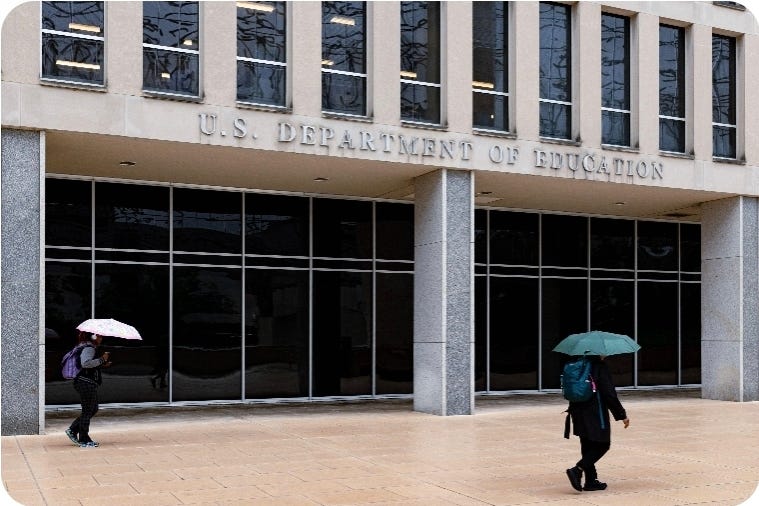
The U.S. Department of Education has opened Title IX investigations into three Michigan school districts over allegations involving transgender students in sports and locker rooms, escalating the Trump administration’s use of federal civil-rights enforcement against schools that recognize trans students’ gender identity.
The districts named are Ann Arbor Public Schools, Monroe Public Schools, and Chippewa Valley Schools. According to the department, the investigations involve claims that students were allowed to participate in school athletics or use locker rooms based on gender identity rather than sex assigned at birth.
That is the administration’s framing. The larger issue is what the federal government is doing with it.
Title IX was written to prohibit sex-based discrimination in education. The Trump administration is now using that law as a pressure tool against districts accused of including trans students in school life. The message to schools is clear: if a district allows trans students to participate, dress, compete, or move through campus according to gender identity, the federal government may treat that inclusion as a civil-rights violation.
That turns the purpose of Title IX upside down. A civil-rights law meant to protect students from discrimination is being used to investigate schools that are trying to protect trans students from exclusion.
The Education Department’s Office for Civil Rights says Ann Arbor allegedly allowed a transgender student to compete on a girls’ volleyball team. It says Monroe required its girls’ team to compete against and share locker-room space with a team that included a transgender student. It says Chippewa Valley permitted a student to use a locker room based on gender identity.
Those allegations have not been fully tested in a public process. But the department’s announcement already did what these investigations often do: it turned trans student inclusion into a national political signal before the districts had a full chance to respond.
That matters because the pressure does not land only on administrators. It lands on trans kids.
When the government announces investigations like this, it tells trans students that ordinary school participation can become a federal case. A volleyball roster, a locker room, a team assignment, or a district policy becomes the entry point for national enforcement. The child is turned into the controversy. The school becomes the warning sign.
That is how policy intimidation works. It does not need to remove every protection on day one. It creates fear around protecting students at all.
The Trump administration has made schools one of the central fronts of its anti-trans agenda. Athletics, bathrooms, locker rooms, school records, healthcare, grants, and federal recognition have all become tools for narrowing where trans students can be seen, named, protected, and included.
The administration is not merely arguing about sports policy. It is building an enforcement theory that treats gender identity recognition itself as suspect.
That distinction matters. If the story is reduced to “trans athletes,” the frame becomes too narrow and too easily captured by the administration’s language. The actual story is broader: the government is using Title IX investigations to pressure schools away from trans inclusion.
The Education Department’s statement described gender-identity-based participation as unsafe and unlawful. That language is not neutral. It is part of the administration’s theory that recognizing trans students creates harm by itself. Once that premise is accepted, every trans student who asks to participate in school life can be framed as a threat to someone else.
Trans students are not the controversy. Federal targeting is the controversy.
Chippewa Valley reportedly said it had not yet received the complaint and learned of the investigation through the media. The district said it would cooperate and remained committed to a safe, supportive, and respectful learning environment for all students. Ann Arbor and Monroe did not immediately respond in the source report.
That detail matters. A district can learn through media coverage that it has become part of a federal enforcement campaign. The public political effect begins before the legal process fully develops.
For trans kids, the damage is not limited to the final outcome of an investigation. The announcement itself can isolate students, inflame local hostility, and pressure schools to retreat from inclusion. It can make administrators more cautious, parents more fearful, and students more exposed.
School is not optional for children. Students need classrooms, teams, bathrooms, locker rooms, records, teachers, and peer environments. When government power is used to make those spaces unstable for trans students, the harm reaches daily life.
The administration’s Title IX theory also places districts in a trap. Schools may face federal pressure for recognizing gender identity, while students and families may face harm when districts refuse recognition. The result is a political squeeze in which trans students’ basic participation becomes the bargaining chip.
That is not child protection. That is federal escalation.
The Michigan investigations also arrive in a national climate where individual trans students have been singled out by politicians and right-wing media. AB Hernandez, a California student athlete, has already been targeted publicly by President Trump after competing under California Interscholastic Federation rules. Her mother, Nereyda, has defended her daughter by saying the attacks are not really about fairness in sport but about erasing transgender children.
That context should not replace the Michigan story, but it shows the pattern. Trans kids are being turned into symbols for adult political campaigns. Their names, teams, bodies, and school records become vehicles for a national message: comply with anti-trans policy or become the next example.
The central question is not whether every school has the same sports policy. The central question is whether the federal government should use civil-rights enforcement to threaten schools that include trans students in ordinary school life.
A government that treats trans participation as a violation is not protecting students from discrimination. It is redefining discrimination so that trans inclusion becomes the alleged harm.
That reversal carries consequences. It tells trans students that access is conditional. It tells schools that support may be punished. It tells families that a child’s presence in a locker room or on a team can become a federal investigation.
Title IX should not be used as a weapon against trans kids. School districts should not be pressured into abandoning students because the government has chosen to turn gender identity into an enforcement target.
The issue is not a “fairness debate” detached from power. The issue is federal power being used to make trans students harder to recognize, protect, and include.
When the government targets schools for allowing trans students to participate, the message reaches far beyond Michigan. It reaches every trans kid wondering whether school will be a place of belonging or another place where adults turn their existence into a case file.
Federal investigations like this do not just pressure school districts. They make trans kids easier to isolate, exclude, and target.
Upgrade to a paid subscription to support documentation of these fights because trans students deserve safety, recognition, housing, healthcare, and survival support before institutions turn their lives into political battlegrounds.